
Vase with Red Poppies: Story, Meaning & Brushwork
In the spring of 1886 Vincent van Gogh left Antwerp for Paris and moved into his brother Theo’s apartment on the Rue Laval. He was thirty-three, his eyesight troubled by the fumes of Antwerp’s harbour, and his palette still leaning on the browns and greys of the Dutch potato-eaters he had painted the year before. Paris changed that within months.
He had arrived to study at Cormon’s studio, but what reshaped his painting was not the classroom. It was the shop windows of colour merchants, the Impressionist canvases he saw for the first time, and the sheer competitive pressure of a city where painters he admired were already working in pure, unmixed pigment. Van Gogh needed practice, and flowers were cheap, patient models that did not charge for sittings.
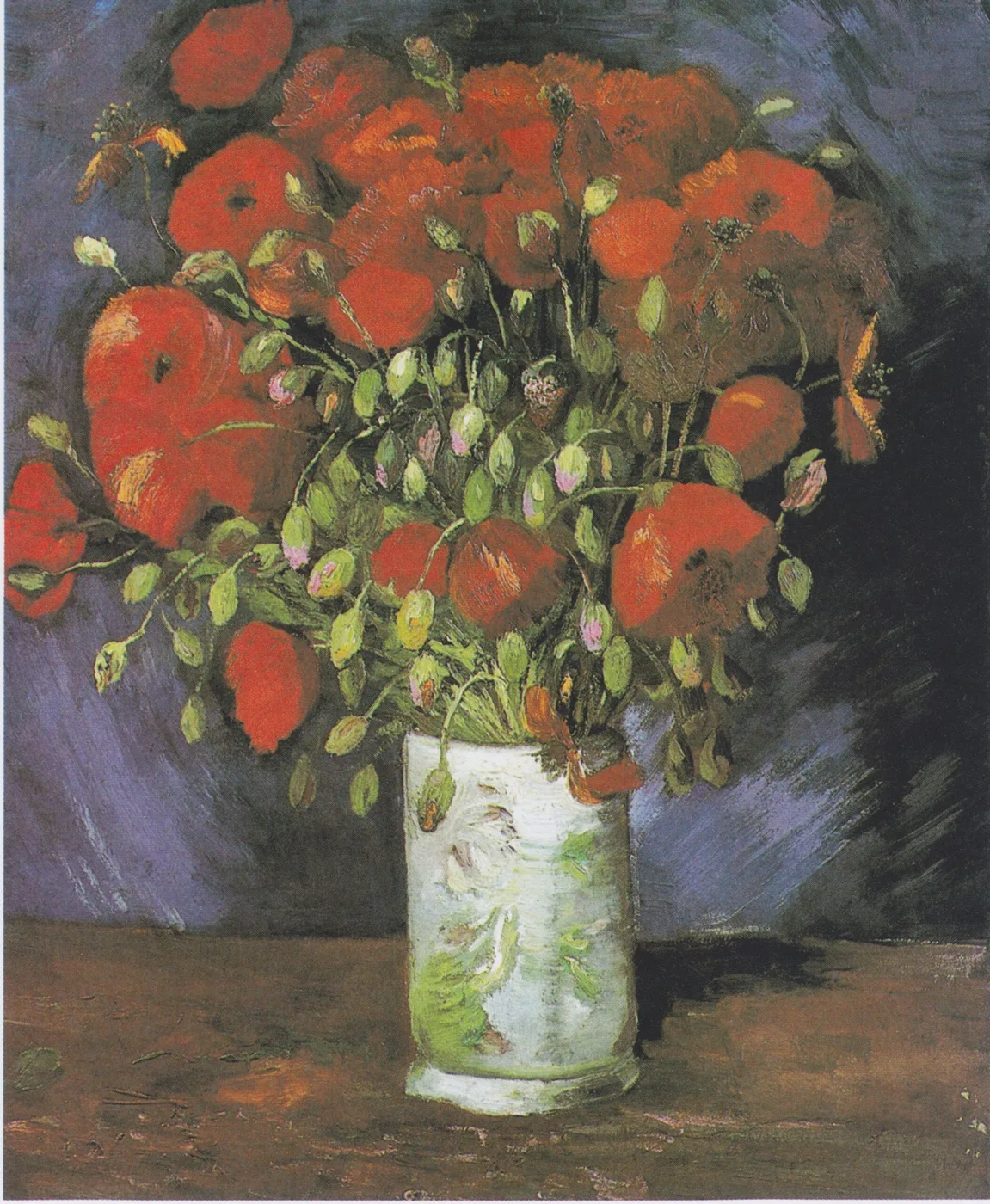
Through that first Paris year he painted bouquet after bouquet: sunflowers, roses, fritillaries, and the red poppies gathered here. Vase with Red Poppies, painted in 1886 and now in the collection of the Wadsworth Atheneum Museum of Art in Hartford, belongs to that run of studies. It is a working canvas, made by a painter teaching himself to see colour rather than describe it.
A Bouquet Pushed to the Edge of the Frame
The painting is small, just 46.5 by 56 centimetres, and the flowers fill nearly all of it. A pale, slightly greenish vase sits low in the composition, almost cropped at its base by the edge of a bare wooden table, while the poppies rise and spread until they nearly touch the top and both sides of the canvas.
The blooms themselves are irregular and a little battered, the way cut poppies actually sit in a jug within a day of picking: some petals still cupped, others already splitting and curling back. Van Gogh has not tidied them into a formal arrangement. They lean at different angles, a few reaching out past the main mass toward the right, one head drooping low over the rim of the vase.
Threaded through the red is a haze of thin green stems and unopened buds, dozens of them, some tipped with small pink and white blossoms that read almost as static against the heavier poppy heads. This tangle of stalks does most of the quiet work in the picture, filling the space between one bloom and the next so the red does not sit as isolated blocks of colour.
Where the Red Meets the Blue
The background is a dark, brushy violet-blue, darkening further into near black on the right-hand side behind the vase. Against that ground the poppies read as pure heat, and the painting’s entire charge comes from that one relationship: warm red against cool, bruised blue.
There is no other light source to speak of and no attempt at a window, a shadow line, or a tabletop still life prop beyond the vase itself. The eye meets the poppies first, then drops to the pale cylinder of the vase, then finally notices the plain brown table it stands on, painted almost as an afterthought in loose horizontal strokes.
That restraint is telling. Van Gogh was not yet painting the thick, rope-like impasto of his final years. Here the paint is handled more thinly in places, especially in the background and table, with the density saved for the flower heads themselves.
How the Paint Sits on the Canvas
Look closely at any single poppy and the construction becomes clear: a loaded stroke of vermilion or red-orange laid down first, then darker strokes dragged into it while still wet to suggest the shadowed fold at the centre of each bloom. The petals are built, not outlined.
The stems and buds are done almost the opposite way, in thin, dry, wiry lines flicked on with a nearly empty brush. That contrast between the fat, wet strokes of the flower heads and the scratchy, linear treatment of the stalks gives the bouquet its sense of a living, slightly untidy mass rather than a diagram of a plant.
The vase carries its own small passage of experiment: patches of green and pink reflected light worked into the white ground, as though Van Gogh was already testing the idea that a shadow could be coloured rather than simply darkened. It is a modest detail, easy to miss, but it points directly at the colour theory he would push much further within the year.
Living With It
Hung in a room with any daylight at all, the picture changes character through the day. In flat morning light the blue ground reads as calm and recedes, letting the red sit forward and hot. Later, in warmer artificial light, that same blue can deepen toward black, and the poppies seem to burn against it rather than simply contrast with it.
It is not a large or a grand painting, and it does not ask to be. It asks to be looked at closely, the way Van Gogh himself was looking closely at a jug of cut flowers in a rented Paris room, working out how far colour alone could carry a picture before he had the confidence to trust it completely.
Sizes and materials for Vase with Red Poppies are listed on its product page.
More from this collection
Bring this painting home
Choose a hand-painted oil reproduction for real brushwork, or an archival canvas print for a crisp museum-image edition. Every size preserves the original proportions.
View this work & options
Further reading
Verify the original in the Wadsworth Atheneum Museum of Art collection record and continue through related works in the catalogue.