
View to Saintes-Maries-de-la-Mer: Story
A Detour From Arles
By the last week of May 1888, Vincent van Gogh had been settled in Arles for a little over three months. He had come south chasing a clearer light and a Japanese-style simplicity of colour, and he was working at a pace that alarmed even him, filling canvas after canvas with the orchards and streets around the Yellow House.
He left Arles for a few days to see the Mediterranean, travelling by diligence to the small fishing village of Saintes-Maries-de-la-Mer on the Camargue coast. It was his first sight of the sea since leaving the Netherlands, and he used the short trip hard, filling sketchbooks and starting canvases on the spot before the light changed.
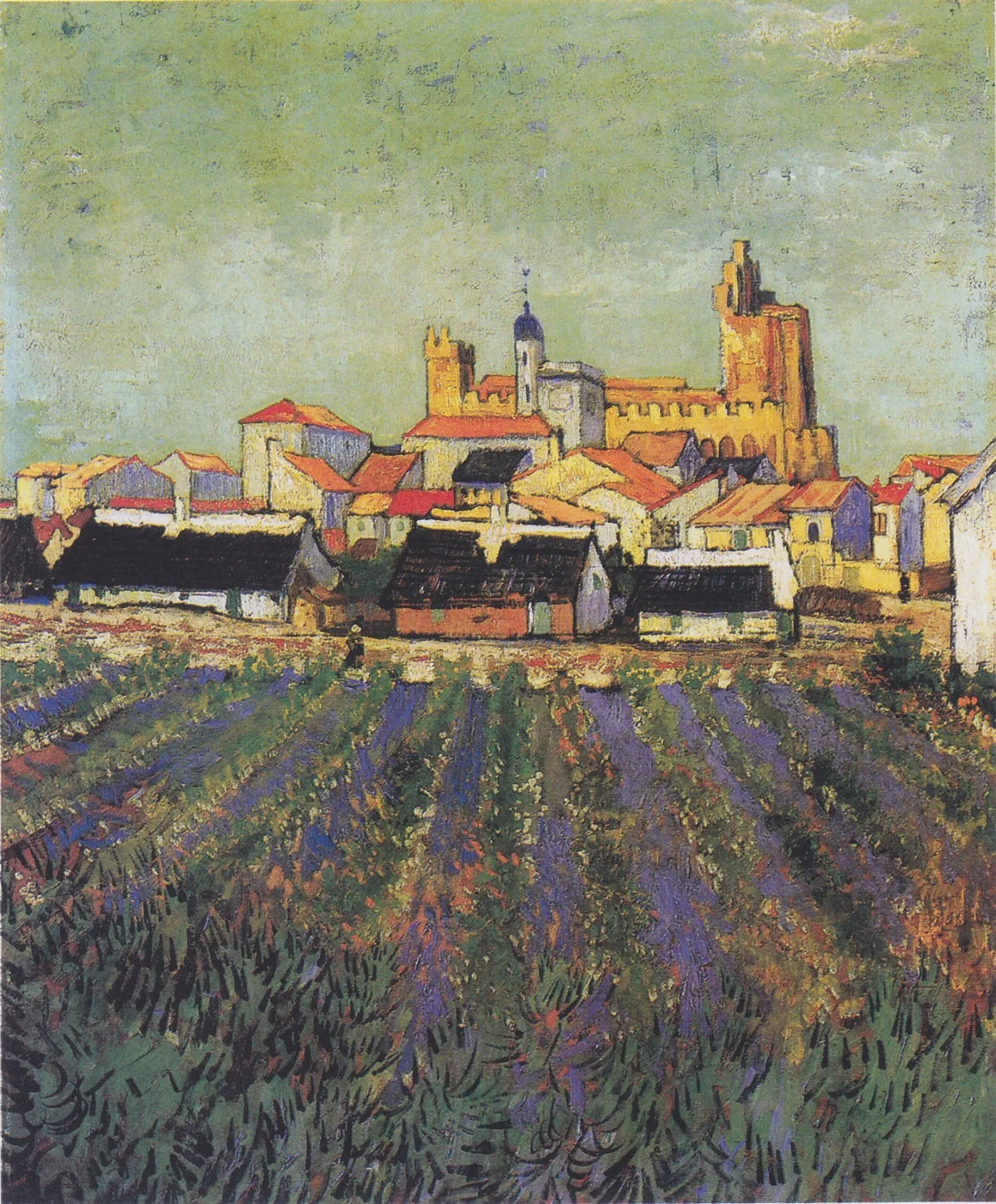
View to Saintes-Maries-de-la-Mer is one of the paintings that came out of that week. It is dated to 1888 and measures 53 by 64 centimetres, a modest size that matches the speed at which it must have been painted, standing in a field on the edge of the village with the wind coming off the water.
A Fortified Church Above the Roofs
The village sits in a band across the middle of the canvas, its rooftops pitched in ochre and red tile, its walls a patchwork of white, cream and pale blue. Above them all rises the church of the village, a squat, fortress-like building with a crenellated tower that Van Gogh has pulled slightly out of true, leaning the architecture toward the viewer.
That church was a refuge as much as a place of worship, built low and thick-walled against pirates and storms, and Van Gogh clearly relished its bluntness. He gives it more weight and colour, a warm ochre against the paler houses around it, than a purely accurate rendering would need.
In front of the church, smaller buildings with dark, steeply pitched roofs sit close to the edge of the field, their black gables cutting sharp triangles against the paler town behind. A single figure, reduced to a few dabs of paint, walks the track between the field and the houses, the only human presence in the whole scene.
Furrows of Blue and Green
The lower half of the canvas is given over entirely to a cultivated field, its rows running diagonally from the bottom edge up toward the village. Van Gogh paints each furrow as a separate passage of colour, violet-blue crop alternating with green and touches of rust-red earth showing through.
The brushwork here is short, loaded and directional, each stroke following the line of a furrow rather than describing an individual plant. Seen up close the field dissolves into a thicket of small marks; stood back, it reads instantly as row after row of growing crop receding toward the rooftops.
This is the part of the painting where Van Gogh’s hand moves fastest, and it shows. The rhythm of the rows carries the eye from the very bottom of the canvas straight up to the church tower, so that the whole composition works as a single, sweeping approach to the village rather than two separate halves.
A Sky Without Weather
Above the rooftops, the sky takes up nearly half the canvas and is painted in a pale, greenish yellow that has none of the deep blues Van Gogh used elsewhere that summer. It is brushed in loose horizontal strokes, thin enough in places that the weave of the canvas shows through, giving the light a slightly worn, sun-bleached quality.
There is no sun in the picture and no clouds to speak of, only a flat, even glow that falls across roofs and field alike without casting a single hard shadow. It reads as the light of early afternoon on the Camargue, when the heat flattens the whole landscape into a single, shimmering plane.
Against that pale sky, the ochre of the church tower and the red of the tiled roofs sit as the warmest notes in the whole painting, small concentrations of heat in an otherwise cool and airy scene. It is a simple contrast, but it is what makes the village, rather than the field or the sky, the point the eye keeps returning to.
Living With the View
Hung in a room with shifting daylight, the painting changes with the hour much as the original scene must have changed under the Camargue sun. Morning light picks out the violet in the furrows; by evening, the ochre tower and red roofs hold their colour longer than anything else on the wall.
It rewards a room where it can be approached slowly, a hallway or a study rather than a spot glanced at in passing, because the field only gives up its structure of individual, deliberate strokes on close inspection. From further back, the rows and rooftops settle into the single unbroken view Van Gogh composed that week on the coast.
The original View to Saintes-Maries-de-la-Mer is held by the Kröller-Müller Museum, painted in the same restless months that produced so much of Van Gogh’s Arles work. Seen well, a reproduction of it carries something of that same immediacy, a landscape set down quickly, by someone who knew he had only a few days to get it right.
Sizes and materials for View to Saintes-Maries-de-la-Mer are listed on its product page.
More from this collection
Bring this painting home
Choose a hand-painted oil reproduction for real brushwork, or an archival canvas print for a crisp museum-image edition. Every size preserves the original proportions.
View this work & options
Further reading
Verify the original in the Kröller-Müller Museum collection record and continue through related works in the catalogue.