
Wheatfield with a Reaper: Story, Meaning & Brushwork
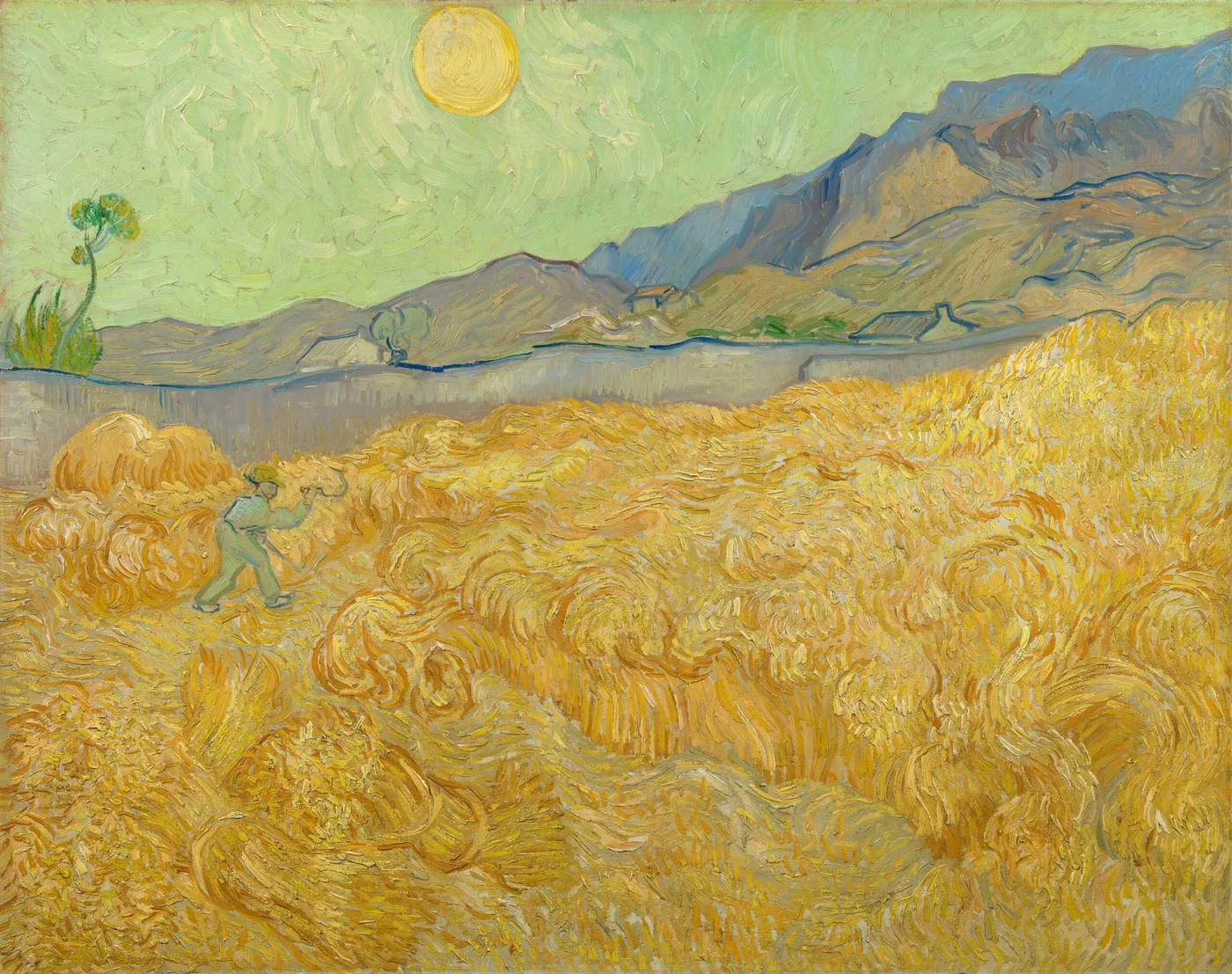
By the time Vincent van Gogh painted Wheatfield with a Reaper in September 1889, he had spent five months as a voluntary patient at the asylum of Saint-Paul-de-Mausole, just outside Saint-Rémy-de-Provence. His room and the adjoining studio looked out over a walled wheat field enclosed by the low ridge of the Alpilles, and through that summer he returned to the same view again and again, watching the crop grow, ripen and finally fall to the sickle.
He had asked his brother Theo to keep him supplied with canvas and paint through the worst stretches of his illness, and work remained one of the few things that steadied him. He had painted this same field once before, in June, with the wheat still green. By September it stood fully ripe, and he returned to the subject with a single reaper now cutting through it.
A walled field under the Alpilles
The canvas, painted at 92.7 by 73.2 centimetres, is built almost entirely from what fills its lower two thirds: wheat. A low stone wall runs across the middle distance, separating the cultivated field from a scatter of red-roofed farm buildings and the blue-grey mass of the Alpilles beyond.
To the left, rising above the wall, a single flowering plant with a thick stem and a tufted head stands taller than anything else in the picture, one of the only vertical accents in a composition otherwise built from long horizontal sweeps of land. A pale, near-white sun hangs low in a sky washed in soft green and yellow, its light so even across the scene that almost nothing casts a shadow.
The farm buildings along the wall are painted small and plain, little more than a few strokes of red and grey, enough to place the field within a working landscape rather than an empty one. They sit at exactly the height where the eye, having crossed the wheat, comes to rest before climbing into the hills.
The reaper at work
Near the centre of the field, small against the mass of grain around him, a man in pale blue-green clothing and a straw hat bends into his sickle. He is built from only a handful of strokes, yet the arm swung out and the whole body leaning into the cut read instantly, even at a distance.
Beside him, sheaves already gathered stand bundled at the field’s edge, stacked while the rest of the crop still waits to be cut. Around his feet the wheat curls and eddies in the paint, worked so densely that it seems to move, though nothing in the scene is hurried.
Colour laid on thick
Van Gogh built the field from short, curved strokes of yellow, gold, ochre and orange, laid one against another until they read less as individual stalks than as a single turning current of colour. In places the paint stands proud of the canvas in ridges, applied thickly and dragged with the brush so that the surface itself catches light.
Against that heat, the sky is worked in cooler, thinner passes of pale green and lemon, and the hills behind the wall in muted blue and violet. The whole surface is unified by the same rhythmic, circling stroke, so that sky, hillside and grain all seem to have been painted in one continuous motion of the hand.
It is this handling, more than the subject itself, that gives the picture its particular pitch. The wheat does not sit still on the canvas the way a photograph would render it; it swells and turns, each stroke following the curve of the one before it.
Death without sadness
Van Gogh described the reaper to Theo in a letter written that September, and his words remain the clearest guide to what he meant the figure to carry. He saw in the reaper, he wrote, the image of death, in the sense that humanity might be the wheat being cut down.
He was careful to add that there was nothing sad in this death, that it went about its work in broad daylight, under a sun flooding everything with a light of pure gold. Painted from inside an asylum, in a year that had already brought him close to his own mortality more than once, the image reads less as despair than as an attempt to make peace with an ending.
The sower, a figure he had painted repeatedly in earlier years, casts seed forward into a future. The reaper, cutting through wheat he did not plant, closes a cycle instead of opening one, and Van Gogh seems to have found in that closing something closer to calm than to grief.
On a wall, through the day
The original hangs today in the Van Gogh Museum in Amsterdam. In a reproduction hung at home, the same shifts in light that Van Gogh was chasing across the day play out again on the wall: the picture keeps its heat under a lamp in the evening and turns paler, cooler, in the grey of early morning.
Hung where it can be seen from a short distance rather than close up, the swirl of brushwork settles into the calm, continuous field Van Gogh intended, a single reaper working steadily through a harvest that never quite seems to finish.
Sizes and materials for Wheatfield with a Reaper are listed on its product page.
More from this collection
Bring this painting home
Choose a hand-painted oil reproduction for real brushwork, or an archival canvas print for a crisp museum-image edition. Every size preserves the original proportions.
View this work & options
Further reading
Verify the original in the Van Gogh Museum collection record and continue through related works in the catalogue.