
La Berceuse (Madame Roulin): Story, Meaning & Brushwork
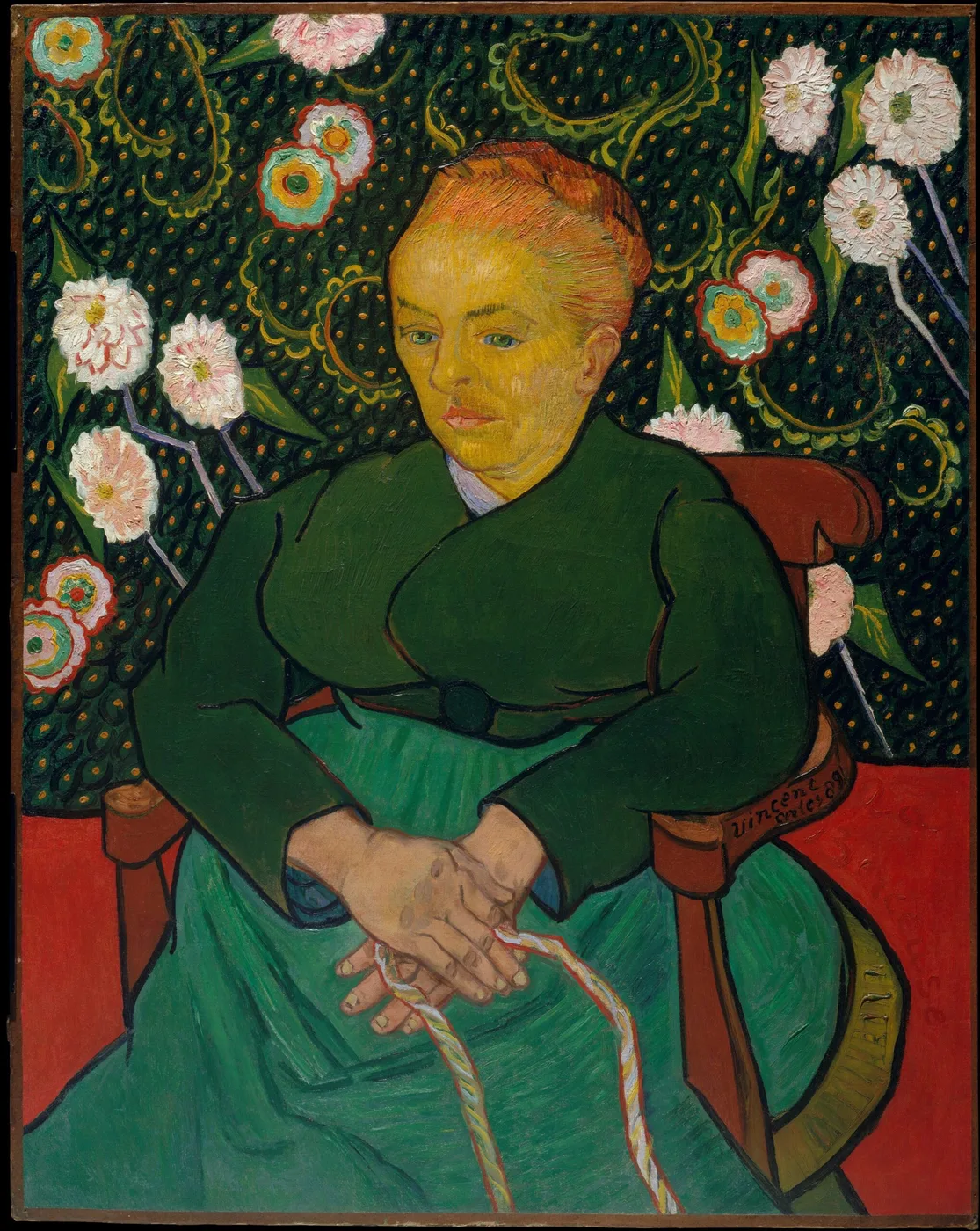
By the last days of December 1888, Vincent van Gogh had just come through the worst collapse of his life. He had spent Christmas in hospital in Arles, recovering from the breakdown that ended his months of shared work with Paul Gauguin, and among the few people he trusted through that winter were a local postal worker, Joseph Roulin, and his wife Augustine. Roulin had sat with him during the worst of it; the couple had a new baby daughter at home. When Van Gogh was well enough to hold a brush again, he turned to Augustine’s face and kept returning to it.
He called the result La Berceuse, the woman who rocks the cradle, and over the following months painted five closely related versions of Augustine Roulin, 1851 to 1930, seated with the cord of an unseen cradle in her hands. This canvas is dated 1889 and measures 73.7 by 92.7 centimetres. It is now held by the Metropolitan Museum of Art.
Augustine Roulin, holding still
She sits almost square to the viewer, her hands folded in her lap around a plaited white cord that runs down out of the frame to a cradle we never see. Her green jacket is buttoned high and dark at the collar, her skirt a paler, blue-tinted green that pools around her in loose folds. Her red hair is pulled back tightly, and her face, lit in warm yellow and gold, tilts slightly downward, eyes lowered rather than meeting ours.
There is no motion in the picture, and yet the whole point of it is a rocking rhythm we have to imagine, the pull of that cord repeated somewhere below the frame, over and over, in the dark. Van Gogh gives her stillness instead: a heavy, seated calm, hands at rest, mouth closed. It reads as a portrait of someone holding a room quiet.
A wall of paint behind her
Behind Augustine, Van Gogh filled the upper two thirds of the canvas with a floral wallpaper of his own invention, dark bottle green scattered with small orange dots and looping vine work in a lighter yellow green. Out of that ground grow large, loosely brushed dahlias and chrysanthemums in white, pink, and salmon, each one set down as a few thick, decisive strokes rather than a botanical study.
The flowers are not arranged the way real wallpaper repeats. They cluster more heavily to the left, thin out around her shoulders, and reappear at the top right in a last loose spray, so the pattern feels grown rather than printed, alive rather than decorative filler.
Below, the background drops abruptly to a flat, hot red-orange, the colour of the tiled floor and the wooden armchair she sits in. The chair’s arm, carved and plain, carries Van Gogh’s signature and the date, painted directly onto the wood as though signing a piece of furniture rather than a picture.
Green against red, orange against white
Van Gogh was working, in this first winter after Arles, in the flattened, high-key manner he had been pushing toward under the influence of Japanese prints, laying down each area of the picture as a single bold colour bounded by a dark outline rather than modelled through gradual light and shade.
The whole canvas is built from complementary pairs pushed hard against one another: the green of her jacket against the red floor, the orange of her hair against the cool green wallpaper, white flowers against near black shadow. Nothing is mixed to a compromise; each colour stays pure and is left to argue with its neighbour.
The paint itself is thick and varied in handling from one passage to the next. Her face is built from smaller, more careful strokes that follow the structure of cheek and brow, while the dress is filled in with broader, almost slab-like sweeps of green, and the wallpaper flowers are dashed in with quick, loaded touches that leave ridges of paint visible at the surface.
A lullaby meant for sailors
Van Gogh imagined the picture hanging at the centre of a triptych, flanked by two of his sunflower paintings, so that the whole group would read, in his own words, like a lullaby in colour. He thought specifically of fishermen and sailors alone at sea, far from any woman who might comfort them, and wanted this image of a mother’s steady presence to reach them the way a hymn or a folk song might.
That ambition says as much about Van Gogh’s state that winter as it does about Augustine Roulin herself. He was painting comfort for strangers he would never meet, using the one household that had shown him kindness as his model for what comfort should look like.
He gave more than one version of the picture to the Roulin family directly, a gesture of thanks folded into the working method itself: the same image, repeated, handed back to the people who had inspired it.
On a wall, through changing light
Reproduced at scale and hung in a room, La Berceuse keeps working the way Van Gogh intended it to. In daylight the red floor and green dress read as a single loud, warm chord; toward evening, under lamplight, the same red deepens toward brown and the wallpaper’s dark ground swallows more of its detail, leaving Augustine’s lit face and the pale flowers to hold the eye.
It rewards being looked at twice: once from across the room, where it reads simply as a seated woman in green against a garden of flowers, and once up close, where the cord in her hands, the brushwork in her hair, and the loose, unfinished-looking flowers behind her come forward as the record of a specific, difficult winter’s work.
Sizes and materials for La Berceuse (Portrait of Madame Roulin) are listed on its product page.
More from this collection
Bring this painting home
Choose a hand-painted oil reproduction for real brushwork, or an archival canvas print for a crisp museum-image edition. Every size preserves the original proportions.
View this work & options
Further reading
Verify the original in the Metropolitan Museum of Art collection record and continue through related works in the catalogue.