
Road with Cypress and Star: Story, Meaning & Brushwork
By May 1890 Vincent van Gogh had spent a year committed to the asylum at Saint-Rémy-de-Provence, and he was making plans to leave it. His brother Theo had arranged rooms for him further north, near a doctor who might keep a closer watch on his health, and the move meant abandoning the landscape that had absorbed him for two years: the wheat, the olive groves, and above all the cypresses that stood black and upright against the Provençal sky.
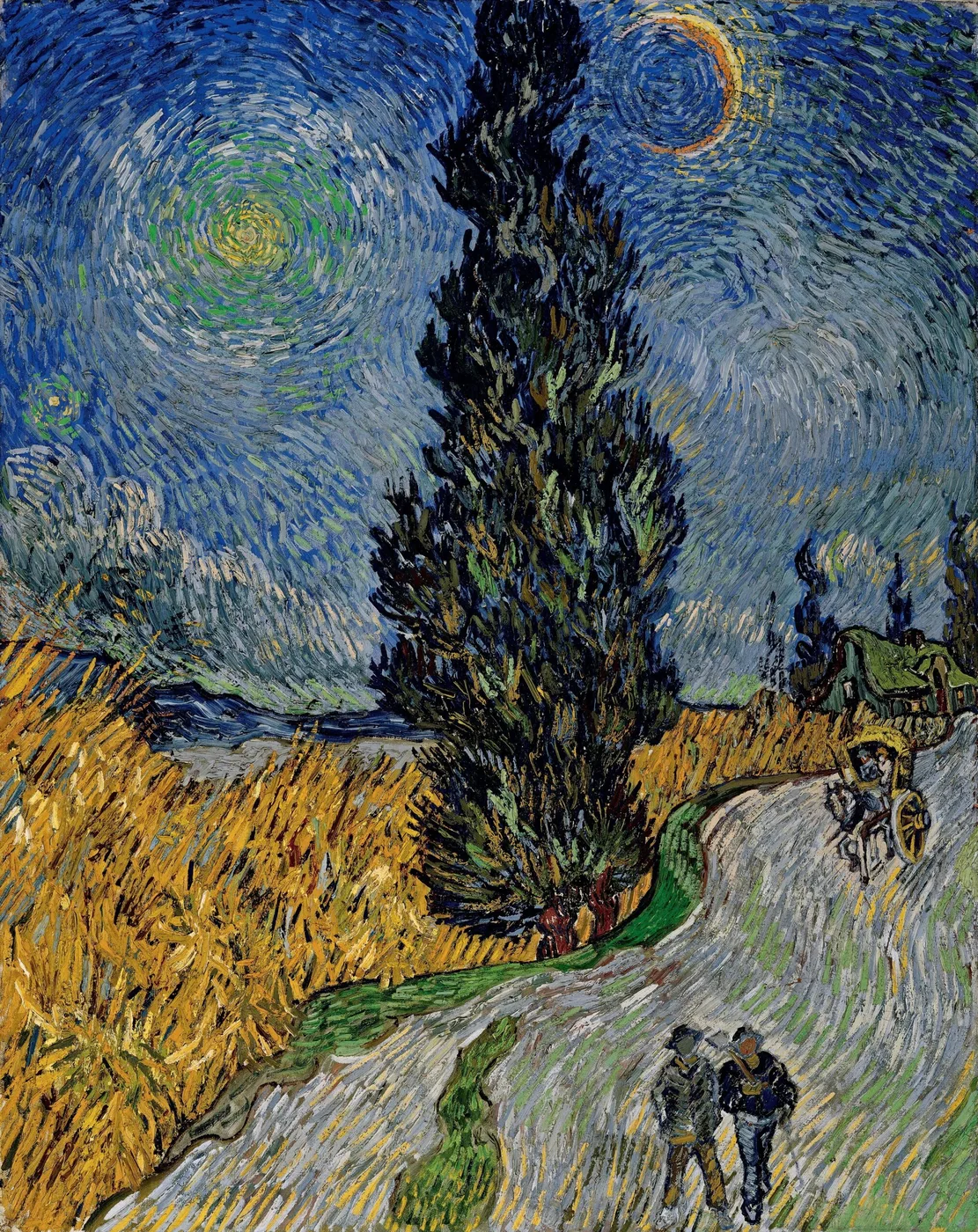
Before he left, he wanted one more canvas that pulled those obsessions together. Road with Cypress and Star, sometimes catalogued as Country Road in Provence by Night, was among the last pictures he made at Saint-Rémy, painted in 1890 on a canvas measuring 73 by 92 centimetres, larger than most of the studies he had been sending north in batches all spring.
A Room Emptying Out
The months before this painting had been rough. Van Gogh had come through a serious crisis that winter, and the productivity of April and May reads like a man working against a deadline he had set for himself rather than one imposed from outside. He had already painted cypresses standing alone against turbulent skies; here he gathered cypress, star and road into a single composition, as though closing an account before it changed hands.
He had written more than once that the cypress preoccupied him the way sunflowers once had in Arles, and that he wanted to do something with the tree that matched its strangeness: a dark accent, he thought, among all the greens and blues of a southern landscape. This canvas is that ambition worked out at full size, not a sketch toward it.
A Cypress Splitting the Sky
The eye goes first to the cypress, a single dark spire that climbs through the middle of the canvas and pushes the top edge apart into two unequal halves of sky. It is painted almost black at its core, but the black is built from strokes of bottle green, ochre and deep blue laid one over another, so that the tree seems to smoulder rather than simply stand.
To its left a star burns low and enormous, a whorl of yellow and green rings that could be mistaken for a small sun. To its right, further off, a thin crescent moon sits inside a ring of orange, paler and further away, as though the sky held two separate sources of light and had not decided between them.
The whole upper half of the canvas is built from short curling strokes of blue, laid in arcs that circle the star and the moon like weather fronts. Below, the land settles into more legible strokes of gold and ochre, a wheat field to the left, a line of low hills behind it, and the grey-green road curving round the foot of the cypress toward the horizon.
Figures on the Road
Two men walk together at the bottom right, close enough to be touching, painted in a few dark strokes that give them no faces and barely any features. Behind them, further along the curve of the road, a horse pulls a cart past a cottage with a green roof, small enough that it takes a moment to notice.
Nothing in the scene suggests these people are in any hurry, or that anything unusual is happening to them. Their smallness against the cypress and the turning sky is the point: the road carries the eye from the two travellers, past the cart and the cottage, and out toward a horizon that the sky has already claimed.
Brushwork Built to Move
Van Gogh was not painting a windy night; he was painting paint that moves the way wind moves. The cypress is built from long vertical dashes that taper and thicken unevenly, the wheat from short diagonal flicks, the sky from circular sweeps that never quite close. Almost nothing in the picture is a flat passage of colour; everything carries the mark of the brush that made it.
He described the cypress and the star as among his favourite motifs, and treated this picture as a kind of last attempt at the night sky of the south before he left it behind. The impasto is thick enough to cast its own small shadows across the surface, so the painting changes slightly depending on where the light in the room is coming from.
On a Wall, Through the Day
That is what makes a picture like this rewarding to live with rather than simply look at once. In low or angled light the ridges of paint catch shadow and the cypress reads almost sculptural, its outline sharpened. Under flatter daylight the colour does more of the work, and the gold of the wheat field and the green of the star pull forward against the blue.
The original hangs at the Kröller-Müller Museum, one of the paintings from Van Gogh’s final months at Saint-Rémy before he travelled north, where he would die within a matter of weeks. Painted in 1890 on a canvas of 73 by 92 centimetres, it remains one of the clearest statements of the two motifs, cypress and star, that occupied him for the whole of that last productive year.
Sizes and materials for Road with Cypress and Star are listed on its product page.
More from this collection
Bring this painting home
Choose a hand-painted oil reproduction for real brushwork, or an archival canvas print for a crisp museum-image edition. Every size preserves the original proportions.
View this work & options
Further reading
Verify the original in the Kröller-Müller Museum collection record and continue through related works in the catalogue.