
The Sower at Sunset: Story, Meaning & Brushwork
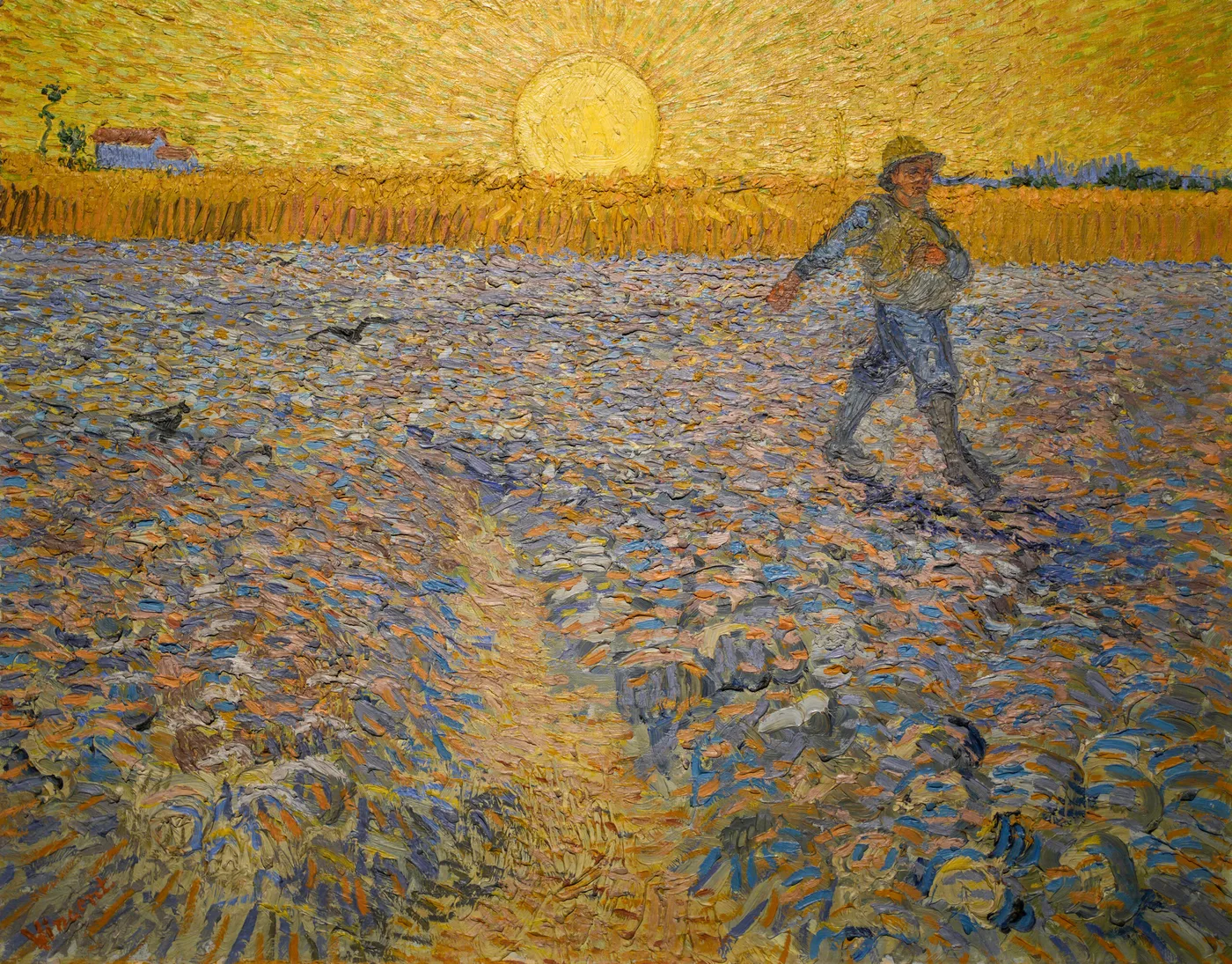
By June 1888 Vincent van Gogh had been in Arles for four months, working through the wheat harvest at a pace that alarmed even him. He wrote to his brother Theo that he was painting like a man possessed, chasing the light before the season turned. The Sower, also known as The Sower at Sunset, belongs to that stretch of work, a canvas he built around a subject he had returned to again and again since his earliest days as an artist in the Netherlands.
A Debt to Millet, Paid in Colour
The sower was not Van Gogh’s invention. He had copied and reinterpreted Jean-Francois Millet’s peasant figures for years, drawn to the idea of dignified labour rendered without sentimentality. In Arles he set that borrowed figure loose in colour Millet never used.
Where Millet worked in earthen greys and browns, Van Gogh gave the same motif a sky the colour of hammered brass and a field of violet and blue. He wrote of wanting to paint the sower as a symbol of eternity, sowing and harvest standing in for the whole span of a life.
The gesture survives from Millet: the wide stride, the arm flung out mid-cast. Everything around it belongs to Van Gogh alone.
A Field Built From Its Opposite
Look at where the sun sits. It is enormous, low, and nearly white at its core, ringed by a halo of yellow strokes that radiate outward like spokes. A narrow band of ripening wheat runs along the horizon beneath it, and a small farmhouse with a blue-grey roof stands to the left, dwarfed by the sky behind it.
The ploughed field that fills the lower two thirds of the canvas is not brown at all. It is built from violet and blue, laid down in short, choppy strokes, with orange and gold worked back through it wherever the low sun catches a ridge of turned soil.
That pairing of yellow against violet is the whole engine of the picture. The two sit opposite each other on the colour wheel, and Van Gogh knew exactly what placing them side by side would do: each colour makes the other ring louder than it would alone.
A pair of crows works the furrows in the foreground, small dark notes against all that broken colour. A path cuts diagonally through the field toward the sun, pulling the eye back to meet it.
A Figure Pushed to the Edge
The sower himself is not centred. Van Gogh set him well to the right, striding in from beyond the frame with his arm caught mid-throw, a satchel of seed slung across his body and a straw hat shading his face. His feet are planted in blue and grey, half sunk into the same broken paint as the field around him.
It is an odd, almost off-balance composition, and that seems deliberate. The sun, not the man, claims the middle of the canvas. The figure is present but not dominant, a working detail inside something much larger than himself.
That imbalance is part of what makes the painting hold attention. The eye lands first on the great yellow disc, circles the radiating sky, and only then travels down to find the man doing the actual work.
Paint Handled Like the Subject It Shows
Van Gogh was working fast that summer, and the surface shows it. The sky is laid on in long, directional strokes that fan out from the sun like the sower’s own broadcast seed. The field beneath is thicker still, dabbed and dragged in a way that gives the whole lower half of the canvas real physical texture.
Nothing here is blended smooth. Colour sits next to colour, stroke next to stroke, so that the picture keeps a kind of vibration even at a distance. It is a technique built to be seen, not just looked past.
The picture measures 80.3 by 64.2 centimetres, a size that keeps the sun and the field in close, almost pressing proximity to the viewer. Van Gogh painted it in 1888, and it now belongs to the Kröller-Müller Museum, which holds one of the largest concentrations of his work anywhere.
What It Does on a Wall
Hung where morning or evening light can reach it, the picture changes with the room. Warm lamplight draws out the gold and amber in the field; daylight sharpens the violet and lets the crows and the sower’s dark clothing register more clearly against all that brightness.
It is not a quiet picture, and it does not ask to be quiet. The sun at its centre keeps working on the eye the way it worked on Van Gogh, insistent, closer to the edge of what paint can hold than most landscapes attempt.
What stays with a viewer, over repeated looking, is the tension between the calm subject and the restless surface. A man sowing a field is about as old and steady a scene as exists. Van Gogh painted it as though the whole sky were on fire around him.
Sizes and materials for The Sower at Sunset (Arles) are listed on its product page.
More from this collection
Bring this painting home
Choose a hand-painted oil reproduction for real brushwork, or an archival canvas print for a crisp museum-image edition. Every size preserves the original proportions.
View this work & options
Further reading
Verify the original in the Kröller-Müller Museum collection record and continue through related works in the catalogue.