Poppies and Butterflies: Story, Meaning & Brushwork
A garden behind the asylum wall
In May 1889, Vincent van Gogh moved himself into the asylum of Saint-Paul-de-Mausole at Saint-Rémy, seeking shelter after the crisis that had ended his time in Arles. The move gave him a room to sleep in and, just as valuable, an overgrown garden he could paint without needing to go far. Butterflies and Poppies, painted that year, is one of the small studies that came out of walks no further than the enclosure.
At 25.5 by 34.5 centimetres, the canvas is barely larger than a page torn from a sketchbook. Van Gogh worked close to the ground, the way a person crouches to look properly at what is growing underfoot rather than at the horizon.
The Van Gogh Museum, which holds the picture today, keeps it among the group of garden and undergrowth studies he made in the weeks after his arrival, when longer excursions were still difficult and the near view was what he had to work with.
Red poppies, pale wings and the green between them
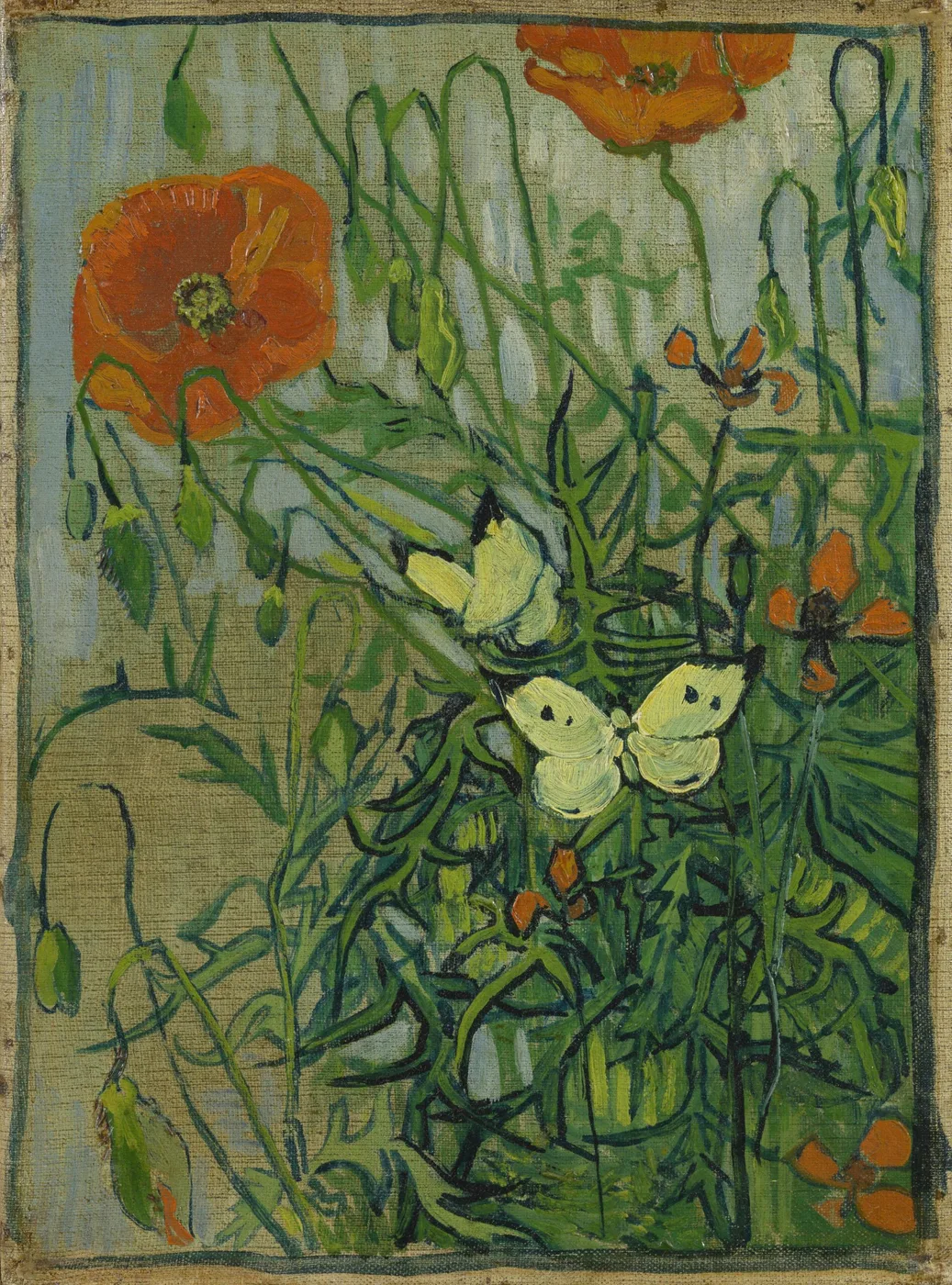
Two red poppies anchor the upper corners of the canvas, their petals loose and slightly ragged, the way poppies look a day or two after opening rather than freshly unfurled. Between them the ground turns to grey-blue and buff, left thin enough that the weave of the canvas still shows through the paint.
Lower down, where the background thickens into a tangle of stems and leaves, two pale butterflies sit close together on the foliage, wings held upright. Their cream and pale yellow is the lightest, calmest note in the picture, which is exactly why the eye goes there first.
Smaller orange butterflies are tucked into the right-hand side and lower corner, echoing the poppies’ colour in miniature. Curled seed pods and unopened buds fill the gaps between them, keeping the lower half of the canvas as busy as the pale sky above is empty.
Paint put down fast and left that way
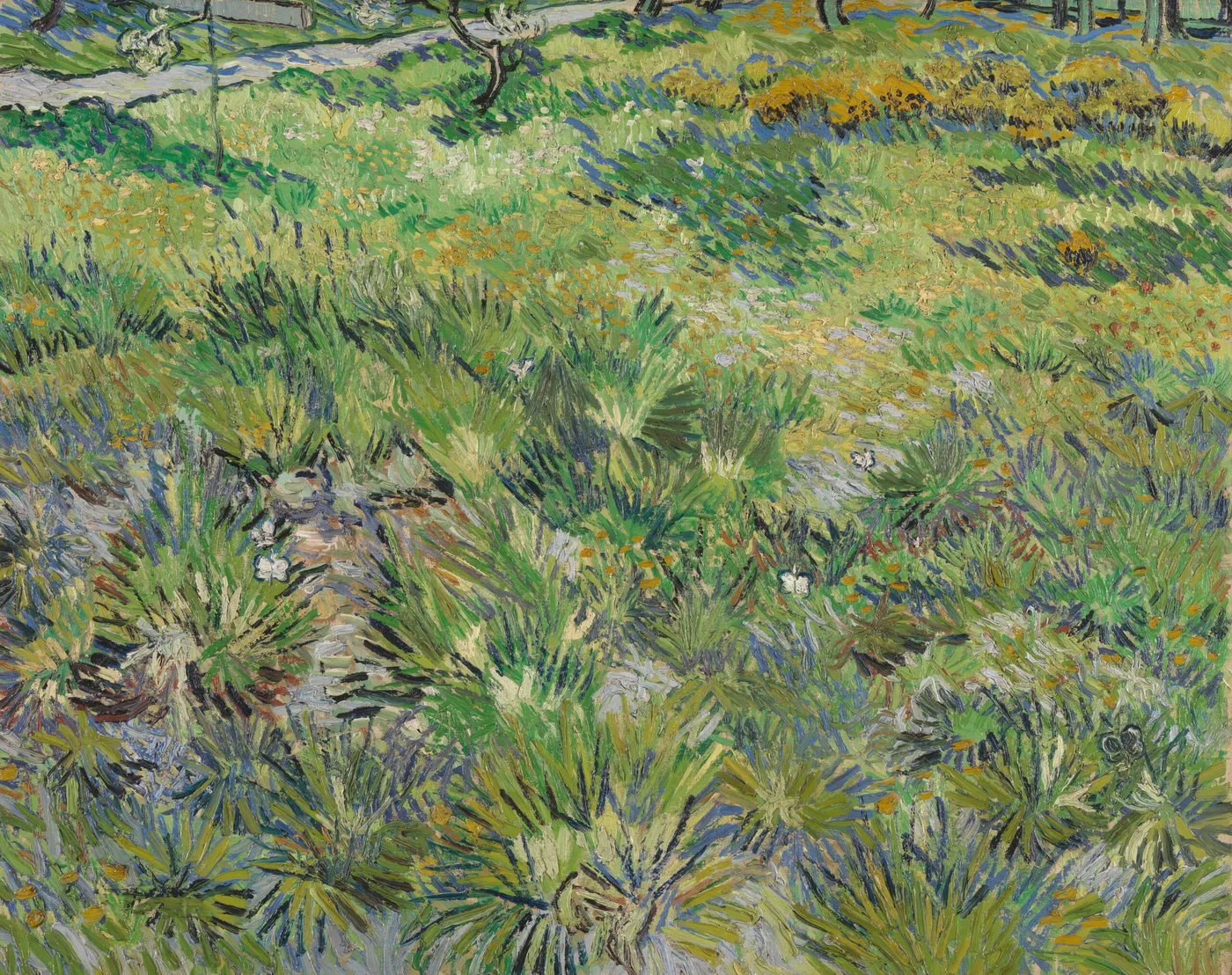
Van Gogh built the greens in short, directional strokes that follow the lean of each stem rather than filling in a flat mass, so the foliage reads as a thicket of separate plants rather than a backdrop. Dark outlining in a near-black green holds the looser colour in place, much as lead does around glass.
He left the poppies rough. Looked at closely, the red is not one red but several, laid wet into wet, with the dark centre of each flower barely more than a few quick marks. Nothing here has been corrected or smoothed afterward.
The pale ground at the top is, by contrast, thin and almost dry, brushed on fast enough that the canvas beneath still reads through the pigment. That bareness looks deliberate: he spent his effort on the poppies and the butterflies, not on filling every corner evenly.
A small, steady kind of looking
The garden studies from this stretch of 1889 are usually read as a sign of what Van Gogh could still manage during a hard period of illness, close and contained subjects that did not require him to travel or to organise a large scene. A poppy, a butterfly, a patch of grass were all within reach of the asylum grounds, and all held still, or returned often enough, to be studied properly.
No surviving letter explains what he meant by this particular canvas, so it has to speak for itself. What it shows, plainly, is attention: an artist working out, flower by flower and wing by wing, how much could be said with red, white and green and a few decisive lines.
On the wall, as the light turns
Hung where daylight reaches it directly, the pale background lightens further and the red of the poppies pushes forward hard against it. Under evening or lamp light, that contrast softens, the greens deepen, and the two pale butterflies become the brightest, calmest shapes left in the picture.
It rewards a close look more than a passing one. The loose weave of stems, the unevenly loaded brush, the small orange butterflies tucked into the lower corners are easy to miss from across a room and worth stepping in for, in the original at the Van Gogh Museum and in any faithful copy of it.
Sizes and materials for Two White Butterflies are listed on its product page.