
Japanese Vase with Roses and Anemones: Story
By the early summer of 1890 Vincent van Gogh had settled into the small village of Auvers-sur-Oise, north of Paris, under the informal care of Dr Paul Gachet. He had left the asylum at Saint-Remy only weeks before, and he painted at a pace that still startles: a canvas most days, sometimes two. Among the fields and thatched roofs that dominate this last burst of work, he also turned, more than once, to something closer at hand and far more modest: cut flowers set in a vase on a table indoors.
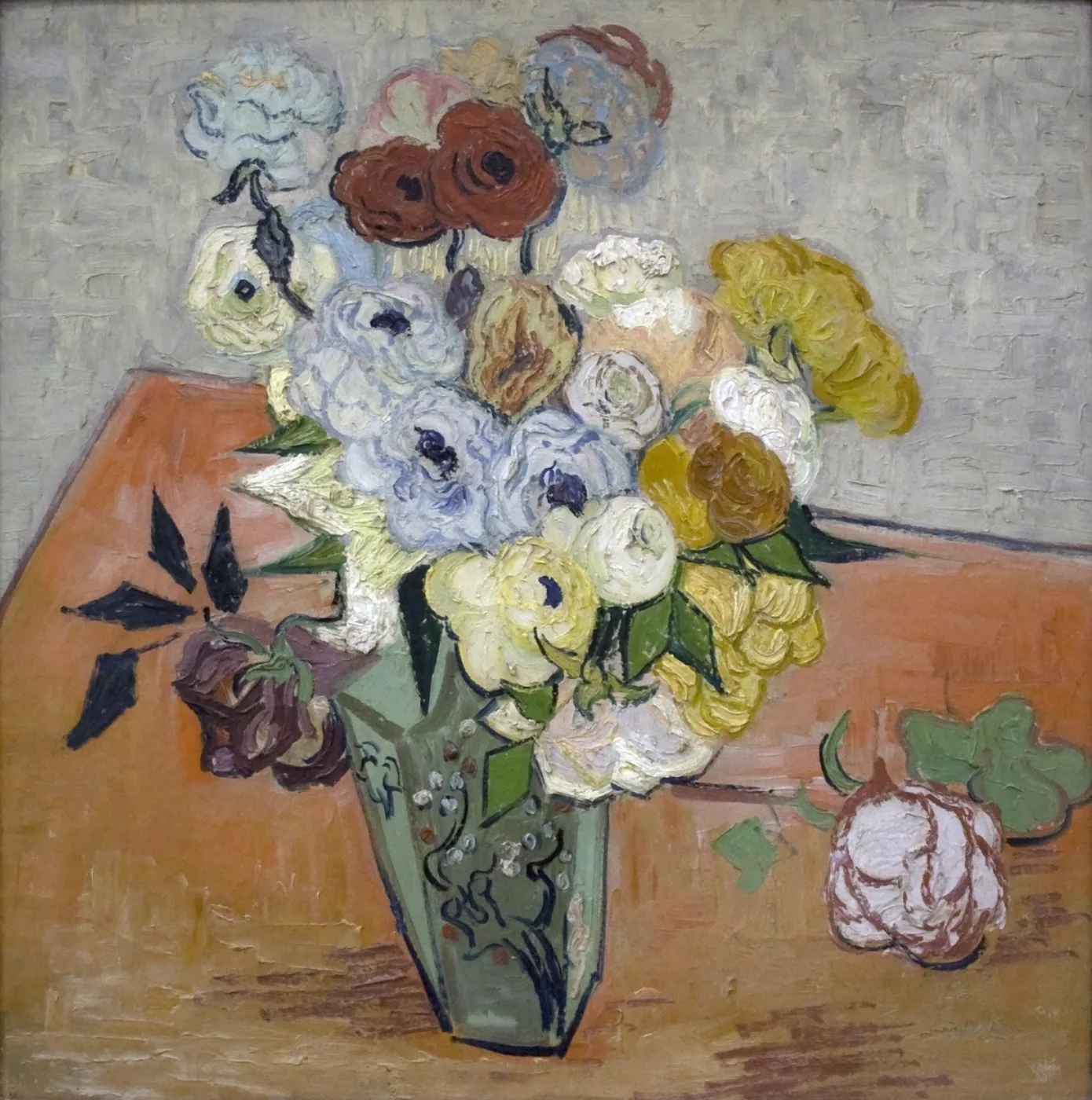
Still Life: Japanese Vase with Roses and Anemones, painted that summer and now in the collection of the Musée d’Orsay, is one of these interior pictures. It measures only 52 by 51.7 centimetres, almost square, small enough to have been finished in a single sustained sitting.
A last summer spent close to home
Van Gogh’s letters from Auvers describe long working days and a restlessness that never quite let up, even as he found the village and its surroundings genuinely absorbing. Flowers offered him something the wheatfields could not: total control over the arrangement, the light and the colour relationships within a single afternoon.
He had painted flowers before, in Paris and in Arles, always as a way of testing colour against colour without the complications of a wider scene. At Auvers this habit resurfaces in a handful of pictures, of which this is one of the most fully worked.
There is no evidence of a special occasion behind this particular bouquet. It reads instead as a working session: roses and anemones bought or cut, arranged quickly, and painted before they wilted.
A vase carried from another tradition
The container itself is not incidental. It is tall, faceted and pale green, its angular sides marked with a dark, looping pattern that recalls the decorated ceramics Van Gogh had collected and copied since his years in Paris, where he studied Japanese woodblock prints in depth.
He never travelled to Japan, but he described the light and clarity he associated with Japanese art as something he was chasing in the south of France. Here that debt surfaces directly, in an object rather than a landscape: a European bouquet standing in a vessel shaped by a tradition he admired from a distance.
The vase sits low in the composition, its dark green a firm anchor beneath a mass of paler colour above. Everything the eye does after that is governed by what rises out of it.
Colour massed and colour let loose
The bouquet itself is dense: pale blue and white anemones with near-black centres crowd against deep maroon roses, buttery yellow blooms and roses the colour of ivory and blush pink. Van Gogh has packed the flowers close together, so that colour meets colour with almost no green foliage to separate one bloom from the next.
Against this the wall behind is kept nearly neutral, a pale grey-white worked in short, restless strokes that read as texture rather than as a flat backdrop. The table beneath is a warm, unbroken orange, and it is this single strong colour, more than the flowers themselves, that pulls the whole picture into balance.
To the right of the vase a single loose bloom lies apart from the rest, a pale rose set down flat on the tabletop with a few green leaves scattered near it. It is a small, deliberate break in an otherwise tightly gathered arrangement, and it gives the eye somewhere to rest once it has travelled through the crowd of colour above.
How the paint itself was handled
Van Gogh worked this canvas in short, loaded strokes, each petal built from two or three decisive touches of the brush rather than blended shading. Up close the anemones in particular resolve into distinct marks of blue, white and black, laid side by side and left to mix in the eye rather than on the palette.
The background is not a resting surface either. Its diagonal hatching keeps the whole upper half of the canvas in quiet motion, so that even the emptiest part of the painting has a pulse to it.
Nothing here looks laboured or corrected. The picture has the directness of something painted fast, in the hours a cut flower still holds its shape, and that urgency is visible in every stroke.
What the painting gives a room
Hung at eye level, this is a picture that rewards both distance and closeness. From across a room the orange table and the packed bouquet read as a single warm mass; step nearer and the same passage breaks apart into dozens of individual, unblended strokes of colour.
Morning light draws out the warmth of the table and the yellow roses; in the low light of evening the blues and near-black centres of the anemones come forward instead, and the whole balance of the composition shifts. Few still lifes change so visibly with the hour.
It asks to be looked at more than once, and it rarely looks quite the same way twice.
Sizes and materials for Still Life: Japanese Vase with Roses and Anemones are listed on its product page.
More from this collection
Bring this painting home
Choose a hand-painted oil reproduction for real brushwork, or an archival canvas print for a crisp museum-image edition. Every size preserves the original proportions.
View this work & options
Further reading
Verify the original in the Musée d'Orsay collection record and continue through related works in the catalogue.