
Three Sunflowers in a Vase: Story, Meaning & Brushwork
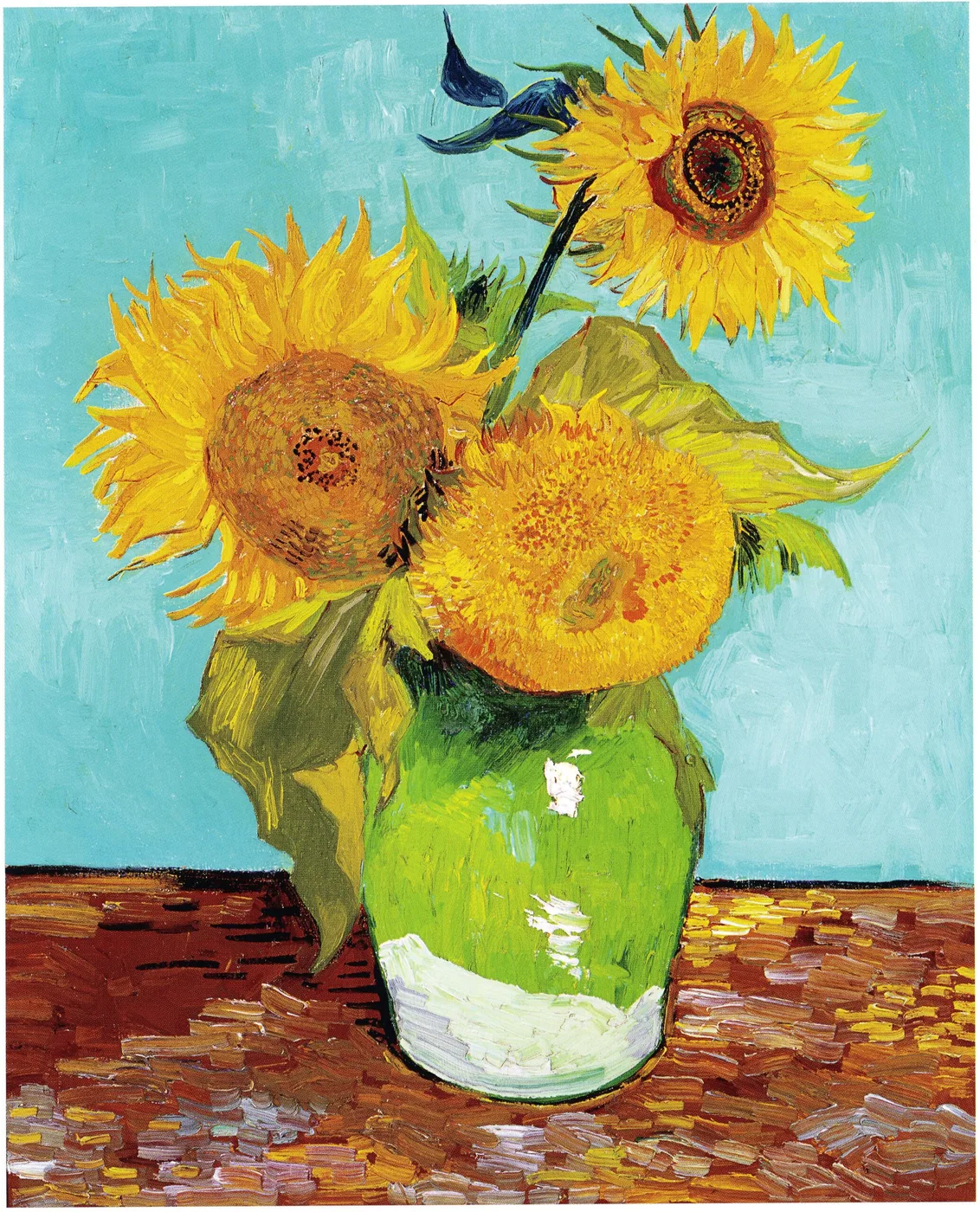
By the summer of 1888, Vincent van Gogh had been in Arles for several months, working at a pace that alarmed even him. He had taken the Yellow House on the Place Lamartine and was preparing it for Paul Gauguin, whose arrival he awaited with a mixture of hope and anxiety. The sunflower paintings were meant for that house, decorations for the room Gauguin would sleep in, and Three Sunflowers in a Vase belongs to that August campaign.
In the Yellow House, August 1888
Van Gogh worked on his sunflowers in short, intense bursts, sometimes finishing a canvas in a single sitting. He wanted the flower he associated with the south of France, with sun and warmth, to fill a room the way a fresco might. Several versions came out of that summer, varying in the number of blooms and the colour of the ground behind them.
This canvas, dated 1888 and measuring 58 by 73 centimetres, is one of the more compact studies in the group. Three flowers, not the twelve or fifteen of the better-known versions, stand in a plain glass vase. It reads less like a grand statement and more like a rehearsal for one, a chance to test how far a single motif could be pushed with so little else on the canvas.
Three heads, not a dozen
The vase holds exactly three sunflowers, each caught at a different moment. Two are shown in profile, one turned to the right and one to the left, their petals beginning to curl and their centres darkened into the dense, seeded brown of a flower past its peak. The third faces the viewer more directly, tipped slightly downward, its centre still a warm gold flecked with only a little of that darker seed colour.
A single thin stem rises above the main cluster, carrying a small blue-grey leaf that breaks the run of yellow and green. It is a small detail, easy to miss, but it stops the top of the composition from feeling top-heavy. Broad, sword-shaped leaves fan out beneath the flowers, painted in the same loose, confident strokes as the petals.
The vase itself is glass, not ceramic, rendered in cool greens with streaks of white where the light catches its curved surface. Van Gogh lets the stems show faintly through the glass, a detail that grounds the still life and gives the flowers somewhere believable to stand.
Turquoise behind, ochre below
The background is a flat, unbroken turquoise, brushed on in long strokes that leave the canvas weave visible in places. It has none of the incident of the flowers themselves, and that is the point: a plain field of cool colour against which the hot yellows and oranges of the sunflowers can do their work.
Below the table line, the colour shifts to a deep reddish brown, built up from short, choppy strokes of ochre, rust and pale lilac. It is a rougher passage than the sky-coloured background, closer in handling to the tabletops in his other Arles interiors, and it anchors the composition with a warmth that answers the yellow of the flowers rather than competing with it.
Set side by side, the turquoise and the ochre-brown sit almost at opposite ends of the colour wheel from the yellows between them. That contrast is what gives the picture its charge. The eye is pulled first to the brightest petals, then out to the cool field around them, then down into the warm table, and back again.
How the paint sits on the canvas
Van Gogh drew each petal as a single loaded stroke, thick enough to cast its own small shadow, radiating outward from the two darker centres like the spokes of an uneven wheel. The paint on the flower heads themselves is stippled and dabbed rather than blended, dozens of short touches of red-brown and ochre standing for the packed seeds at the core of a real sunflower.
The leaves are built the same way, in loose diagonal strokes of green and yellow-green that never quite settle into a smooth surface. Nothing here is polished. The brushwork stays visible at every point, which is part of what makes the flowers feel alive rather than arranged.
The vase is the one area painted with any real smoothness, its glass surface built from thin, blended passages of green interrupted by hard white highlights. That contrast between the loose, dry handling of the flowers and the wetter, more controlled paint of the glass is easy to miss at a glance but does a great deal to separate the two elements visually.
Living with three flowers
A still life this contained behaves differently on a wall than the larger, more crowded sunflower paintings do. With only three blooms and a plain field of turquoise around them, there is more room for the eye to rest, and the picture reads clearly from across a room as well as up close.
Morning light tends to flatten the turquoise into something paler and more atmospheric, while the warmer light of evening pulls the ochres and rust tones of the table forward and deepens the shadows inside the seed heads. The painting is not static in a room the way a photograph would be; the balance between its cool and warm passages keeps shifting with the hour.
What stays constant is the direction the eye is given. Two flowers turn away from the viewer in profile, one faces forward, and that small asymmetry keeps the composition from settling into a static, centred arrangement. It is a modest picture in scale, but not in intent.
Sizes and materials for Three Sunflowers in a Vase are listed on its product page.
More from this collection
Bring this painting home
Choose a hand-painted oil reproduction for real brushwork, or an archival canvas print for a crisp museum-image edition. Every size preserves the original proportions.
View this work & options
Further reading
Verify the original in the collection record and continue through related works in the catalogue.