
Self-Portrait as a Painter: Story, Meaning & Brushwork
A Painter Newly Arrived in Paris
In the early months of 1886, Vincent van Gogh stepped off a train from Antwerp and moved in with his brother Theo in Paris. He had abandoned his studies at the Antwerp Academy after a matter of weeks, unwilling to be corrected by teachers who wanted him to draw like everyone else. Paris was meant to be a fresh start, close to the art dealer who kept him fed and the galleries that were rewriting what painting could look like.
He arrived carrying years of work done in the flat brown light of the Dutch countryside, pictures of weavers and potato diggers built from earth pigments and shadow. Around him now were canvases by Monet, Pissarro and the younger Impressionists, full of broken colour and open air. He had not yet touched that palette himself. This portrait, painted in 1886 and measuring a modest 38.5 by 46.5 centimetres, was made in the gap between the two.
A Face Held Close to the Canvas
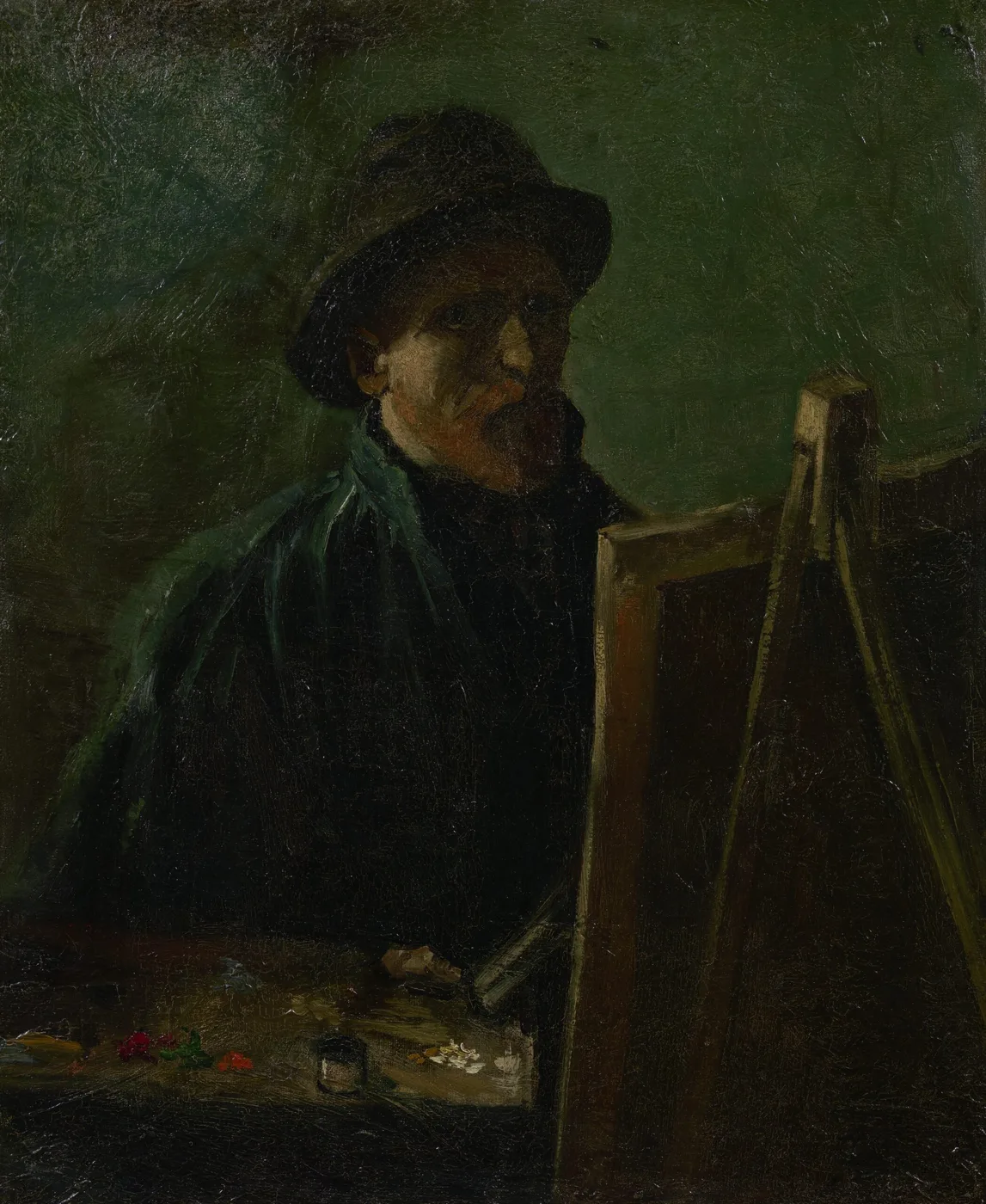
Van Gogh paints himself pressed near his easel, close enough that its wooden strut cuts across the lower right of the picture. He wears a dark felt hat pulled low over his brow, its brim throwing a soft shadow across his eyes. Beneath it his face is the only pale, warm note in the whole composition, built up in ochre and rose against the surrounding dark.
His gaze meets the viewer directly, neither posed nor performing. There is none of the theatrical intensity of his later Saint-Remy self-portraits here. This is a working painter caught mid-thought, beard reddish and unkempt, collar turned up against a chill that seems to belong to the room as much as the season.
A greenish-black coat covers his shoulders, its folds picked out in long, loose strokes rather than careful modelling. A scarf or collar of deeper green falls at his throat, echoing the murky olive of the wall behind him. Nothing in the clothing or the setting asks to be looked at. Everything directs the eye back to the face and, just below it, to his hands.
The Only Colour in the Room
Look down and the picture changes register entirely. In the lower left corner, on a table crowded with tools, Van Gogh has set down a small heap of paint: dabs of red, green, ochre and chalky white, squeezed straight from tube or scraped fresh onto the wood. It is the single passage of unguarded colour in an otherwise sombre canvas.
That contrast is the quiet argument of the whole picture. Everything around the painter, his coat, his hat, the wall, the easel, is painted in the tonal, closely valued browns and greens he had learned in the Netherlands. Only the palette itself admits what was coming: pure pigment, laid down almost carelessly, waiting to be picked up.
It reads less like decoration than like evidence. Here is the material a painter actually works with, set against the muted world he was still, at that point, choosing to paint in. The dabs of red and green are small, but they are the loudest thing in the picture.
Brushwork Still Rooted in Nuenen
The paint handling throughout is thick and searching rather than smooth. Van Gogh builds the coat and background with visible, dragged strokes, letting ridges of pigment catch the light unevenly across the surface. The wall behind him is not a flat field but a worked, scumbled green, brushed on in overlapping passes that keep the surface restless even where the colour barely changes.
This is still recognisably the technique of his Nuenen years, when he modelled form through tone rather than through separate strokes of contrasting hue. The face is the exception, built with slightly more care and a warmer key, as though he allowed himself more attention there than anywhere else in the canvas. Even so, nothing in the picture yet resembles the broken, prismatic touch he would adopt within months of settling in the city.
That gap between method and setting is what makes the portrait worth pausing over. It is not a painting about Impressionism, and it is not a painting still fully inside the Dutch tradition either. It sits exactly on the date it carries, a single year, 1886, caught between two ways of seeing.
What It Does on a Wall
Hung in a room, this is not a picture that announces itself from across a doorway. Its colours sit low and close together, greens sliding into blacks, browns into deeper browns, so that from a distance it can read almost as a single dark shape with a pale face suspended in it. Only on approach does the room resolve: the easel, the hunched shoulders, the small bright wound of colour on the palette.
Morning light draws out the warmth in the face and the faint red in the beard, softening the surrounding dark into something closer to green than black. By lamplight in the evening the tonal values collapse further still, and the painter’s eyes become the one place the picture holds onto you. It rewards being lived with rather than glanced at, a canvas that keeps a little of itself back on the first look.
The original hangs today in the Van Gogh Museum in Amsterdam, where it is catalogued among the artist’s earliest Paris work. Seen there or reproduced at home, it remains a small, deliberately unglamorous picture of a man deciding, in real time and in front of his own easel, what kind of painter he was about to become.
Sizes and materials for Self-Portrait as a Painter are listed on its product page.
More from this collection
Bring this painting home
Choose a hand-painted oil reproduction for real brushwork, or an archival canvas print for a crisp museum-image edition. Every size preserves the original proportions.
View this work & options
Further reading
Verify the original in the Van Gogh Museum collection record and continue through related works in the catalogue.