
Self-Portrait with Pipe: Story, Meaning & Brushwork
Arriving in Paris
Vincent van Gogh reached Paris in March 1886, moving into his brother Theo’s apartment with barely any warning. He was thirty-three, largely self-taught, and had spent the previous years painting weavers and potato eaters in the flat brown light of Nuenen. Paris was a different climate entirely, thick with the arguments of Impressionist and Neo-Impressionist painters he had only read about in letters.
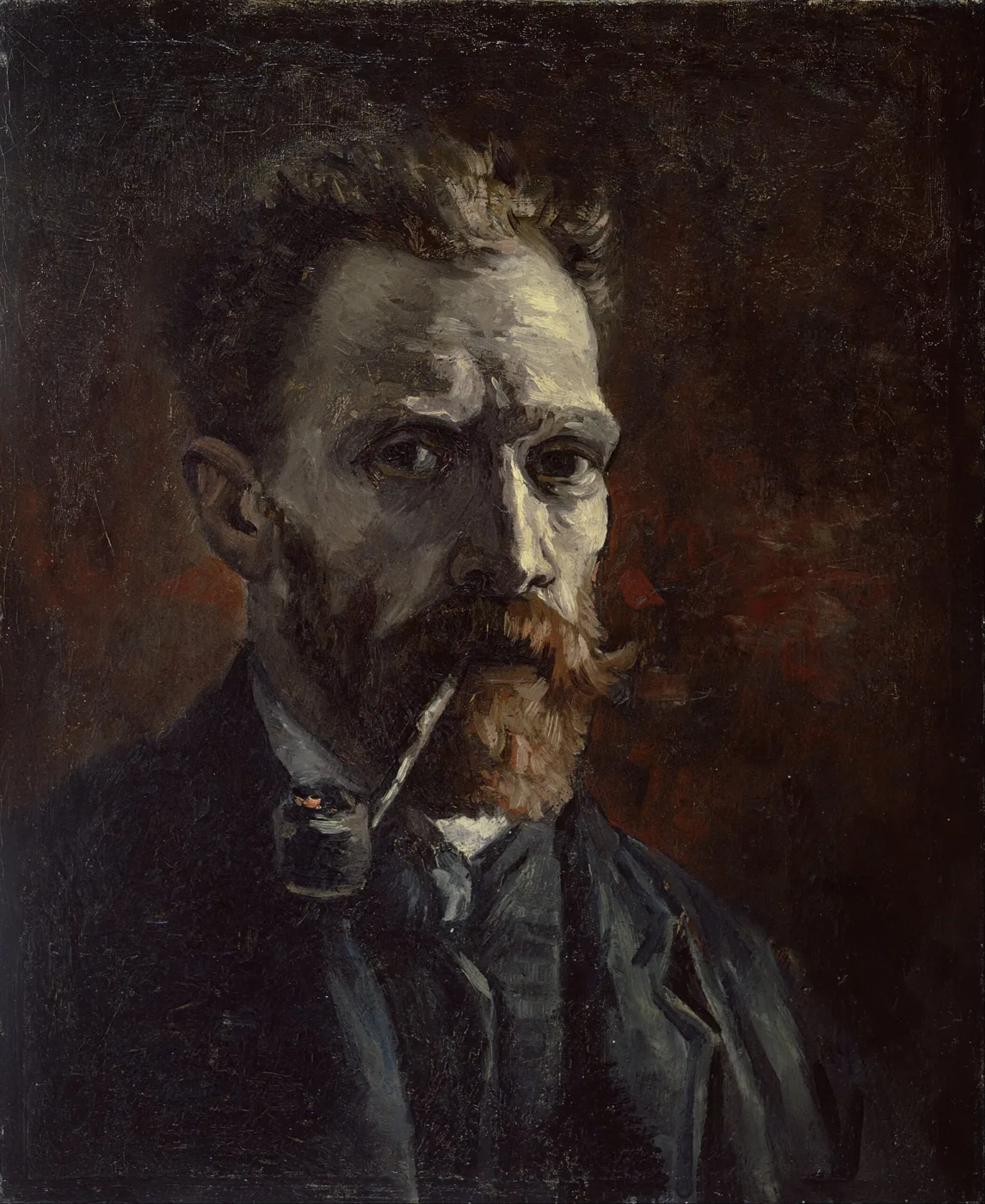
He did not arrive fluent in the new visual language around him. This self-portrait, painted in 1886, belongs to his first months in the city, before the broken colour and quickened brushwork of his later Paris canvases took hold. The palette is still largely the one he brought with him from the Netherlands.
A Face Half in Shadow
The painting is small, just 38 by 46 centimetres, and it asks to be looked at from close range. Van Gogh presents himself from the chest up, wearing a dark coat with a pale collar and cravat just visible beneath his beard. A clay pipe is clenched in his mouth, its stem angled downward, a thread of colour rising from the bowl.
Light falls from the upper left, catching the crown of his head and the left side of his face while the right side sinks into a warm, ruddy shadow. His hair and beard are a coppery ginger, painted in short, dry strokes that catch the light differently from the smoother modelling of the skin. His eyes do not meet the viewer directly; they are set slightly to the side, watchful rather than confrontational.
Behind him the ground is a dark, mottled red-brown, scumbled and worked with visible brushmarks rather than laid flat. It gives no sense of a room or a window, only a shallow, close atmosphere pressing in around the sitter. Against that darkness the pale forehead becomes the single brightest note in the painting, the place the eye returns to first.
Sitting for Himself
Van Gogh could not afford professional models with any regularity, and in Paris he turned to the one face that cost him nothing: his own. Over his two years in the city he painted himself upward of twenty times, using a small mirror propped in his room.
Each attempt let him test something without needing to negotiate a sitting fee or a stranger’s patience. A self-portrait could be started and abandoned in an afternoon, then picked up again the next day with the paint still workable. That repetition became, in effect, his private tuition in the new painting he was encountering at exhibitions and in artists’ studios around Montmartre.
Seen against the self-portraits he painted only a year or two later, with their broken dashes of colour and near-shocking brightness, this one reads as reticent. The pipe and the level gaze belong to a man still presenting himself in something close to his old Dutch manner, even as the city around him was pulling his eye elsewhere.
A Hand Still Loyal to Nuenen
The brushwork here is firm and built up in patches rather than the rapid, directional strokes that would soon define his mature style. On the forehead and cheek the paint is blended with some care, modelling the bone beneath the skin in greys, ochres and touches of green. The beard and hair are handled more freely, with short, springy marks that suggest texture without describing every strand.
The coat and background are painted more loosely still, almost as a foil to the tighter handling of the face. Van Gogh clearly wanted attention to settle on the head, and he used both light and paint handling to make sure it does. There is little of the impasto he would later pile onto canvas; the surface stays comparatively restrained throughout.
What makes the picture worth pausing over is exactly this tension between an old, careful hand and a new set of ideas pressing at its edges. Nothing here is showy, but the choice to paint his own unguarded, tired face, rather than a flattering or composed one, already carries the honesty that would mark his later self-portraits.
Where It Sits Now
The painting is held by the Van Gogh Museum in Amsterdam, part of a collection that traces his development year by year. Placed among his other 1886 Paris canvases there, it reads clearly as a hinge point, the moment before his colour opened up.
On a wall in a home, away from that sequence, it behaves differently. In low light the browns and near-blacks of the coat and background recede almost entirely, leaving the lit side of the face suspended on its own. Under a stronger lamp or daylight, the reddish undertones in the shadow and the ginger of the beard come forward, and the picture warms considerably.
It rewards the kind of looking Van Gogh himself was doing at the mirror: slow, close and repeated. A portrait this quiet does not announce itself across a room, but it holds attention once found, in the way a face glimpsed unexpectedly in a dim hallway holds attention.
Sizes and materials for Self-Portrait with Pipe are listed on its product page.
More from this collection
Bring this painting home
Choose a hand-painted oil reproduction for real brushwork, or an archival canvas print for a crisp museum-image edition. Every size preserves the original proportions.
View this work & options
Further reading
Verify the original in the Van Gogh Museum collection record and continue through related works in the catalogue.