
The Reaper (after Millet): Story, Meaning & Brushwork
Saint-Rémy, 1889: Painting Without a Model
By the late spring of 1889 Van Gogh had admitted himself to the asylum of Saint-Paul-de-Mausole at Saint-Rémy-de-Provence, a former monastery given over to the treatment of nervous disorders. He was allotted a small cell and, before long, a second room to use as a studio. Wheat fields ran almost up to the walls of the grounds, visible through the bars on his window.
Cut off from the models he had relied on in Arles, he turned back to an artist he had revered since his earliest years of drawing: Jean-François Millet. He began reworking a set of black and white prints after Millet’s compositions, treating them less as pictures to copy than as scores to be reinterpreted in colour.
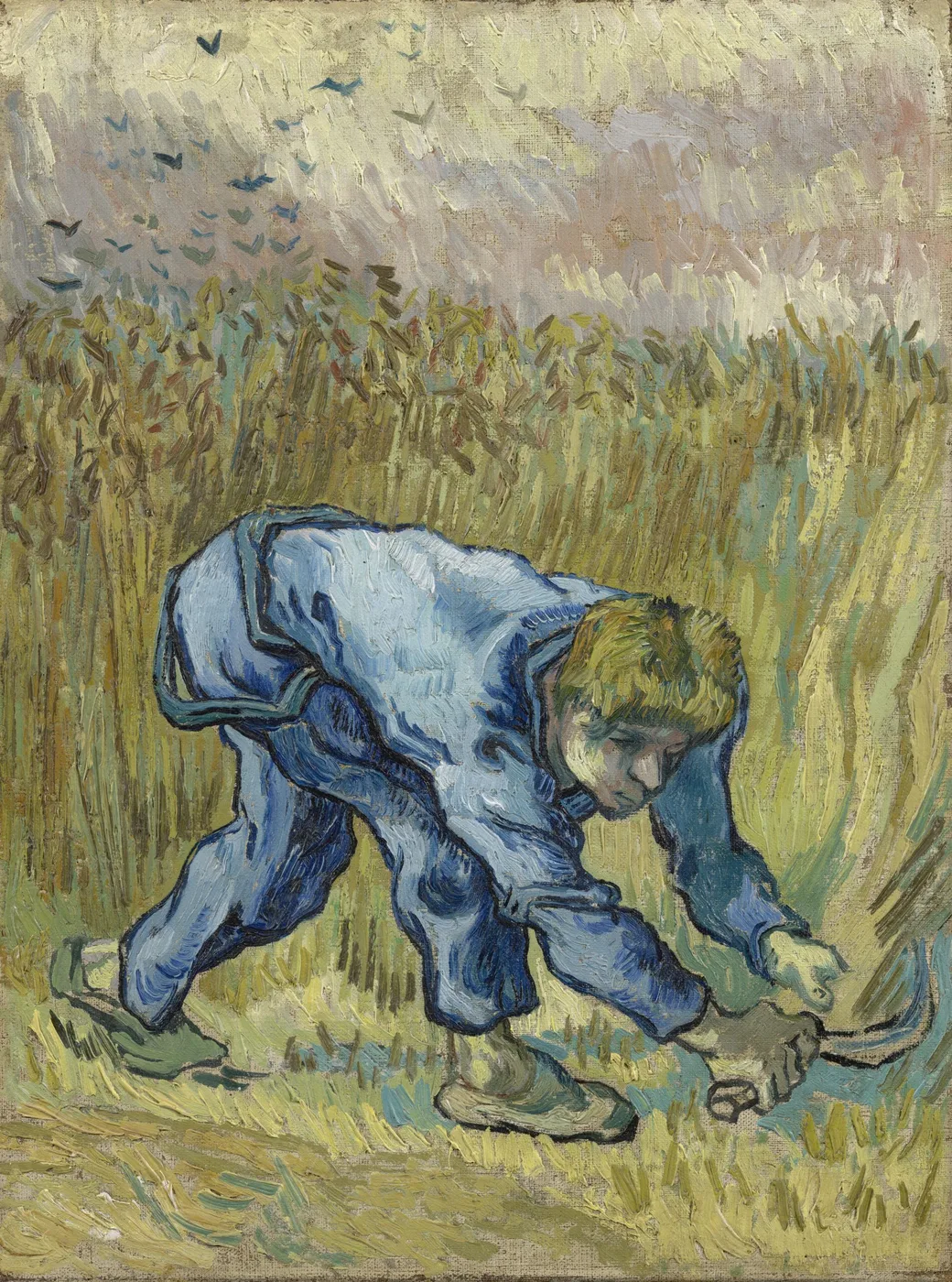
The Reaper, painted in 1889 and now held by the Van Gogh Museum, belongs to that sequence. Millet had drawn a man swinging a sickle through standing grain decades earlier; Van Gogh took the same pose and rebuilt it entirely in his own paint, his own light, and his own restless rhythm of brushwork.
A Single Figure Bent Low in the Wheat
At 33 by 44 centimetres, the canvas is small enough that the eye takes in the whole scene almost at once, then is pulled straight down to the man at its centre. He is bent nearly double, one hand gripping a curved sickle close to the stalks, the other braced against his own leg, caught mid stroke rather than posed for it.
His jacket and trousers are a deep, saturated blue, built up in thick, curling strokes that read almost like a separate weather system moving through the field. Around him the wheat is laid in short diagonal dashes of yellow, ochre and olive green, following the direction the grain would actually lean.
Above the field the sky lightens to pale cream and dusty rose, and a scatter of dark birds crosses it in loose, broken V shapes, each drawn in a handful of quick marks. There is barely a horizon line; the grain simply rises to meet the sky, so the whole image reads as one close, enclosed space with the reaper working inside it.
The blue of the clothing and the gold of the wheat sit almost opposite each other on the colour wheel, and Van Gogh leans on that contrast hard, letting the two fields of colour push against one another rather than blend. It is the loudest thing in the picture, louder even than the labour it depicts.
Death Recast as Daylight
Van Gogh wrote to his brother Theo about the reaper he was painting that summer, describing the figure as an image of death, though not one he found sorrowful. He set the cutting of the grain under full daylight and warm colour rather than shadow, so the act reads as part of a natural cycle rather than an ending to fear.
That reading sits easily against what was happening to him. Van Gogh was working through severe illness during his time at the asylum, and wheat, which he painted repeatedly that year in different states of growth and weather, became one of the few subjects he could return to again and again and still find something new in.
The reaper himself stays anonymous, his face turned down and largely hidden. What the picture asks the viewer to watch is not a portrait but a motion, repeated stroke after stroke, echoed in the repeated strokes of paint that build the field around him.
Blue Against Gold: How the Figure Was Built
Van Gogh outlined the man in dark, near-black contour lines, a technique closer to stained glass than to anything in Millet’s original drawing. Inside those outlines the paint sits in flat, confident planes of colour, the blue deepening to near black in the folds, cream and white catching where light lands on his back and shoulder.
The field around him is handled quite differently, in short broken strokes that never resolve into individual stalks but read, at a normal viewing distance, as one continuous moving surface. That contrast in touch, firm edges on the man, loose motion around him, is what keeps the eye returning to the figure even though he occupies a small part of the canvas.
The birds carry almost no modelling at all, just dark strokes dropped onto the pale sky, and they do more to suggest scale and distance than any use of perspective in the field itself.
On a Wall, as the Light Changes
Hung somewhere that gets real daylight, the painting shifts noticeably through the day. Overcast or morning light softens the blue of the reaper’s clothing into the greens around it, while a warmer, lower light pulls the gold of the wheat forward until it seems to press against the surface.
It rewards being looked at from two distances: up close, where the individual strokes separate out into their own small gestures, and again from across a room, where they resolve back into a single bent figure making his way through a field that appears to have no visible end.
Sizes and materials for The Reaper (after Millet) are listed on its product page.
More from this collection
Bring this painting home
Choose a hand-painted oil reproduction for real brushwork, or an archival canvas print for a crisp museum-image edition. Every size preserves the original proportions.
View this work & options
Further reading
Verify the original in the Van Gogh Museum collection record and continue through related works in the catalogue.