
Fritillaries in a Copper Vase: Story & Meaning
In the early months of 1887, Vincent van Gogh was living with his brother Theo in Montmartre, spending his days in the company of painters whose work he had barely known two years before. Pissarro, Signac and the circle around Seurat were pulling colour apart into its separate strands, and Van Gogh, watching and arguing and painting alongside them, began using cut flowers as his laboratory. They were cheap, they did not complain about sitting still, and they let him test one combination of colour against another without the pressure of a commissioned portrait or a landscape that had to be found and travelled to.
A Bouquet as a Colour Problem
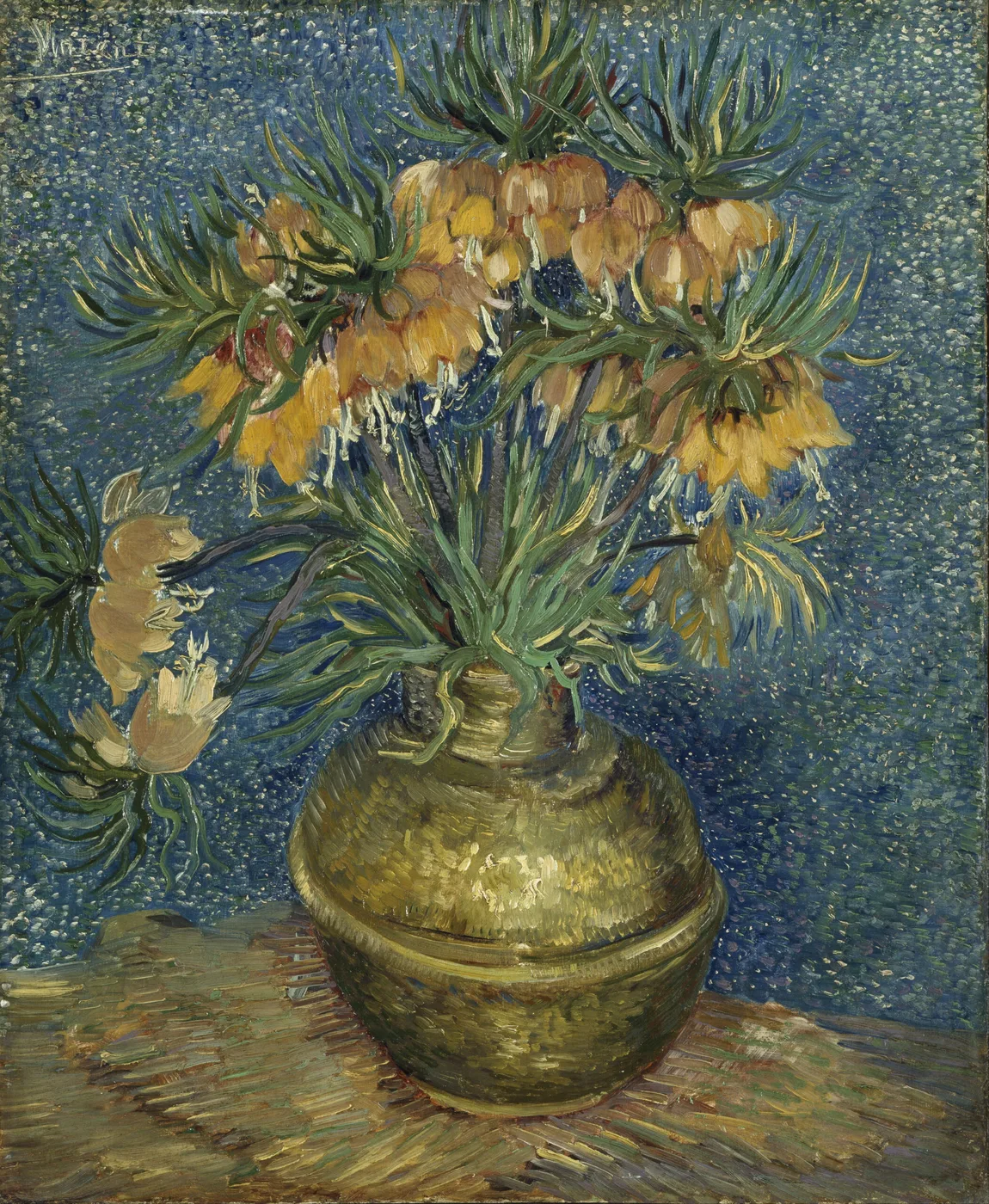
Fritillaries in a Copper Vase belongs to that run of flower still lifes from 1887, painted at a moment when Van Gogh was less interested in flowers as flowers than in what happened when one hue was set hard against another. Crown-imperial fritillaries, with their heavy bell-shaped heads, gave him a mass of warm orange and ochre to push against something cool.
He did not have to travel to find this motif or wait for weather to cooperate. A vase, a table and an afternoon were enough, and that practical freedom is part of why so many canvases of cut flowers survive from this single year of his life.
What Stands on the Table
The vase itself is a rounded copper pot, broad at the base and gathered in at the neck, its metal surface built from short dabs of ochre, olive and dull gold that catch and lose the light as the eye moves down its curve. Out of it rises a dense cluster of crown-imperial fritillaries, their orange and yellow-orange bells hanging downward on thin stems above a fan of long, spiky green leaves.
One flowering stem breaks from the main bunch and droops to the left, almost out of the vase entirely, its pale blooms catching light against the dark ground. It is a small asymmetry that keeps the bouquet from reading as a tidy, balanced arrangement, and it gives the composition a sense of a plant still behaving like a plant rather than a still life set-up.
Below, the table is laid in with crosshatched strokes of ochre, pink and green, a woven or ribbed surface rendered quickly, in clear contrast to the smoother handling of the copper above it. The signature sits in the upper left corner, over the mottled blue field.
Orange Against a Field of Blue
The background is where the picture does its real work. Van Gogh laid in a deep blue ground and then covered it with a scatter of small dots and short dashes in lighter blue and white, a field that hums rather than sits flat, and against it the orange of the flowers reads with far more force than it would against a plain wall.
Orange and blue sit opposite each other on the colour wheel, and Van Gogh was reading about exactly that kind of pairing during these Paris years, testing in paint what he was encountering in conversation and in his reading on colour theory. The dotted handling of the background also shows him trying out a technique close to the Neo-Impressionists’ broken colour, without adopting their strict system wholesale.
The result is a canvas where the flowers seem to advance and the background seems to vibrate rather than recede quietly, so the whole surface stays active from edge to edge.
The Paint Itself
Up close, the brushwork changes character from one part of the canvas to another. The petals are built from loaded, confident strokes that follow the curve of each bell-shaped bloom, the leaves are laid in with quick linear touches that flick outward from the stems, and the copper vase is worked in shorter, more deliberate dabs that describe its rounded metal form.
This is paint used descriptively and expressively at once. The strokes do not just fill in local colour, they carry the direction and pressure of the hand that made them, which is part of why the picture still feels immediate more than a century later.
At 60 by 76 centimetres, the canvas is close enough to life size in its main elements that the bouquet has real presence rather than sitting as a small decorative detail. It rewards the kind of close looking that a reproduction on a wall invites, where a viewer can step in to see the brushwork and step back to see the whole arrangement settle into place.
On a Wall
Hung in a room with changing daylight, a picture built on this much contrast keeps shifting. Morning light will pull the blue field forward and let the orange blooms sit warm and separate against it, while lamplight in the evening softens that contrast and lets the copper vase glow more than the flowers around it.
It is a picture that asks to be looked at more than once in a day, which is part of what makes a good still life different from a decoration chosen and then never really seen again. Fritillaries in a Copper Vase is held today by the Musée d’Orsay in Paris, the city where Van Gogh painted it in 1887, working out on canvas a set of colour relationships he would carry with him into the more famous paintings still to come.
Sizes and materials for Fritillaries in a Copper Vase are listed on its product page.
More from this collection
Bring this painting home
Choose a hand-painted oil reproduction for real brushwork, or an archival canvas print for a crisp museum-image edition. Every size preserves the original proportions.
View this work & options
Further reading
Verify the original in the Musée d'Orsay collection record and continue through related works in the catalogue.