
The Green Vineyard: Story, Meaning & Brushwork
By the end of September 1888, Vincent van Gogh had been in Arles for six months and was working faster than he ever had before. He was preparing the Yellow House for Paul Gauguin’s arrival, filling its rooms with canvases in a hurry that reads, even now, as urgency rather than haste. Among the fields he returned to that autumn were the vineyards south of the town, where the harvest was under way and the light was already turning.
He would paint the vines more than once that season, in different states of colour as the season advanced. The green vineyard, painted in 1888, catches an earlier moment than its better-known companion, the vineyard still mostly green with only the first patches of rust and copper showing through. It is a record of a specific week in a specific place, made on the spot and finished with the same speed it depicts.
A Field Still Turning
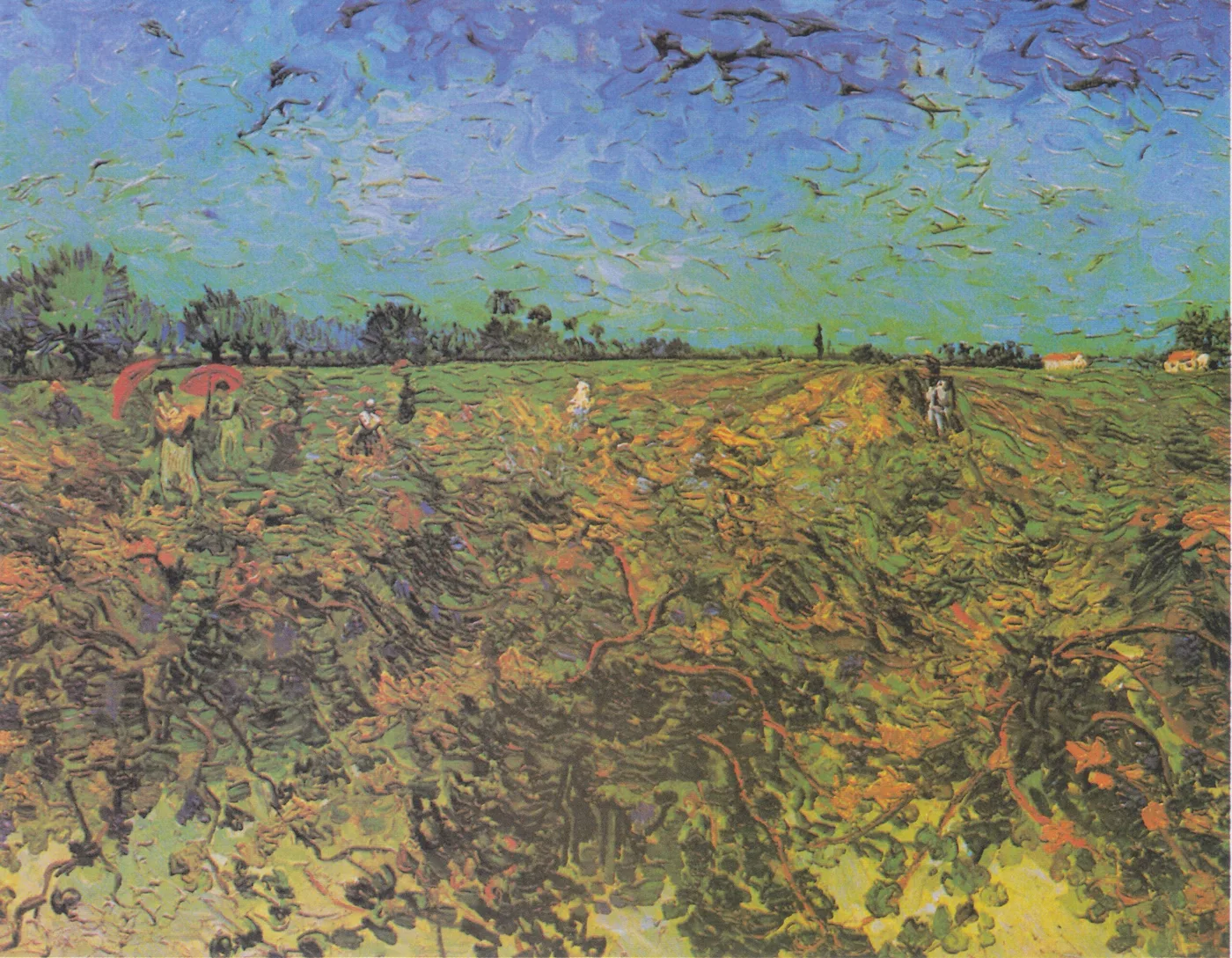
The canvas is given almost entirely to the vineyard and the sky above it, with barely a horizon line to separate the two. The rows of vines run from the lower edge of the picture back towards a thin strip of trees and rooftops, so that the eye is pulled into the field rather than across it.
Green dominates, but it is not a single green. Van Gogh lays in olive, sap green and a sharper acid green side by side, then threads them with orange, rust and touches of violet where the foliage has already begun to turn. The effect is of a field caught mid-change, neither fully green nor yet given over to autumn.
Small houses sit on the horizon at the right, their roofs a warm ochre against the cooler distance. They anchor the scene in a real, inhabited stretch of countryside rather than an imagined one, the kind of working landscape van Gogh had come to know well by his second summer in Provence.
The People Working the Rows
Figures are scattered through the vines, small against the scale of the field. On the left, a woman shelters under a red parasol, its colour the single sharpest note of red in the whole canvas and the first thing the eye finds. Beside her, another figure bends low among the leaves, close enough in handling to be identified only by posture rather than detail.
Further into the field, more workers appear in twos and threes, their forms reduced to a few strokes of dark cloth and pale flesh tone. On the right, two figures stand close together near a darker mass of foliage, watching or resting rather than picking.
None of these people is painted with individual features. Van Gogh gives them just enough form to read as human labour, figures doing a job that would have been entirely ordinary to anyone living near Arles in September, and leaves the rest to the vines around them.
A Sky That Will Not Sit Still
The upper half of the canvas is sky, and it is anything but calm. Van Gogh builds it from short, dark, comma-shaped strokes set against a ground of blue and pale green, so that the whole expanse seems to flicker rather than sit still.
Whether those dark marks read as birds, as wind moving through unseen cloud, or simply as agitated brushwork, they give the upper half of the picture the same restlessness as the field below. Nothing in this painting is inert.
The contrast matters. Below, the vine rows have a structure and a direction, running back in disciplined lines. Above, that order gives way to something closer to weather, a sky that seems to be moving even though the picture holds still.
How the Paint Sits on the Canvas
Van Gogh worked this scene in short, loaded strokes, laid one against the next without much blending, so that the brushwork itself carries the direction of growth in the vines and the movement of air above them. Up close, the picture breaks into hundreds of individual marks. Standing back, those marks resolve into rows, leaves and figures.
The paint is thick enough in places to catch real light, ridges of pigment that throw small shadows across the surface depending on where a lamp or window sits. This is not a flat picture, and it was never meant to be looked at only from a fixed, ideal distance.
Colour does much of the structural work that drawing might otherwise do. Complementary pairs, green against red, blue against orange, keep the eye moving across the canvas, from the parasol to the rust-coloured leaves to the warm rooftops on the horizon.
Living With the Painting
At 92 by 72 centimetres, The green vineyard is large enough to hold a wall on its own, without needing company. Hung where daylight reaches it at an angle, the impasto catches and loses light through the day, so the field seems to shift in exactly the way a real vineyard would as the sun moves.
In the evening, under lamplight, the reds and oranges tend to come forward, while the dark strokes in the sky recede into the blue around them. The painting reads differently depending on the hour, which is fitting for a picture so concerned with a landscape mid-change.
The original hangs in the Kröller-Müller Museum, one of the largest holdings of van Gogh’s work anywhere, where it sits among the other paintings from his Arles period. Seen there or reproduced at home, it remains a record of a working autumn field, painted by someone who needed, that season, to work as fast as the land in front of him was changing.
Sizes and materials for The green vineyard are listed on its product page.
More from this collection
Bring this painting home
Choose a hand-painted oil reproduction for real brushwork, or an archival canvas print for a crisp museum-image edition. Every size preserves the original proportions.
View this work & options
Further reading
Verify the original in the Kröller-Müller Museum collection record and continue through related works in the catalogue.