
Wild Flowers and Thistles in a Vase: Story
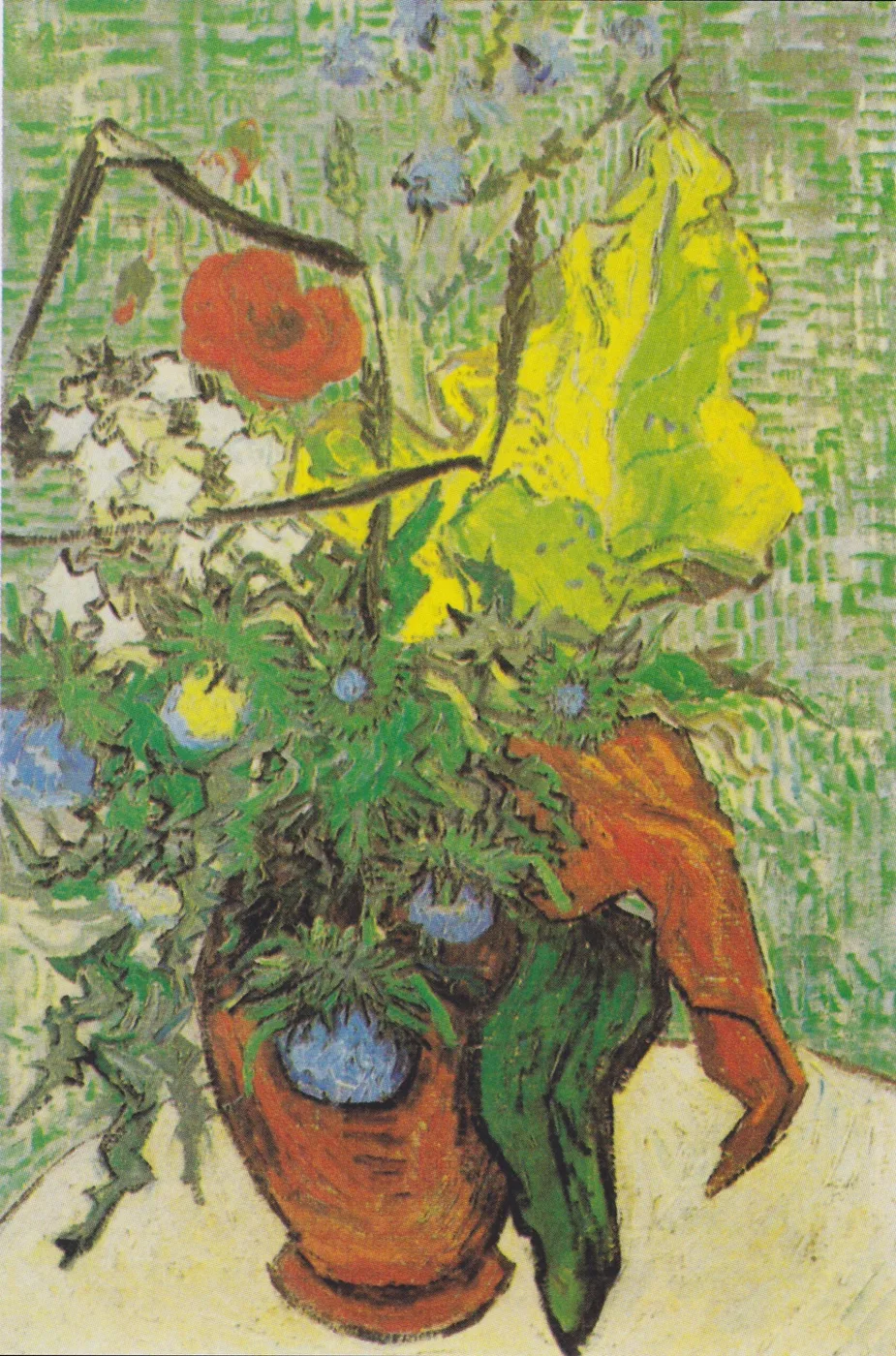
By the early summer of 1890 Vincent van Gogh had settled in Auvers-sur-Oise, a village on the Oise river north-west of Paris, under the informal watch of Dr Paul Gachet. He was working at a furious pace, sometimes finishing more than one canvas a day, and among the wheat fields and cottage gardens he kept returning to a simpler subject close at hand: whatever flowers, weeds and cut stems he could gather into a jug on the table in front of him. Wild Flowers and Thistles in a Vase belongs to this last burst of work.
It is a small, upright canvas, just 47 by 67 centimetres, quickly filled with as much colour and incident as Van Gogh could pack into it. Nothing about it looks arranged for effect. It reads instead like a bouquet snatched from a verge or a garden edge and pushed into the nearest container before it wilted.
A Jug Filled with Whatever Came to Hand
The vase holds a mixed, unruly bunch: spiky green thistles, a cluster of small white blossoms, sprays of pale blue cornflowers, and a single red poppy that breaks through near the top left like a spark. There is nothing cultivated about the selection. It is the kind of bouquet made from what grows wild at a field’s edge rather than what a florist would choose.
Van Gogh gives each flower its own small passage of paint rather than blending them into a general mass. The poppy is a few strokes of saturated red laid over white. The cornflowers are dabs of blue with a darker centre. The white blossoms are built from short, dry touches that catch the light without ever resolving into individual petals.
Two broad leaves interrupt the tangle of stems. One, acid yellow-green, droops heavily to the right of the vase, its surface streaked with darker veins that follow the leaf’s own curl. The other, a deep rust-orange, hangs down over the vase’s shoulder like a scarf someone has thrown across it, its tip curling almost to the tabletop.
An Earthenware Vase, Wide and Plain
The container itself is a plain reddish-brown earthenware vase with a wide, open mouth, its interior glazed a pale blue that Van Gogh lets show clearly at the rim. He paints it with the same loaded, visible brushwork as everything else in the picture, dragging the brush in short strokes that follow the curve of the pot rather than smoothing it into an even surface.
Beneath the vase, the tabletop is barely more than a few strokes of cream and pale ochre, just enough to place the arrangement in space. Van Gogh spends almost no time on it. Nearly all of the painting’s weight sits in the crowded upper two-thirds of the canvas.
Hatched Green Behind the Bouquet
Behind the flowers, the wall is built from short, repeated diagonal strokes of green, grey and white, laid down in a dense cross-hatch that never quite settles into a single tone. Up close it reads as pure texture. From a normal viewing distance it reads as a wall, but a wall that seems to vibrate faintly around the still, solid shape of the vase.
This kind of hatched, directional stroke recurs across Van Gogh’s late paintings and drawings, applied here to a plain interior wall rather than to a field or a sky. The effect is to keep the background alive without letting it compete with the bouquet in front of it.
The colour balance follows a logic Van Gogh had been testing for years: greens and blues pushed hard against their opposites, red and orange and yellow. The single poppy carries almost the full weight of red in the painting, and it sits exactly where the eye will find it first, high and slightly left of centre against the cooler green ground.
Paint Laid Down at Speed
The handling throughout is fast. Stems are single continuous lines pulled straight in one movement of the brush, some running nearly the full height of the canvas without a break. Thistle leaves are jagged, almost scratched into the surface, their serrated edges rendered as quick angular jabs rather than careful outlines.
There is no sign of correction or overworking anywhere in the picture. Wild Flowers and Thistles in a Vase reads as a painting made in a single sitting, from a bunch of stems that would not have lasted much longer than that sitting itself.
On a Wall at Home
Hung in a room with any natural light, the painting changes through the day in ways a flat image on a screen cannot suggest. Morning light picks out the raw red of the poppy and the blue glaze inside the vase; by evening the hatched green background deepens and the two hanging leaves, yellow and rust, start to dominate instead.
It rewards being looked at from close in and from across a room. Close up, the canvas is a record of quick, individual decisions, stroke by stroke. Standing back, those same strokes settle into a bouquet that still looks freshly cut, more than a century after it was painted in 1890.
Sizes and materials for Wild Flowers and Thistles in a Vase are listed on its product page.
More from this collection
Bring this painting home
Choose a hand-painted oil reproduction for real brushwork, or an archival canvas print for a crisp museum-image edition. Every size preserves the original proportions.
View this work & options
Further reading
Verify the original in the collection record and continue through related works in the catalogue.