
Two Children: Story, Meaning & Brushwork
A Household in the Last Weeks at Auvers
In May 1890, Vincent van Gogh arrived in Auvers-sur-Oise, a village on the Oise river within easy reach of Paris by train. He had left the asylum at Saint-Rémy hoping for a quieter, more sociable life, and he found lodgings above a café run by the Ravoux family. Doctor Paul Gachet, an amateur painter and collector, kept an eye on his health and became one of his last close acquaintances.
The pace of work in those weeks was extraordinary. Van Gogh painted almost every day, often completing a canvas within hours, turning to whatever subject was near at hand: the wheatfields beyond the village, the church, the thatched cottages, and the people who lived among them. Children were among his readiest sitters, more patient than many of the adults of Auvers, who remained wary of the artist’s reputation.
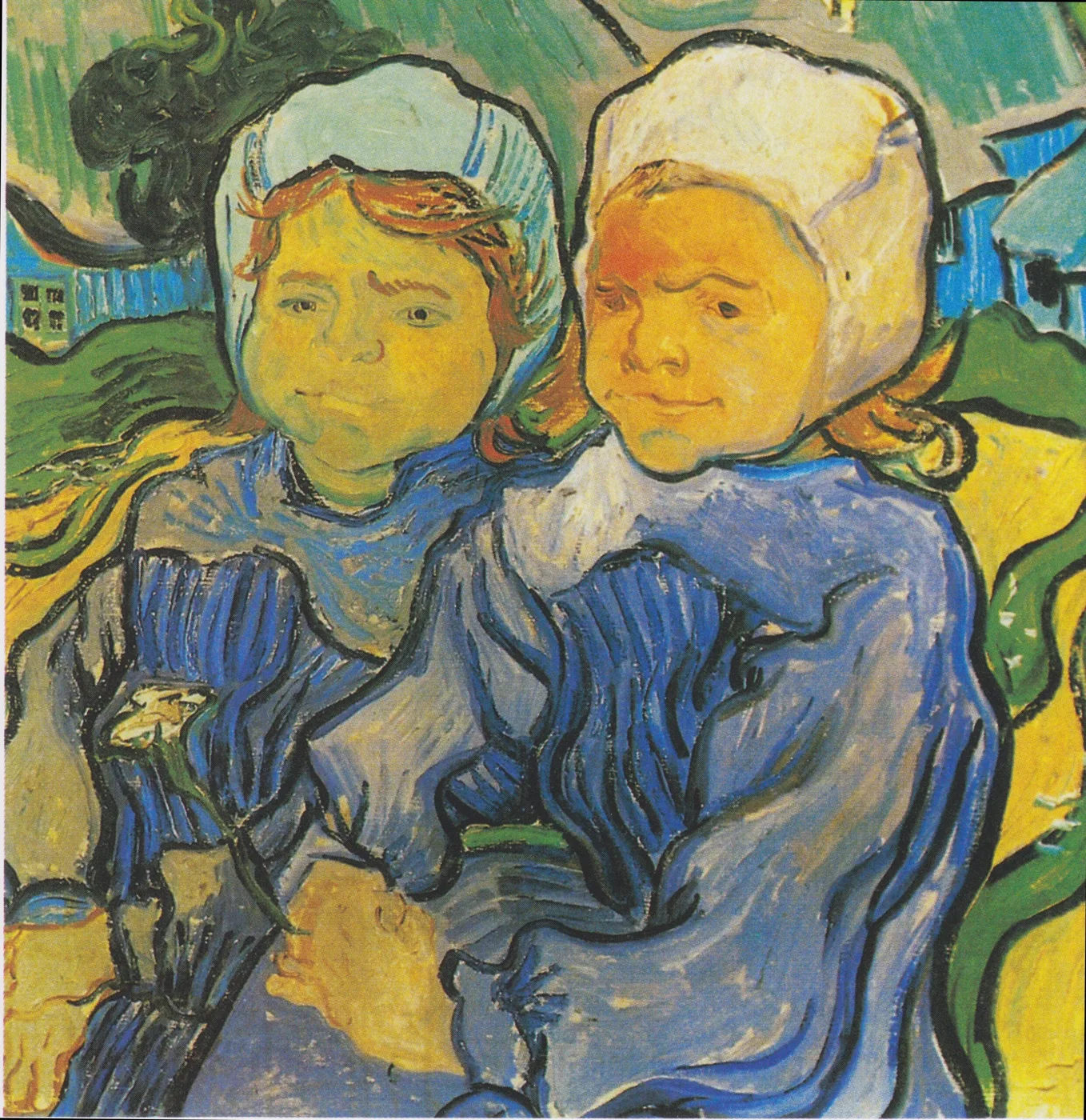
Two Children belongs to this final, urgent stretch of work. Painted in 1890, in the same weeks that produced some of his best-known late canvases, it shows two young village children posed closely together, seen from the chest up against a loosely brushed outdoor setting.
Two Faces, Held Close
The painting brings its subjects right up to the picture plane. Two children, dressed alike in blue smocks and white bonnets, sit shoulder to shoulder, so close that their caps nearly touch. Their round, sunlit faces dominate the upper half of the canvas.
The child on the left looks out with a faint, private smile, red-gold hair escaping from under the bonnet. The child on the right, turned very slightly away, has a more solemn set to the mouth, with eyebrows drawn together above a direct stare. Between them, a small pale flower on a curling green stem is held low, its petals barely more than a few strokes of white and yellow paint.
Behind the two heads, van Gogh sketches in a fragment of the village: a low house with blue-shuttered windows to the left, patches of a wall or roof in blue to the right, and around it all the loose green and gold of a garden or field caught in a few rapid passes of the brush.
Colour Pushed to Its Limit
The palette is high-keyed and deliberately narrow. Egg-yolk yellow fills the faces and much of the ground, set directly against cobalt and ultramarine blue in the smocks and the slivers of sky and building behind. Green threads through the background in long, curling strokes, standing in for grass, hedge and tree in a single sweep of colour.
There is almost no attempt at the softening an academic portrait painter would have used. Shadows on the cheeks are laid in with orange and red rather than grey, and the whites of the bonnets carry streaks of blue and green picked up from their surroundings. The effect is a picture that reads as bright and slightly feverish even in reproduction, the colour doing the work that modelling would normally do.
Outline as Structure
What holds this intensity of colour together is line. Every edge in the picture, the rim of a bonnet, the collar of a smock, the curve of a cheek, is drawn round in a heavy, unbroken band of dark paint, closer to the leading of a stained-glass window than to conventional portrait drawing. Van Gogh had experimented with this kind of contained, flat colour before, and at Auvers he used it to keep his fastest, loosest brushwork from dissolving into pure texture.
Inside those outlines the paint itself is anything but flat. The smocks are built from short, repeated strokes, some dragged straight down, some curved with the fold of the cloth, laid on thickly enough that the ridges of paint still catch raking light on the canvas today. The faces are calmer, built in smoother patches of yellow and orange, so that the eye settles there first before it takes in the restless brushwork of the clothing and the background.
The whole canvas measures 51 by 51.2 centimetres, close to square, a format that suits this composition of two heads set side by side rather than a single figure loose in a landscape.
On a Wall, in Changing Light
Hung where daylight reaches it, Two Children shifts through the day. Morning light picks out the impasto ridges in the blue smocks and throws small shadows along every dark contour line. By evening, under a lamp, the yellows and oranges of the faces come forward and the picture reads warmer, closer to candlelight than daylight.
It is not a large picture, and it was not painted as a public statement; it belongs to the same private, working attention van Gogh gave that summer to a garden or a stretch of wheat. Seen at close range, in a room rather than across a gallery, that intimacy is the point: two children, briefly still, looked at hard and painted fast.
The original hangs today in the Musée d’Orsay in Paris, among the other paintings from van Gogh’s Auvers period, a record of how much he saw and set down in the ten weeks he had left.
Sizes and materials for Two Children are listed on its product page.
More from this collection
Bring this painting home
Choose a hand-painted oil reproduction for real brushwork, or an archival canvas print for a crisp museum-image edition. Every size preserves the original proportions.
View this work & options
Further reading
Verify the original in the Musée d'Orsay collection record and continue through related works in the catalogue.