
Haystacks under a Rainy Sky: Story, Meaning & Brushwork
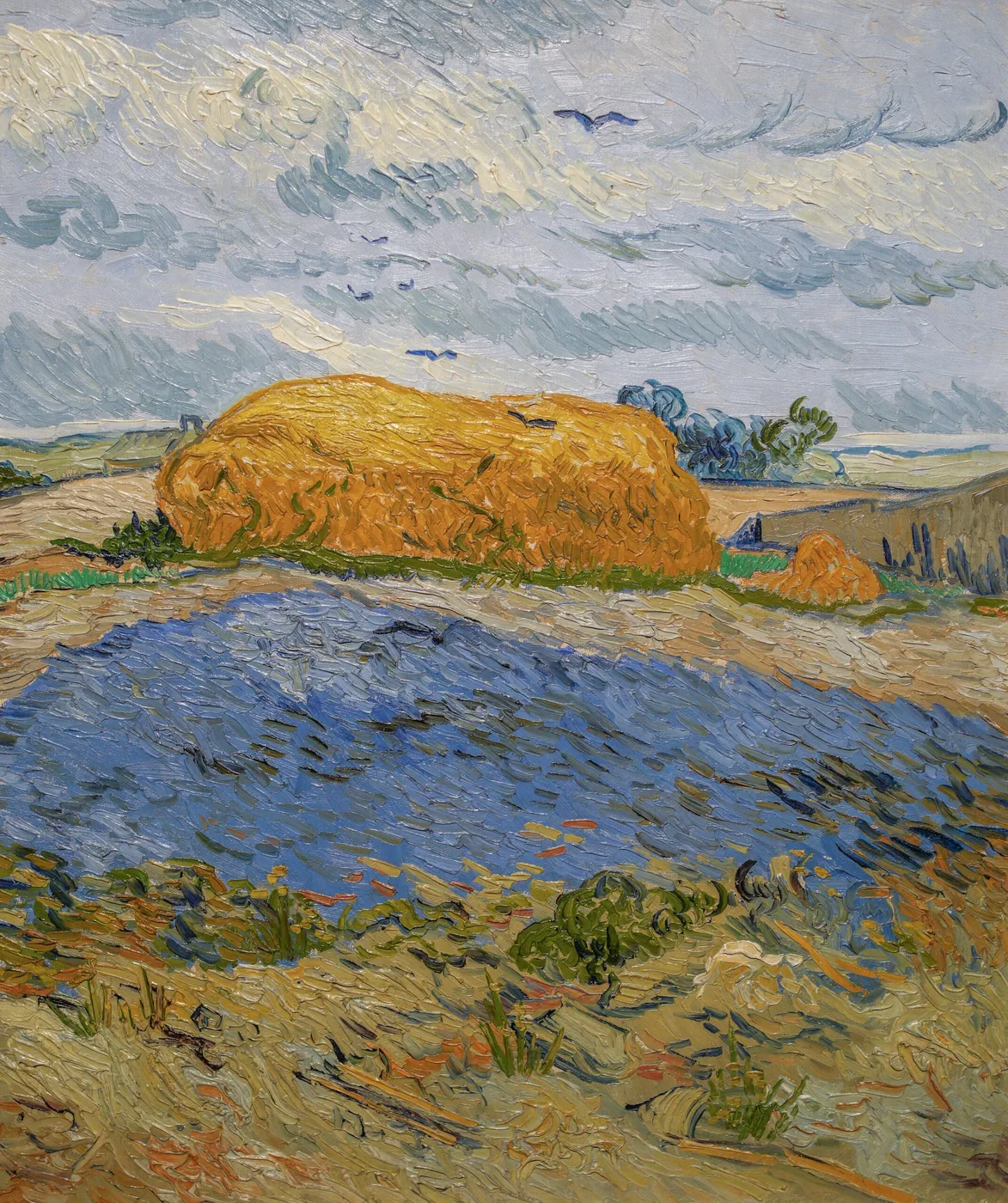
By the late spring of 1890, Vincent van Gogh had left the asylum at Saint-Remy and settled in Auvers-sur-Oise, a village on the Oise river within easy reach of Paris and of his brother Theo. He worked under the loose watch of Dr Paul Gachet, in rooms above a café, and he painted at a pace that still startles people who try to count the canvases: something close to one a day, many of them wide views of the wheat country that surrounded the village. Haystacks under a Rainy Sky belongs to that final burst, painted in 1890, in the weeks before his death in July of that year.
A Village Ringed by Wheat
Auvers sat in open farmland, and by midsummer the fields around it were full of standing grain, cut stooks and the great domed ricks that stored a season’s harvest against the weather. Van Gogh had painted this kind of subject before, at Arles and at Saint-Remy, but at Auvers he returned to it with a new urgency, working the same stretch of plain in different light and different states of sky.
He was not illustrating agricultural life so much as testing how far a landscape could carry feeling. A haystack, a road, a line of hills: these were plain enough motifs that the picture’s charge had to come entirely from colour and the movement of the brush.
One Great Rick, and the Sky Behind It
The picture is built around a single dominant haystack, its rounded golden mass filling the middle distance and catching nearly all the warm light in the composition. A second, smaller rick sits just behind and to its right, half turned away, with a stand of dark trees and the corner of a low building beyond it.
In front of the haystack the ground opens into a wide hollow, its surface rendered in cool blue-violet strokes that read as standing water or deep shadow cutting across the pale stubble of the field. Loose grasses and low green scrub push up through the foreground in quick, scattered marks of green and rust, bringing the eye right up to the picture plane before it travels back to the rick.
Above it all the sky takes up more than half the canvas, a mass of curling grey-white cloud moving in long bands from left to right. Small dark birds cut across that sky in a loose scatter, their wings a few economical strokes of near-black against the pale ground, giving the only hard, sharp marks in an otherwise soft and rolling picture.
How the Paint Sits on the Canvas
Van Gogh worked this canvas, which measures 52.5 by 64 centimetres, with the same restless, directional brushwork that marks his last Auvers pictures. The clouds are not blended but built from separate curved strokes, each one following the turn of the sky, so that the whole upper half of the painting seems to be in motion even though nothing in it is falling or blowing.
The haystack itself is laid in with shorter, denser strokes of ochre, gold and burnt orange, thick enough to catch real light across the paint surface and give the rick a weight the surrounding field does not have. Touches of green and brown define the base where straw meets earth, and a few darker accents mark the birds that have settled or are about to land on its flank.
The blue hollow in the foreground is handled almost as freely as the sky, with the same long curved strokes turned on their side, so that water, cloud and field share a single restless rhythm of paint even though they are three different substances. That repetition is part of what holds the composition together: nothing in it sits still.
Colour throughout stays close to a narrow, considered range: ochres and golds in the rick, blue-violet in the shadowed ground, sober greys and whites in the sky, with green kept mostly to the near foreground. It is a muted palette by van Gogh’s own standards, closer to the tempered colour of his last weeks than to the high-keyed yellows of Arles.
Where the Painting Has Lived
The painting is held today by the Kröller-Müller Museum, in the Netherlands, part of a collection built around exactly this kind of late van Gogh landscape. Its presence there places Haystacks under a Rainy Sky alongside other works from the same Auvers months, pictures made within sight and sound of one another in a single short season.
What the Picture Gives a Room
Hung where daylight reaches it, the painting changes hour to hour in a way flatter, more evenly lit landscapes do not. Morning light picks out the gold of the rick and lets the blue hollow read almost as cool shade; by evening the whole surface tends to grey down, and the sky’s curling strokes become the dominant event in the room.
It rewards a close look as much as a passing one. From across a room it reads simply as a haystack under a heavy sky; up close, the picture resolves into hundreds of individual, deliberate marks, each one still carrying the direction and pressure of the hand that made it in 1890.
Sizes and materials for Haystacks under a Rainy Sky are listed on its product page.
More from this collection
Bring this painting home
Choose a hand-painted oil reproduction for real brushwork, or an archival canvas print for a crisp museum-image edition. Every size preserves the original proportions.
View this work & options
Further reading
Verify the original in the Kröller-Müller Museum collection record and continue through related works in the catalogue.