
Portrait of Adeline Ravoux (Blue): Story
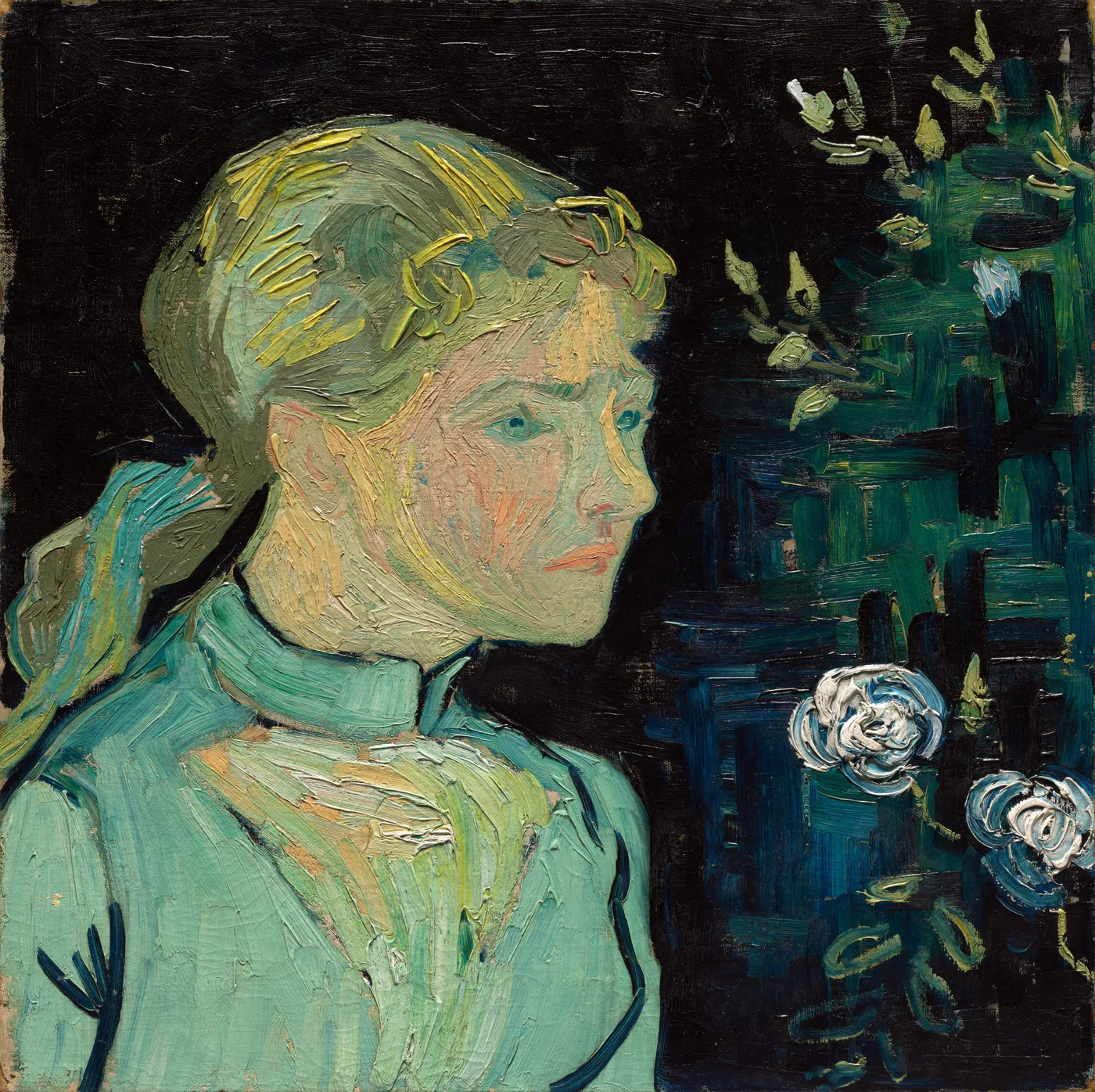
By the early summer of 1890, Vincent van Gogh had left the asylum at Saint-Remy and settled in Auvers-sur-Oise, a village north-west of Paris chosen partly for its nearness to his brother Theo and partly for the presence of Dr Paul Gachet, who had agreed to watch over him. He took a room above the Ravoux inn on the Place de la Mairie, paying a few francs a day for board and a narrow attic under the eaves. It was there, in the last ten weeks of his life, that he painted at a rate that still startles historians, often finishing a canvas in a single sitting.
Among the people he had ready access to in that house was the innkeeper’s daughter, Adeline Ravoux, thirteen years old that summer. She sat for him twice in his final month, and this picture, painted in 1890 and now known simply as Adeline Ravoux, is one result. It is a square canvas, 50.5 by 50.2 centimetres, and it now belongs to the Cleveland Museum of Art.
A girl who happened to be there
Adeline later recalled sitting for van Gogh with some discomfort, unused to the attention and unconvinced by the finished likeness. She was not a professional model, simply a girl in the house where he lodged, available to him in the way a landscape or a vase of flowers was available.
That ordinariness is part of what the painting carries. There is no attempt to flatter her or to soften her into a conventional picture of youth. Her expression is steady and a little guarded, the look of someone sitting still because she has been asked to and would rather be doing something else.
Van Gogh gives her that seriousness without irony. He had painted children and young women before, in Nuenen and in Arles, and he generally treated them with the same close, undecorated attention he gave the postman Roulin or his own reflection.
Blue on blue, with a spray of white
Adeline is turned almost in profile, her face angled to the right against a ground of deep blue-black. Her dress is a pale, chalky turquoise with a high, buttoned collar, the same cool family of colour as the background but several shades lighter, so that her head and shoulders sit forward from the dark behind her.
Her hair is caught back and tied with a ribbon in the same green-blue as the dress, and van Gogh has picked out loose strands at the crown with strokes of yellow and ochre, the one passage of warm colour in the upper half of the canvas besides her skin. The face itself is built from peach, rose and pale orange, with a line of green shadow along the jaw that keeps it from ever separating out of the blue harmony around it.
To the right, filling roughly a third of the square, a flowering branch rises out of the dark ground, its leaves in blue-green and its two open blossoms painted in thick, curling strokes of near white. The flowers give the eye somewhere to rest after the face, and they echo, in a different register, the pale turquoise of the dress.
The whole background reads first as flat darkness and only on closer looking resolves into that planted branch, as though the room behind Adeline had been simplified down to a single ornamental fact.
Paint laid on in short, decided strokes
Van Gogh worked this canvas quickly, and it shows in the handling. The dress is built from long, parallel strokes of thick paint, ridged enough to catch a raking light, while the hair is a scatter of shorter marks that keep changing direction as they follow the curve of the head.
He outlines the profile in a dark, almost black line, a habit he had picked up in part from the Japanese woodblock prints he collected and pinned to his walls, and that line does the work of holding the flat colour shapes together without any conventional modelling in light and shade.
Nothing here is blended smoothly. Colour is set down as colour, blue next to green next to peach, and the picture depends on those relationships rather than on illusionistic depth to make the face come forward and the background recede.
What the picture asks of a room
Hung where daylight reaches it at an angle, the ridges of paint in the dress and background catch and lose the light as the day moves, so the surface is never quite still even though the sitter is. In a room with warm artificial light in the evening, the blues read cooler by contrast, and the small notes of orange in the hair and skin become more insistent.
It is not a large or a loud picture. Its square format and close, cropped view of a single figure make it work at close range, in a hallway or a study, somewhere a person passes often enough to keep noticing new things in it: the exact green of the ribbon, the white flowers catching light from a window, the steadiness in a thirteen-year-old’s eyes near the end of a summer that did not have much longer left to run.
Sizes and materials for Portrait of Adeline Ravoux are listed on its product page.
More from this collection
Bring this painting home
Choose a hand-painted oil reproduction for real brushwork, or an archival canvas print for a crisp museum-image edition. Every size preserves the original proportions.
View this work & options
Further reading
Verify the original in the Cleveland Museum of Art collection record and continue through related works in the catalogue.