
Portrait of Augustine Roulin: Story, Meaning & Brushwork
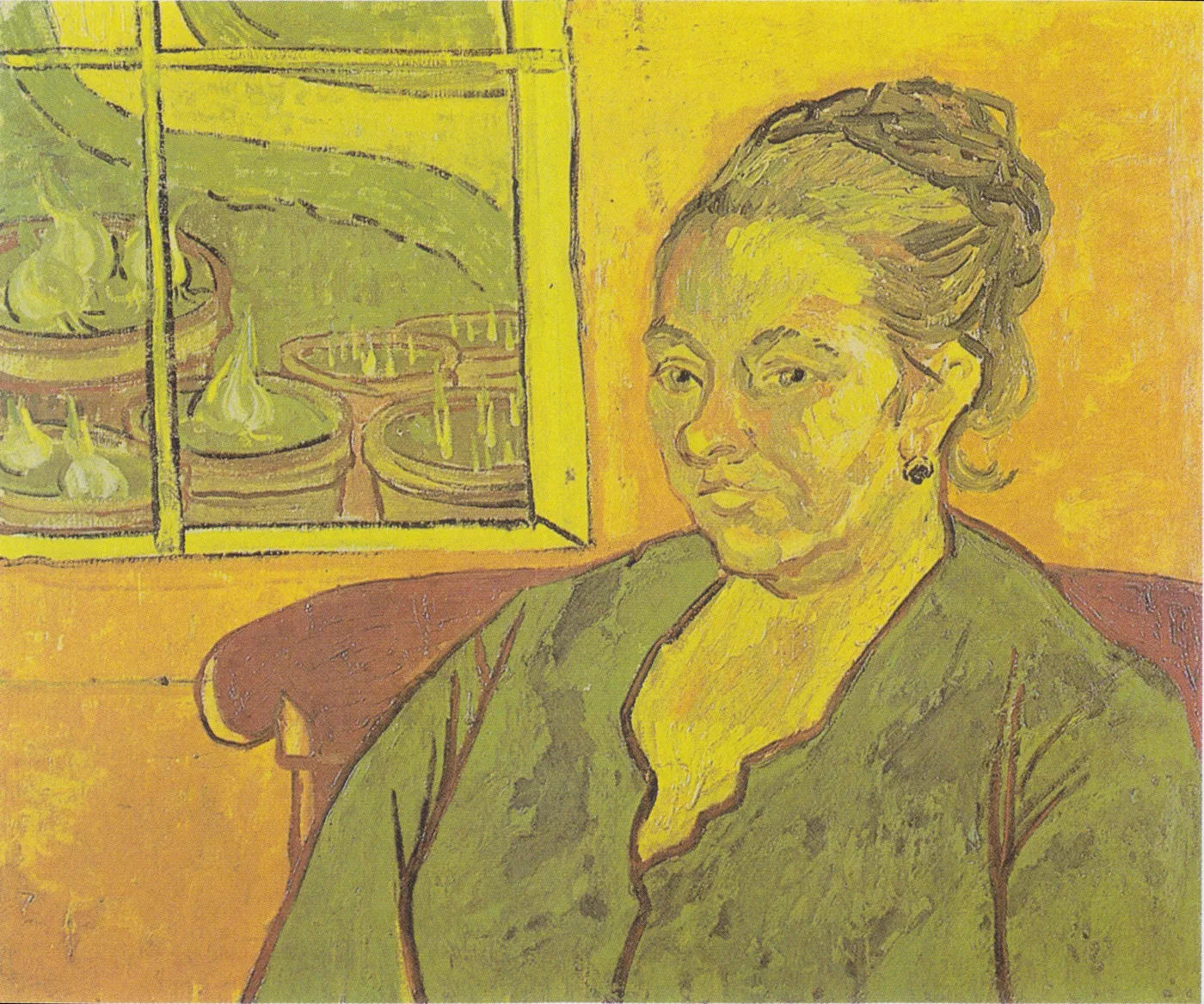
By the autumn of 1888 Vincent van Gogh had been in Arles for the better part of a year, chasing the light he believed the south could give him and finding, instead, mostly isolation. Paul Gauguin’s arrival that October changed the daily rhythm of the Yellow House, but it was an older, quieter attachment that kept van Gogh painting through that stretch: the family of Joseph Roulin, the local postal official, who had become something close to the artist’s only steady company in the town. Roulin’s wife, Augustine, sat for him more than once that year, and this portrait, painted in 1888 and measuring 65 by 55 centimetres, is one record of those sittings.
Nothing about the picture reads as a commission. Augustine Roulin was not a patron and there was no fee changing hands; she was a woman van Gogh had come to know through her husband, agreeing to sit because the family had, in effect, taken him in. That circumstance shapes the picture as much as any formal choice does.
A household that became a subject
Van Gogh had few people in Arles he could call friends. Letters and later accounts agree that the Roulins, ordinary and unglamorous as they were, gave him something like a surrogate family at a point when he badly needed one.
He painted the whole household repeatedly through 1888 and into the following year: Joseph in his postal uniform, the children, and Augustine herself in more than one sitting. This canvas belongs to that sequence, a working relationship built on trust rather than transaction.
That distinction matters for how the sitter is handled. There is no flattery in the picture, no attempt to soften Augustine Roulin into an idealised type. She is painted as someone he actually knew, tired and steady in equal measure.
The room behind her
She sits turned slightly to one side, hands out of view below the frame, her olive-green dress buttoned high to the throat. A dark comb holds her hair back from her face, and a small dark earring catches what little separate light there is.
Behind her the wall is flat, unbroken yellow-orange, giving the picture no real depth and no window onto anywhere else. It is not a domestic interior so much as a field of colour that happens to have a woman sitting in front of it.
At the upper left, a smaller picture hangs on that same wall, its own square of green showing shallow baskets of onions or garlic bulbs and a curling, almost landscape-like ground above them. It is a picture inside the picture, a second passage of paint doing entirely different work from the portrait it sits beside.
The chair she occupies is red-brown, its wood built up in short hatched strokes that let the grain of the paint stand in for the grain of the timber. Her face carries a faint wash of the same yellow that fills the wall, as though the room’s colour has settled onto her skin rather than merely surrounding her.
Colour standing in for shadow
There is almost no conventional shading anywhere in this portrait. Van Gogh builds form with colour set against colour, the green of the dress and the yellow of the wall doing the work that light and dark would do in a more traditional portrait.
Contour lines, dark green and near-black, hold each shape together: the collar of the dress, the line of the jaw, the edge of the chair back. Inside those outlines the brush moves in short, directional strokes, never blended smooth, so the surface keeps a visible record of how quickly the paint went down.
Her expression is held very still against all that activity around her. Heavy-lidded eyes, a closed mouth, a face that reads as patient rather than posed, it is the calm centre the surrounding colour needs in order to register as calm rather than simply loud.
From Arles to Winterthur, and onto a wall
The original Portrait of Augustine Roulin is now held by the Museum collection Am Römerholz. Its modest scale, 65 by 55 centimetres, is easy to forget once the colour is doing its work; this is not a large canvas, but it does not read as a small one either.
Hung in a room, it behaves less like a fixed image and more like a source of warmth. Morning light draws the greens toward grey; a lamp in the evening pulls the yellow forward until the whole wall behind her seems to press closer.
What stays constant, whatever the hour, is the face at the centre of it: unhurried, a little worn, entirely specific to the woman van Gogh actually sat across from in Arles.
Sizes and materials for Portrait of Augustine Roulin are listed on its product page.
More from this collection
Bring this painting home
Choose a hand-painted oil reproduction for real brushwork, or an archival canvas print for a crisp museum-image edition. Every size preserves the original proportions.
View this work & options
Further reading
Verify the original in the Museum collection Am Römerholz collection record and continue through related works in the catalogue.