
Portrait of Patience Escalier: Story, Meaning & Brushwork
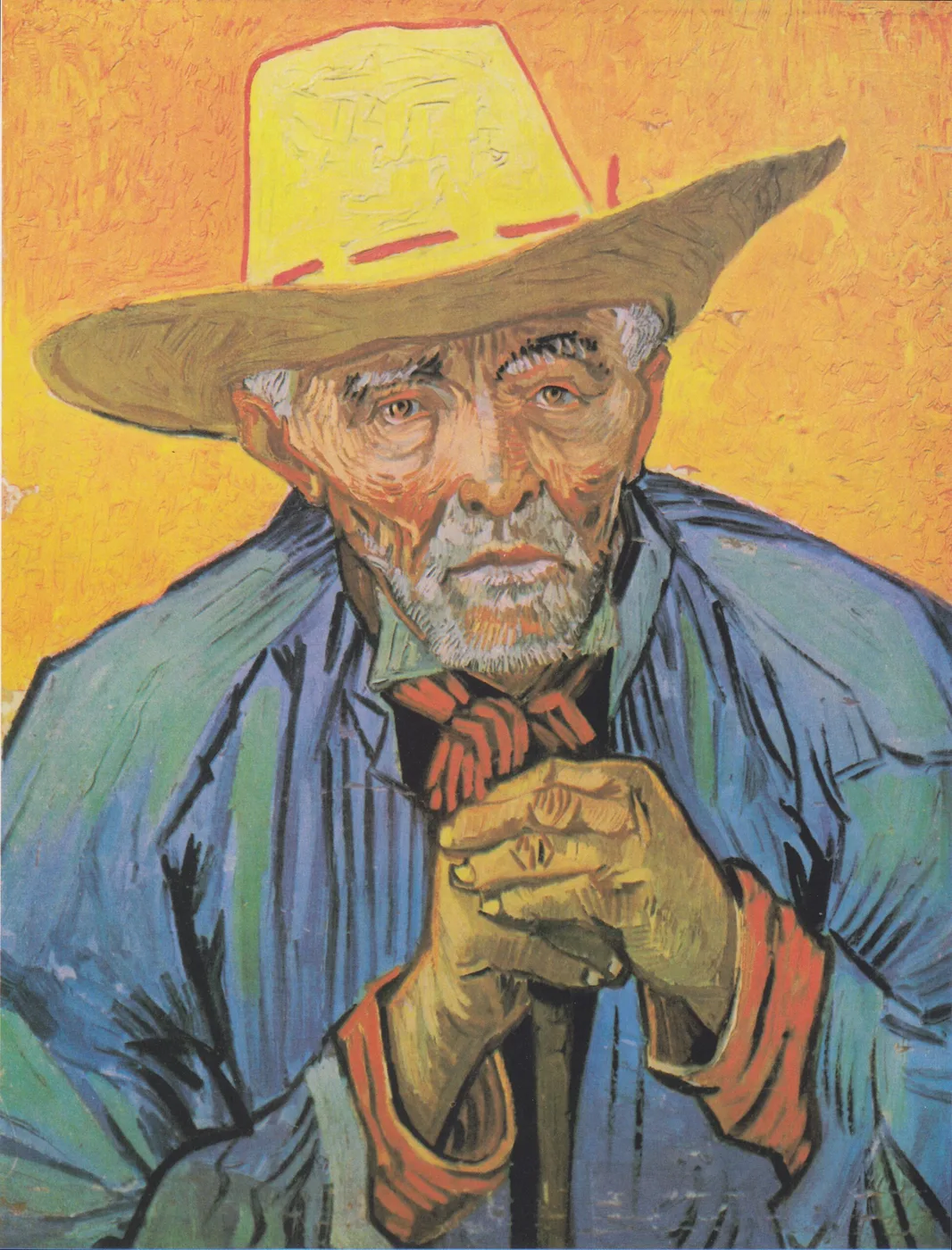
By the summer of 1888 Vincent van Gogh had been in Arles for several months, chasing a light he believed no painter had yet rendered honestly. He wanted portraits as much as landscapes that year, and he wanted sitters who looked as though the sun itself had made them. Patience Escalier, a retired gardener and former shepherd from the countryside near Arles, gave him exactly that face.
Van Gogh had struggled to find people willing to sit for the long hours a portrait demanded. Escalier agreed, and the picture that resulted, titled simply Portrait of Patience Escalier, is one of the most direct studies Van Gogh made that year: a man shown not as a type borrowed from a storybook but as someone who had spent a lifetime outdoors and carried the skin to prove it.
A face built from the fields
The old man fills almost the whole canvas, seen from the chest up, his hands folded over the head of a stick. He wears a broad straw hat that throws a band of shadow across his brow, and that shadow only makes the ruddy, sun-beaten colour of his face more insistent.
His eyes are pale and steady, set deep under heavy brows, and his beard is rough grey stubble catching the same orange light as his skin. There is nothing soft in how Van Gogh painted him. The wrinkles read as structure rather than sentiment, built from short, deliberate strokes that follow the actual creases of the skin.
Around his neck he has knotted a red scarf, the one note of pure, saturated colour that repeats in the orange-red trim at his cuffs. His folded hands are painted in the same warm ochre as his face, so that head and hands read as a single sunburned unit against the cooler blue of his jacket.
Orange against blue
Van Gogh built the picture on a single contrast: the entire background is a hot, unbroken orange, streaked and dragged rather than smoothed flat, and against it he set a jacket worked in blues and greens. It is complementary colour pushed about as far as it will go before the picture threatens to break apart.
The orange is not a flat wash. Looked at closely it moves in long diagonal strokes, darker in places, almost bronze near the shoulders, so the wall behind the sitter seems to radiate heat rather than sit there as a plain backdrop.
The underside of the straw hat picks up that same orange, tying the sitter into the field of colour behind him even as his jacket pulls in the opposite direction. That tension, warm surrounding cool, is what gives the head its force.
The paint itself
Van Gogh was painting fast and thick that year, and the surface shows it. The straw of the hat is scored with fine lines, a brush handle or similar tool dragged back through the wet paint to expose the ground beneath and suggest individual strands.
The jacket is built from short, choppy strokes of blue, green and black set side by side rather than blended, so that from a distance they read as cloth while up close they remain separate, almost woven marks. The scarf and cuffs are laid on more thickly still, in reds that sit slightly proud of the surface.
In the face the handling changes again. The strokes are smaller and more careful around the eyes and mouth, following the structure of the skull, while the beard is a dry, scrubbed passage of grey and white that leaves the weave of the canvas visible in places.
What the picture does in a room
Hung on a wall, this is a portrait that will not let the eye settle. The orange keeps pushing forward, the blue keeps pulling back, and the old man’s face sits caught between the two, lit and unmoving. In daylight the orange reads hot, almost aggressive; under warmer evening light it softens, and the blues of the jacket come forward instead, changing which half of the painting seems to speak first.
At 56 by 69 centimetres, Portrait of Patience Escalier is not a large canvas, but the scale suits a picture meant to be met almost eye to eye. It has remained together in the Collection Stavros Niarchos, one complete statement of what Van Gogh wanted a portrait to be in the summer he spent in Arles.
The picture rewards being looked at twice: once from across the room, where it reads as a single glowing block of colour, and once up close, where the paint breaks apart into the ridges, scrapes and loaded strokes Van Gogh left behind. Few portraits ask so plainly to be seen both ways.
Sizes and materials for Portrait of Patience Escalier are listed on its product page.
More from this collection
Bring this painting home
Choose a hand-painted oil reproduction for real brushwork, or an archival canvas print for a crisp museum-image edition. Every size preserves the original proportions.
View this work & options
Further reading
Verify the original in the Collection Stavros Niarchos collection record and continue through related works in the catalogue.