
Thatched Cottages in Jorgus: Story, Meaning & Brushwork
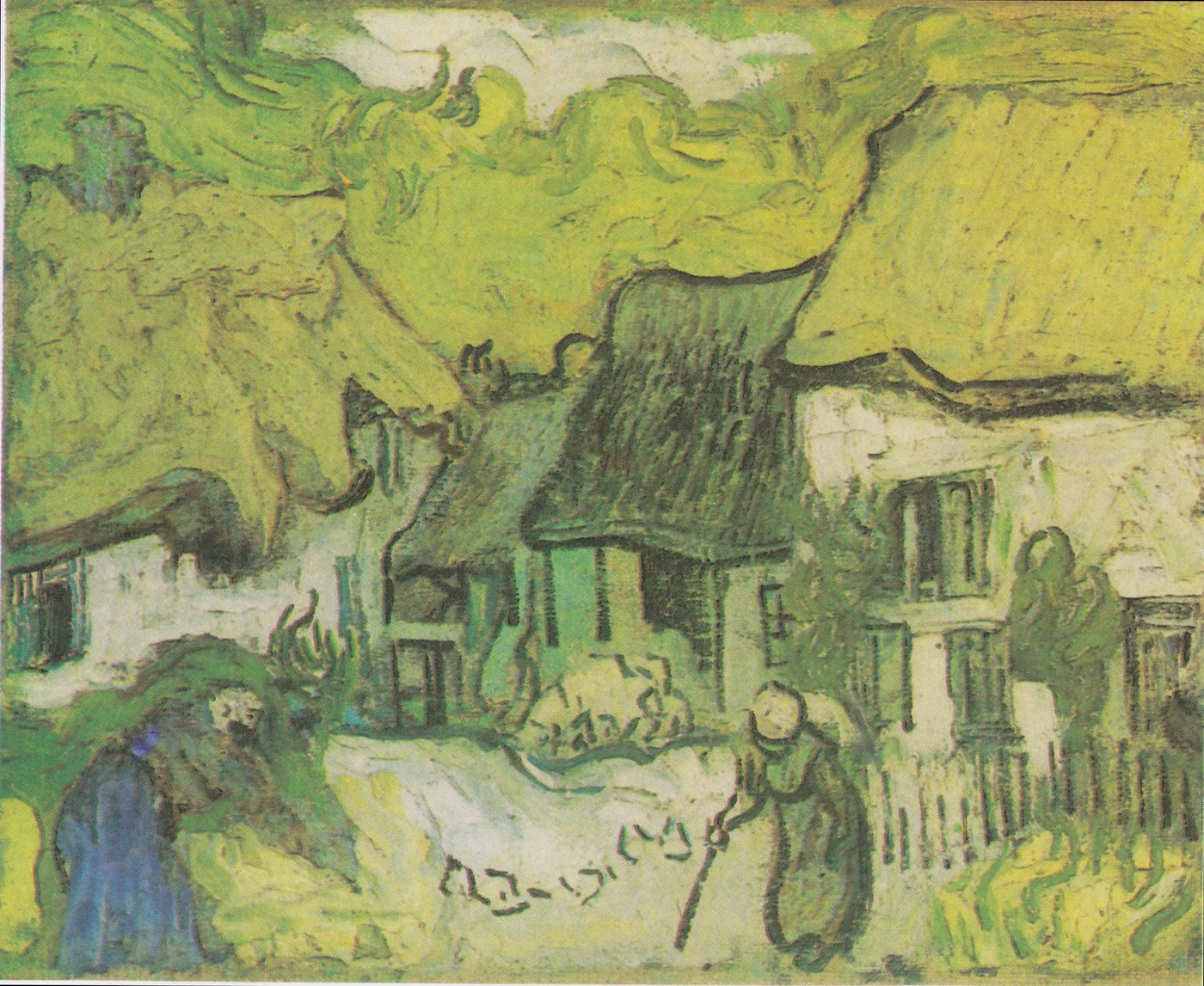
Thatched Cottages in Jorgus belongs to the last, feverish weeks of Vincent van Gogh’s life. He had reached Auvers-sur-Oise in May 1890, discharged from the asylum at Saint-Rémy and placed under the informal watch of Dr Paul Gachet, and he set about painting the village as if he had no time to waste. He was right: within nine weeks he would be dead, and in that span he produced roughly seventy canvases, this one among them.
Auvers gave him something Provence never had: farmhouses with steep, ageing thatch, the kind of roof he had grown up seeing in the villages of his native Brabant. He wrote to his brother Theo about how much these old roofs moved him, and he went looking for them on his daily walks around the settlement, sketchbook and easel in hand.
This picture is one result of that search. Painted in 1890 and measuring a modest 40.5 by 33 centimetres, it shows a knot of farm buildings he found tucked along one of the village lanes, their roofs heavy with age and their walls whitewashed and patched.
A lane of dark thatch and pale walls
Two cottages fill most of the upper half of the canvas. Their thatched roofs are painted in deep olive and near-black green, laid down in short, choppy strokes that follow the pitch and sag of old reed construction. Where the thatch has thinned or been repatched, Van Gogh lets a warmer yellow-ochre show through, so the roofline reads as something lived-in rather than picturesque.
Below the roofs, the walls turn pale, almost bleached, built from little more than white and the faintest wash of blue-green shadow. Windows and shutters are picked out in a few dark, decisive marks, just enough to tell one building from the next without slowing the eye down.
There is no real sky in the ordinary sense. Behind and above the rooftops the whole upper third of the canvas dissolves into swirling yellow-green foliage, the same restless rhythm Van Gogh was using that summer for wheatfields and orchards alike. A single ragged band of white cloud breaks through the green at the centre, the one cool interruption in an otherwise sun-baked palette.
Two figures on the road
In the foreground, on a pale, chalky path streaked with ochre and grey, two women make their way past the cottages. One wears a deep blue robe and is bent forward, absorbed in some task or simply worn by walking. The other, in a pale headscarf, leans on a stick, her whole body angled with the effort of the step.
Neither figure is described in any detail. Van Gogh builds them from the same quick, loaded strokes he uses everywhere else in the painting, so that people and buildings and greenery all seem to be made of the same restless material. They give the lane a human scale without becoming its subject.
Dark blue-black contour lines run around roofs, walls, doorways and figures alike, a habit he had carried from his Arles pictures into this last Auvers group. The outlines hold the composition together even where the colour underneath threatens to boil over into pure pattern.
How the paint is handled
Close up, almost nothing in this canvas is smooth. The thatch is dragged on in dense, parallel dashes; the foliage behind is laid in looping, overlapping curls; the road is scraped and dabbed rather than filled in evenly. Only the whitewashed walls offer any real rest for the eye, and even there the paint sits in visible ridges.
The palette stays narrow and close-toned throughout: greens ranging from bottle-dark to acid-bright, a warm ochre for path and thatch repairs, white for the walls, and that one patch of blue robe as the sole strong accent of colour. Nothing in the picture is black except the contour work, and nothing is fully still.
Living with the painting
Hung in a room with changing daylight, this is a picture that shifts its temperature through the day. Morning light picks out the cool blue-green shadow in the walls; by late afternoon the ochre in the thatch and path warms the whole composition, and the roofs seem to thicken.
At 40.5 by 33 centimetres, the original was built for close looking rather than for a grand wall, and a reproduction at the same intimate scale keeps that quality: it asks to be approached, not viewed from across a room. In a study, a bedroom or any space where someone actually stops to look, that density of brushwork keeps giving something new on the tenth viewing as much as the first.
What stays with a viewer afterwards is not the two women or even the cottages themselves, but the sense of a painter working fast, in green light, in a village that reminded him of home, with very little time left to paint it.
Sizes and materials for Thatched Cottages in Jorgus are listed on its product page.
More from this collection
Bring this painting home
Choose a hand-painted oil reproduction for real brushwork, or an archival canvas print for a crisp museum-image edition. Every size preserves the original proportions.
View this work & options
Further reading
Verify the original in the collection record and continue through related works in the catalogue.