
The Bedroom (Bedroom in Arles): Story, Meaning & Brushwork
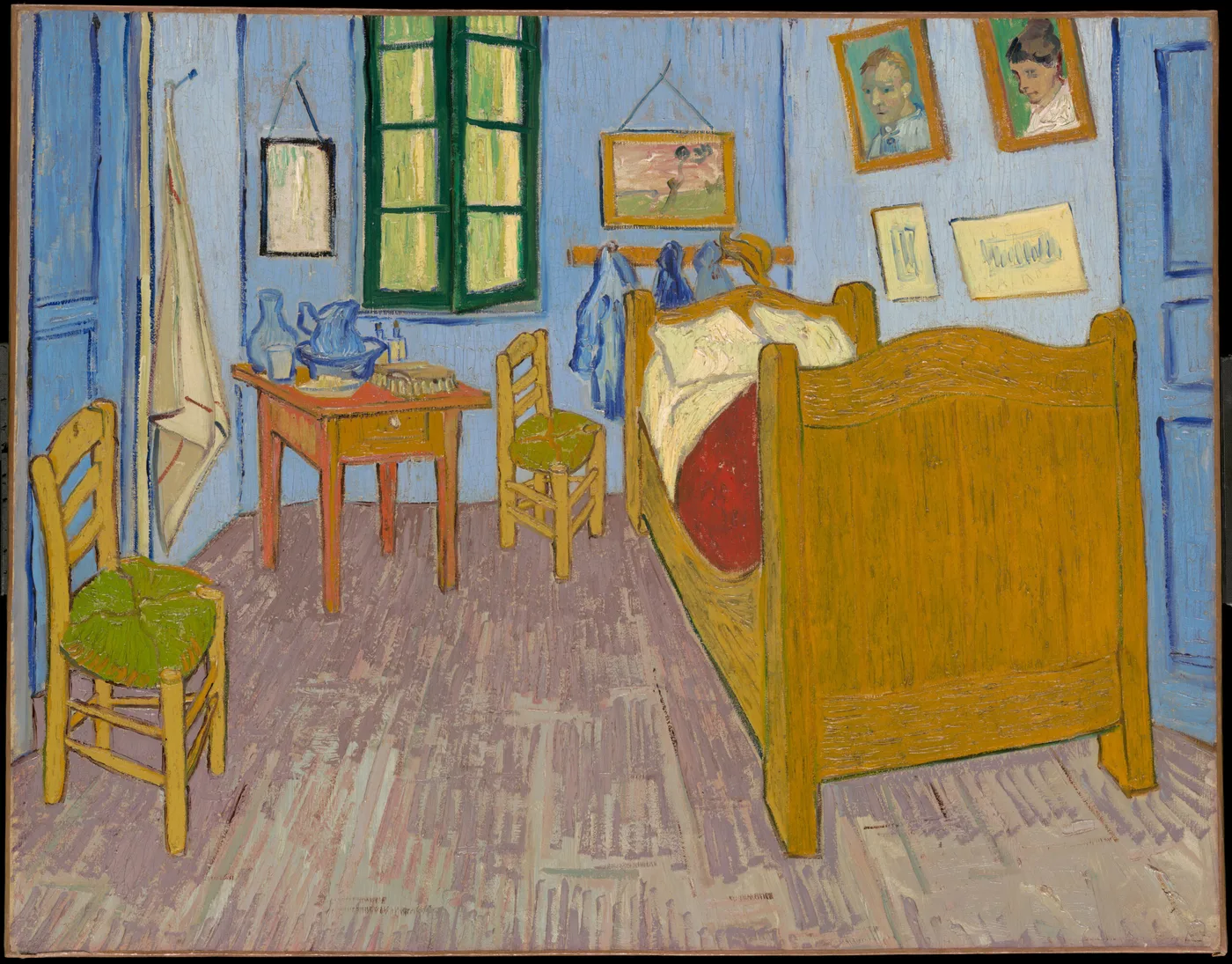
In the autumn of 1888 Vincent van Gogh was renting four rooms in a yellow-washed house on the Place Lamartine in Arles, furnishing them slowly and proudly on almost no money, and waiting for Paul Gauguin to arrive and share the place with him. His own bedroom, small and plain, became the subject of a painting he wanted to be nothing but restful to look at. He described the colours to his brother Theo before the paint was even dry, and the picture he made has been read ever since as a portrait of a man trying to hold himself steady.
He was clear about what he wanted the canvas to do. Looking at it, he wrote, ought to rest the mind, even the imagination. That is an odd ambition for a room tipped so far off the vertical that the floor seems to slide toward the viewer, and it is part of what keeps people looking at this picture rather than walking past it.
A room built from a few plain things
The furniture is almost absurdly simple: a wooden bed pushed against the right wall, two rush-seated chairs, a small table carrying a jug, a basin and a couple of bottles. A towel hangs from a peg by the door, clothes and a mirror by the window, and that is the whole inventory of the room.
Nothing overlaps convincingly. The bed’s footboard, the table and the chairs all seem to have been drawn from slightly different viewpoints and pressed together, so the room reads more like a plan of a room remembered than a view of one observed. Van Gogh was working from a mind full of Japanese prints, where objects are often set out flat and frontal rather than receding smoothly into depth.
The walls in this canvas are a pale, chalky blue, not the violet he first described when he painted the room in Arles. The floor is done in the same lavender-grey family, laid down in long dry strokes that read as bare board rather than the red tiles he originally imagined, and the whole space is held together by that narrow range of blues and lilacs.
Against it, the bed and the two chairs are painted the yellow of fresh butter, and they pull the eye immediately, the largest, warmest shapes in a cool room. A run of small pictures is pinned above the bed head, among them two little portrait sketches added in this particular version, alongside a landscape and the mirror by the window.
Why there are three of this room
Van Gogh first painted this bedroom in October 1888, in the days before Gauguin’s arrival, when the Yellow House still felt like the beginning of something rather than the site of the breakdown that followed. That first canvas was damaged by damp not long afterwards, and he minded enough to want it saved rather than left to decay.
The following September, a patient at the asylum in Saint-Rémy and working partly from memory and a small sketch, he painted two further versions of the same room. This canvas is the third of them, completed in 1889, and it is the one that ended up in Paris.
It is a strange kind of self-portrait, a room emptied of its occupant and repainted from a hospital bed many miles away, remade because he could not bear to lose it and would not simply repaint the original.
Colour laid flat, drawn hard
The paint itself is applied in broad, even passages with almost no blending, each object built from one or two colours rather than a gradient of tones. Firm dark outlines hold every edge in place, a habit Van Gogh borrowed consciously from the woodblock prints he collected and pinned to his own walls.
He leaned hard on complementary contrast to keep the picture from going flat in the dull sense: the warm ochre bed against the cool blue wall, the small hits of red in the coverlet and the picture frames against all that blue and green. It is a controlled, almost decorative use of colour, closer to a poster than to the broken, flickering brushwork he used outdoors.
Up close the floorboards are dragged in long, dry, visible strokes, the bed frame built from short choppy ones that follow the grain of the wood, and the wall behind it laid on in flatter, calmer passages. The paint handling changes register from object to object, quietly doing the work of separating a wooden bed from a plastered wall without ever breaking the flatness of the whole design.
What it does on a wall at home
At 74 by 56.5 centimetres, the original is a modest, close-focus object, sized for a single person to stand near and take in without stepping back, and that intimacy carries over into any reproduction hung at eye level in an ordinary room. The blues shift noticeably between daylight and lamplight, turning greyer and more restful as a room dims in the evening and sharper, almost violet, in cold morning light.
Because the palette is so narrow and the drawing so plain, the picture reads clearly from across a room and rewards standing close to it too, where the dragged brushwork on the floor and the built-up ridges of yellow paint on the bed become visible. It asks to be looked at the way its own subject was meant to be looked at, slowly, without much else competing for attention nearby.
The original hangs today in the Musée d’Orsay in Paris, one room among the three Van Gogh made of the same few plain objects, painted in a year that held both a breakdown and some of the steadiest, most deliberate colour of his career.
Sizes and materials for Bedroom in Arles are listed on its product page.
More from this collection
Bring this painting home
Choose a hand-painted oil reproduction for real brushwork, or an archival canvas print for a crisp museum-image edition. Every size preserves the original proportions.
View this work & options
Further reading
Verify the original in the Musée d'Orsay collection record and continue through related works in the catalogue.