
Portrait of Joseph Roulin: Story, Meaning & Brushwork
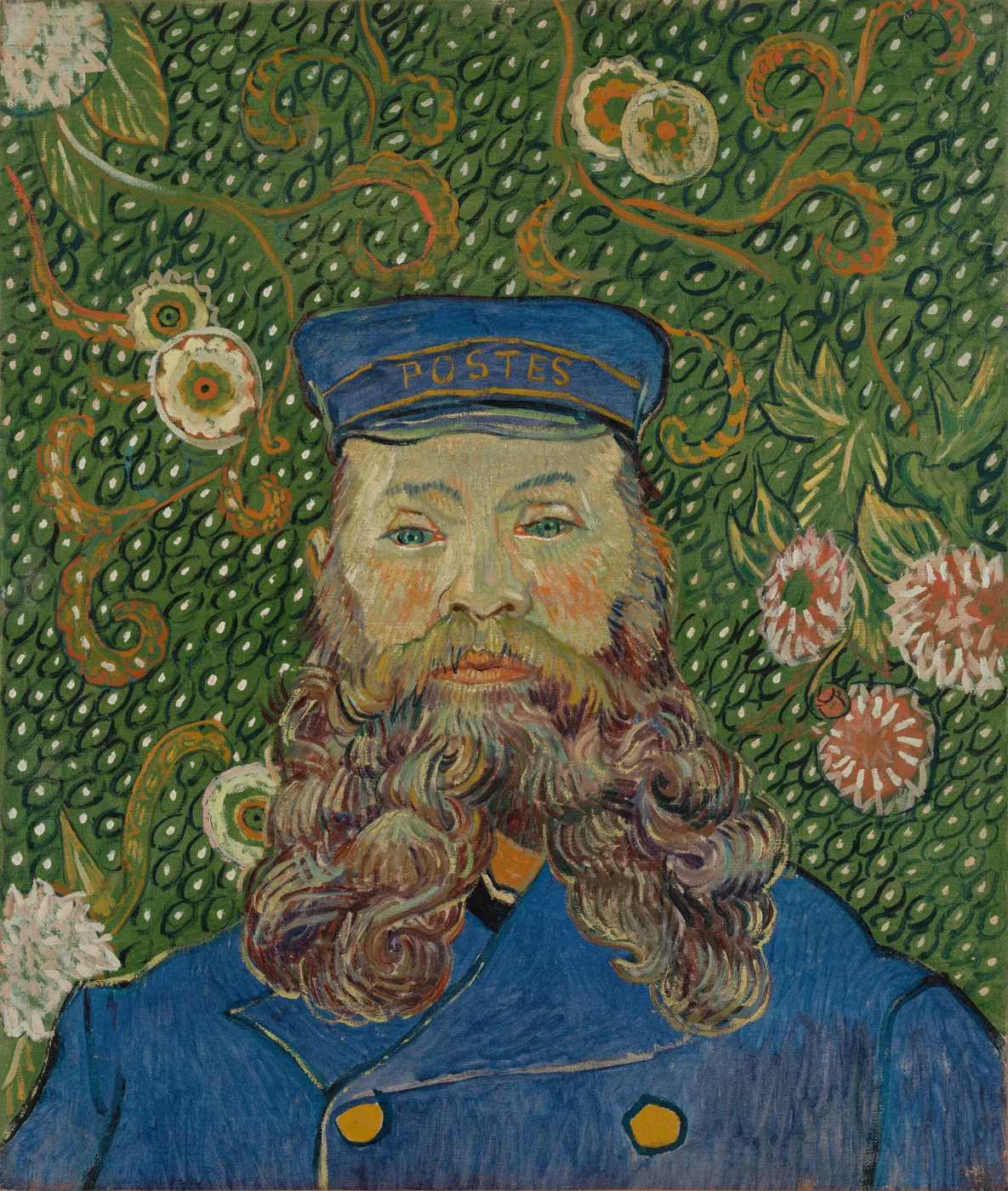
In early 1889 Vincent van Gogh was living through the hardest stretch of his time in Arles. He had spent the turn of the year in and out of the town’s hospital, and the studio at the Yellow House stood largely empty of the company he had hoped to fill it with. Joseph Roulin’s household remained one of the few steady presences left to him.
A Household That Held Him Steady
Roulin worked as a senior postal official at the Arles railway station, a big, opinionated, warm-hearted man rather than a letter carrier, and his heavy build and forked beard had already made him one of Van Gogh’s favourite sitters through the previous winter. Van Gogh painted him, his wife Augustine and their three children again and again, returning to Roulin’s face more often than to almost anyone else he met in the south.
This canvas is dated 1889, painted in the same period when Roulin himself had already left Arles for a new posting further along the line. Van Gogh worked it up from memory and from the studies he had already made of his friend, rather than from a sitting.
The painting measures 55.2 by 64.4 centimetres and now belongs to the Museum of Modern Art in New York. It is one of several closely related portraits of Roulin from these months, each testing a different balance of the same blue uniform against a patterned ground.
The Face Above the Beard
The picture is cropped close, so Roulin fills almost the whole canvas and meets the viewer’s eye directly. He wears his blue postal cap with POSTES lettered across the brim in gold, tipped slightly back from a broad, weathered forehead. His skin is built from strokes of pale green, ochre and pink set side by side rather than blended into each other.
The beard is the real event of the painting. It falls in long forked curls from below his cheekbones to his chest, worked in ropes of ginger, grey, violet and dark brown that twist and cross like separate lines of handwriting. Van Gogh draws it with the same calligraphic freedom he gave to cypress trees and ripening wheat, so that hair becomes a kind of weather.
Roulin’s eyes are rimmed red and faintly tired, fixed somewhere just past the viewer. There is no smile and no theatre in the pose, only a level, patient attention that Van Gogh extends equally to a friend, a chair or a sunflower.
A Garden That Never Existed
Behind Roulin’s head the wall dissolves into a dense field of green, patterned with looping orange and red tendrils and a stipple of small white dashes that reads, from across a room, like foliage caught mid-motion. Two rosette flowers in cream and rust sit in the upper corners, echoing the shape of a wheel. To the right a cluster of pink and white blooms opens out, larger and more loosely painted than the repeating pattern surrounding them.
None of this describes a wallpaper Van Gogh owned or a garden he was sitting in front of. It is an invented decorative ground, built from the same vocabulary of dots, curls and flat colour he used in other portraits from these months, a way of giving a sitter a setting without resorting to a real room. The pattern presses forward rather than receding, so Roulin’s head sits against it rather than inside a believable space.
The green itself is not one colour but four or five distinct values, from near black in the shadows around the ears to a bright, acid tone at the upper edges. That variation is what keeps the background from flattening into ordinary wallpaper.
Blue Wool Against Green Leaves
The uniform coat is a deep Prussian and cobalt blue, double breasted, with two rows of ochre-yellow buttons that strike bright, hard notes against all that blue. Van Gogh paints the wool in long, flat, directional strokes that follow the fall of the cloth over the shoulders rather than modelling it with light and shade. A sliver of orange collar shows at the throat, the one warm note between beard and coat.
Blue and orange, green and red: the whole painting is built on pairs of colours that sit opposite each other on the wheel, pushed close to full strength. It is this contrast, more than any single passage of drawing, that gives Roulin his physical weight and keeps him from being absorbed into the pattern around him.
On a Wall, Through the Day
Hung in a room, the portrait first reads as a mass of blue and green, with Roulin’s pale face and cap the one light interruption in the field. Move closer and the flat shapes break apart into hundreds of individual strokes, the beard above all, which resolves from a single dark form into dozens of curling lines only at close range.
Daylight brings out the acid brightness of the greens and the gold of the cap lettering. Lamplight in the evening pulls the blues down towards black and leaves the ochre buttons and collar glowing almost alone. Either way, Roulin keeps looking straight out of the canvas, unmoved by whatever room has been built around him.
Sizes and materials for Portrait of Joseph Roulin are listed on its product page.
More from this collection
Bring this painting home
Choose a hand-painted oil reproduction for real brushwork, or an archival canvas print for a crisp museum-image edition. Every size preserves the original proportions.
View this work & options
Further reading
Verify the original in the Museum of Modern Art collection record and continue through related works in the catalogue.