
The Night Café: Story, Meaning & Brushwork
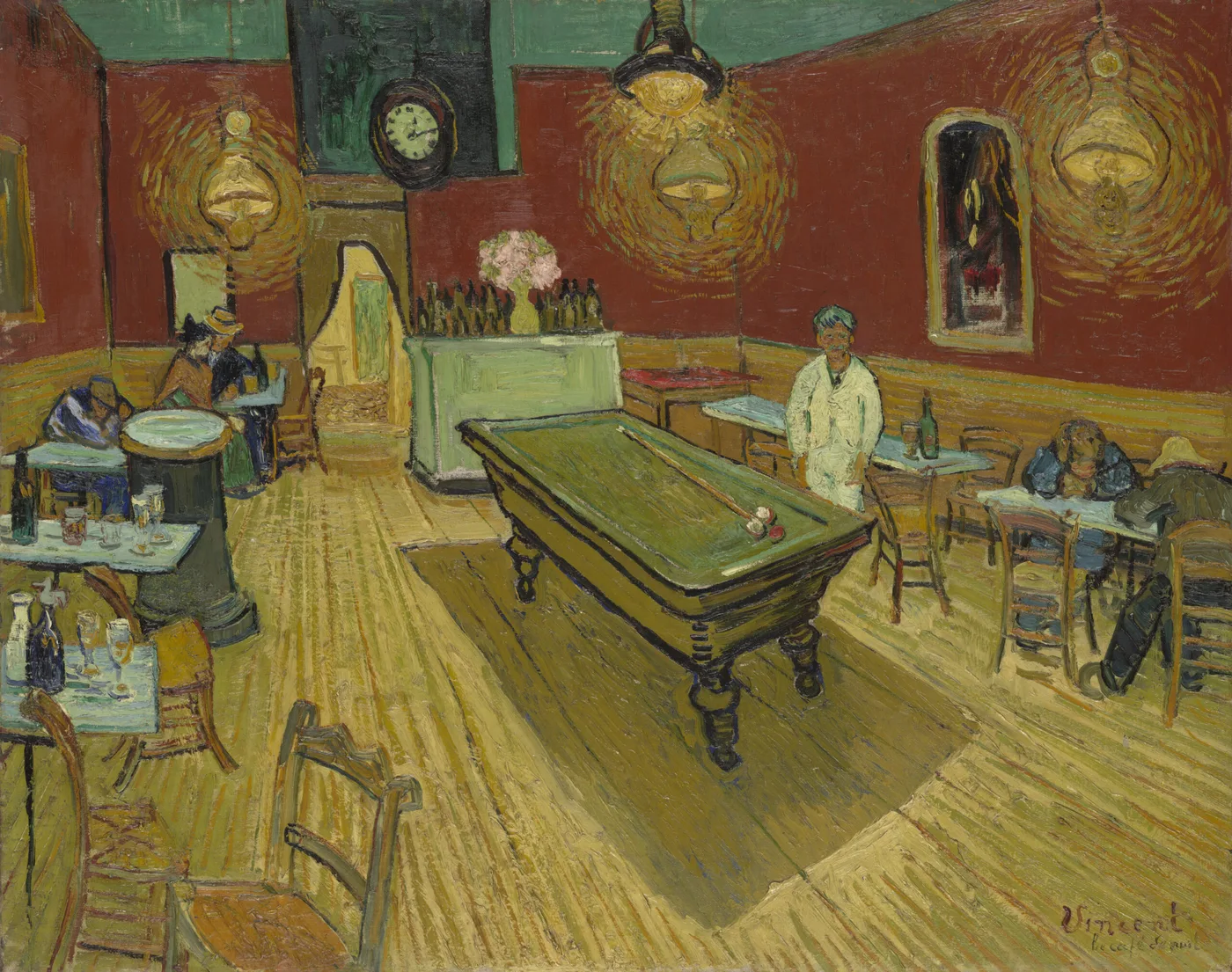
A café on the Place Lamartine, painted through the night
By September 1888, Van Gogh had been in Arles for seven months, chasing the clear southern light he believed would sharpen his colour and his nerve. He was living out of a rented room above the Café de la Gare on the Place Lamartine, waiting for the Yellow House nearby to be furnished, and waiting, too, for Paul Gauguin to make good on his promise to come south and share it with him.
The café’s owner, Joseph Ginoux, kept the place open all night for the town’s night workers, cab drivers and drinkers with nowhere better to be. Van Gogh knew it from the inside, as a lodger as much as a customer, and he set out to paint it not as a picturesque interior but as a document of a particular kind of exhaustion.
He worked through three consecutive nights to finish the canvas, sleeping by day and painting by gaslight, a way of working that left him, by his own account, thoroughly worn out. The picture that resulted, The Night Café, is dated to 1888 and measures 92.1 by 72.4 centimetres.
Inside the room: a billiard table, gas lamps and a handful of drinkers
The eye lands first on the billiard table, its dark green baize set almost dead centre and throwing a long shadow across floorboards that seem to tip up toward the viewer rather than recede away. No game is in progress. The table sits idle under the lamps, a strange still point in a room that otherwise feels unsteady.
Around the edges, the café’s night population is sparse and slumped. A few drinkers sit alone or in twos at small tables, heads down, half asleep over their glasses. Near the bar a lone figure in white, presumably Ginoux himself, stands watch over the empty room, the one upright form among a scatter of bowed ones.
Behind him, bottles line the top of a sideboard beside a pale bouquet, and a clock on the back wall marks a very late hour. Three lamps, strung from the ceiling on iron brackets, blaze with a yellow so intense that each one is wrapped in its own greenish halo, the only true light source in an otherwise windowless room.
Red against green: colour used as a state of mind
Van Gogh built the room almost entirely from a single clash. The walls run a deep, dried-blood red, met at the ceiling by a flat expanse of acid green, and the two never resolve into harmony. He wanted them not to.
He described the aim to his brother Theo directly: to express the terrible passions of humanity through red and green, and to paint a café as somewhere a person could ruin themselves, go mad or commit a crime. That is an unusually blunt statement of intent for a nineteenth-century interior, and it shows in every choice on the canvas.
The billiard table’s green is picked up again in the lamp haloes and in the ceiling, so the eye keeps returning to the same sour note wherever it looks. Nothing in the room is allowed to cool the red down. It is colour used to unsettle rather than to describe.
The paint itself: a tilted floor and haloed light
The brushwork is broad and fast, laid down in visible strokes that follow the direction of the floorboards, the folds of the tablecloths, the curve of each lamp. There is very little blending. Van Gogh lets one loaded stroke sit next to another and lets the eye do the mixing.
The perspective is steep and slightly wrong on purpose, the floor rising too fast toward the picture plane, the billiard table’s legs splaying at an angle that would not quite hold up a real table. That distortion is what gives the room its pressing, airless feeling more than any single object in it does.
Around each gas lamp, thick rings of green and yellow pigment stand in for the glare and the smoke haze of a real all-night bar, painted almost like a halo around a low sun rather than an electric fixture. It is a shorthand for light that has no real precedent in painting up to that date, and it is one of the things that makes the canvas so immediately recognisable.
On a wall, after dark
The original hangs today at the Yale University Art Gallery, where it remains one of the most closely studied paintings from Van Gogh’s Arles period. Seen at a distance, the red and green register first as pure heat and cold set against each other before any object in the room resolves.
A reproduction of this scale holds that same tension in a room of its own. Under daylight the reds sit hard and matte; once the lamps go on in the evening, the painted gas lights answer the real ones, and the greenish haloes seem to pulse a little more than they do by day.
It rewards a spot where someone will stand close enough to follow the brush, rather than glance at it in passing, since so much of what the picture does depends on that steep floor and those unresolved colours working on the eye at short range.
Sizes and materials for The Night Café are listed on its product page.
More from this collection
Bring this painting home
Choose a hand-painted oil reproduction for real brushwork, or an archival canvas print for a crisp museum-image edition. Every size preserves the original proportions.
View this work & options
Further reading
Verify the original in the Yale University Art Gallery collection record and continue through related works in the catalogue.