
Portrait of Camille Roulin: Story & Meaning
A Postman’s Family in Arles, 1888
In the closing months of 1888, Vincent van Gogh was living at the Yellow House in Arles, deep into the most productive and most turbulent year of his career. Paul Gauguin had come and gone, their shared studio experiment ending in a crisis that December, and van Gogh’s circle of friends in the town had narrowed to almost no one beyond a single family.
That family was the Roulins. Joseph Roulin, a postal employee, and his wife Augustine became willing sitters for a painter starved of company, and in time so did each of their three children. Van Gogh worked through the household one face at a time, the way another artist might work through a set of studies, but with real affection for each sitter.
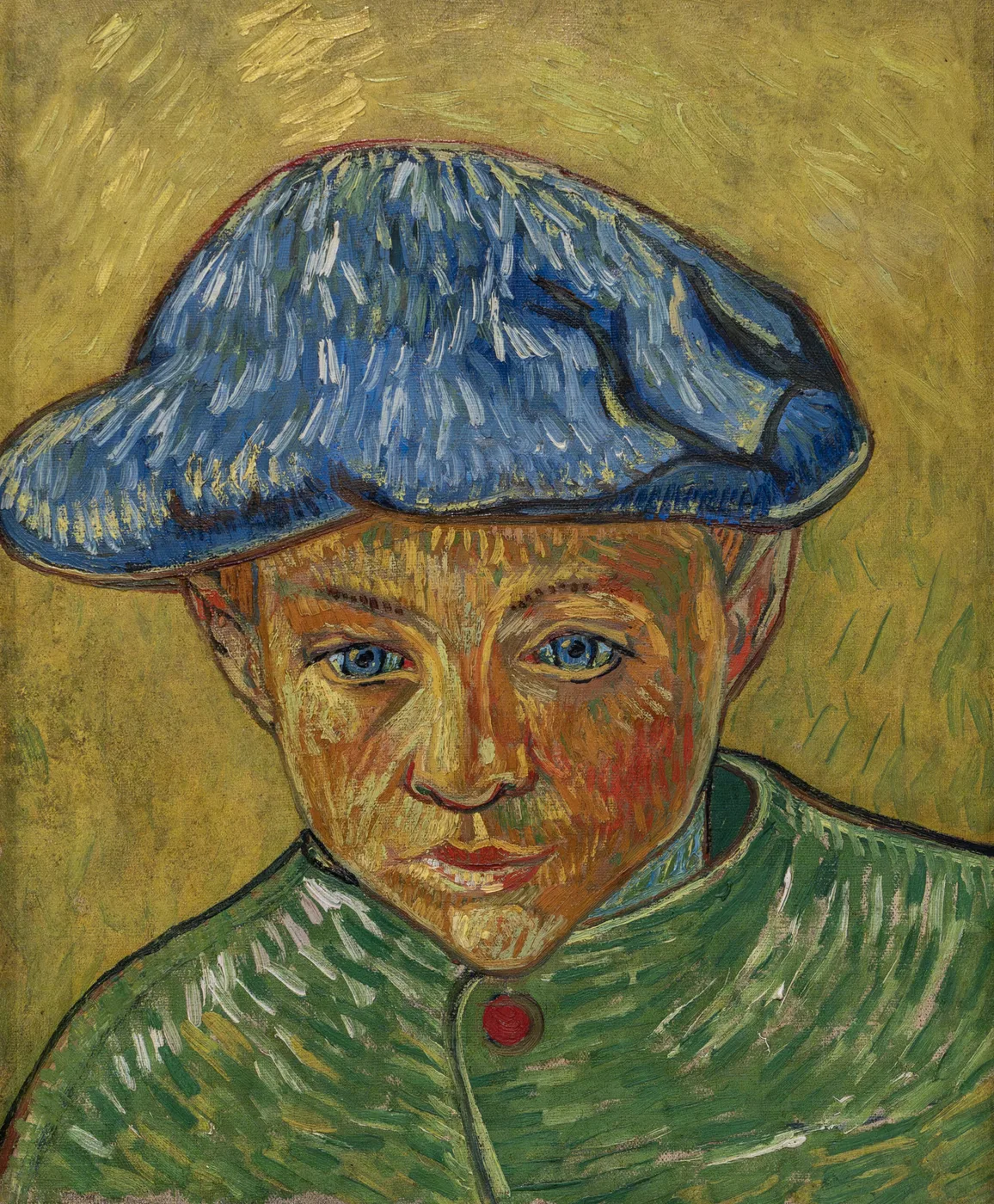
Camille, the middle son, sat for him in 1888, at around eleven years old. The result, Portrait of Camille Roulin, is a small canvas at 32.5 by 40.5 centimetres, now held by the Van Gogh Museum, cropped close so the boy’s head and shoulders fill almost the whole frame.
A Boy Beneath a Ridged Blue Cap
The eye goes first to the cap, a soft blue schoolboy’s cap set at a slight angle, its surface built from short strokes of blue and near-white that catch the light along every ridge of fabric. Beneath it, Camille’s face turns almost straight to the viewer, his blue eyes steady and a little wary, the look of a child asked to sit still longer than he would like.
His skin is painted in strokes of ochre, salmon and pale green laid side by side rather than blended, so the face reads as warm and alive even close up, where it dissolves into a mesh of separate colours. A flush of red sits across one cheek, and his mouth, closed and slightly pursed, is drawn in a single confident line of red.
He wears a green jacket buttoned to the neck, fastened with one red button that gives the eye a small, sharp point of contrast against all that green. The jacket is worked in the same short, directional strokes as the cap, with pale highlights running down the shoulders like grain in wood.
Behind him, the background is a field of ochre yellow, brushed in loose diagonal strokes that thicken into streaks of green towards the right edge of the canvas, as though the wall or field behind the boy were catching the same light as his cap. There is no furniture, no window, nothing to place him anywhere in particular. Van Gogh gives us only the boy, lit and coloured, and nothing else to look at.
Paint Laid Down Without Blending
Van Gogh was working, in these last Arles months, in a manner he had been refining since his arrival in the south two years earlier: colour applied directly, stroke beside stroke, with almost no mixing on the canvas itself. In Camille’s portrait that method is plain to see in the cap and jacket, where individual lines of pigment sit next to one another rather than merging into a smooth surface.
The drawing itself is economical. A dark outline holds the edge of the cap, the line of the jaw, the collar of the jacket, doing the work that shading might otherwise do and leaving the colour to carry the rest. It is a fast, confident kind of portraiture, closer to a study taken from life than to a formal sitting.
This is also, unmistakably, a portrait made by someone who liked the person in front of him. There is none of the flattery of a commissioned likeness and none of the coolness of an academic study. Camille looks like a real boy caught mid-thought, set down quickly before he lost patience with the whole business.
One Family, Six Portraits
Van Gogh’s letters from this period return often to the Roulins, and to Joseph Roulin in particular, whom he described as one of the only people in Arles he could talk to as an equal. Painting the children was partly a way of repaying that friendship, and partly a continuation of an idea he had been chasing all year: a modern portrait built from strong, flat colour rather than from careful modelling.
Seen alongside the portraits of Camille’s parents and siblings, this canvas reads less as an isolated likeness and more as one panel in a set, each member of the household given the same close, direct treatment. The differences between them, in colour, in pose, in the temper of the brushwork, tell almost as much about the sitters as their faces do.
In a Room, Through the Day
Hung on a wall, this portrait holds its own from across a room, the blue cap and green jacket reading as two strong shapes against the yellow ground before any detail of the face resolves. Up close, that simplicity gives way to the granular, hand-built surface of individual strokes, and the boy’s expression comes forward.
Morning light and evening light change it noticeably, since so much of the canvas depends on how the ochre background and the blue of the cap sit against each other. In warmer, low light the yellow deepens and the blue recedes; under cooler daylight the contrast sharpens and the boy’s stare becomes more direct. It is a small painting that asks to be looked at more than once, and rewards each return with something slightly different.
Sizes and materials for Portrait of Camille Roulin are listed on its product page.
More from this collection
Bring this painting home
Choose a hand-painted oil reproduction for real brushwork, or an archival canvas print for a crisp museum-image edition. Every size preserves the original proportions.
View this work & options
Further reading
Verify the original in the Van Gogh Museum collection record and continue through related works in the catalogue.