
Bowl with Sunflowers, Roses and Other Flowers: Story
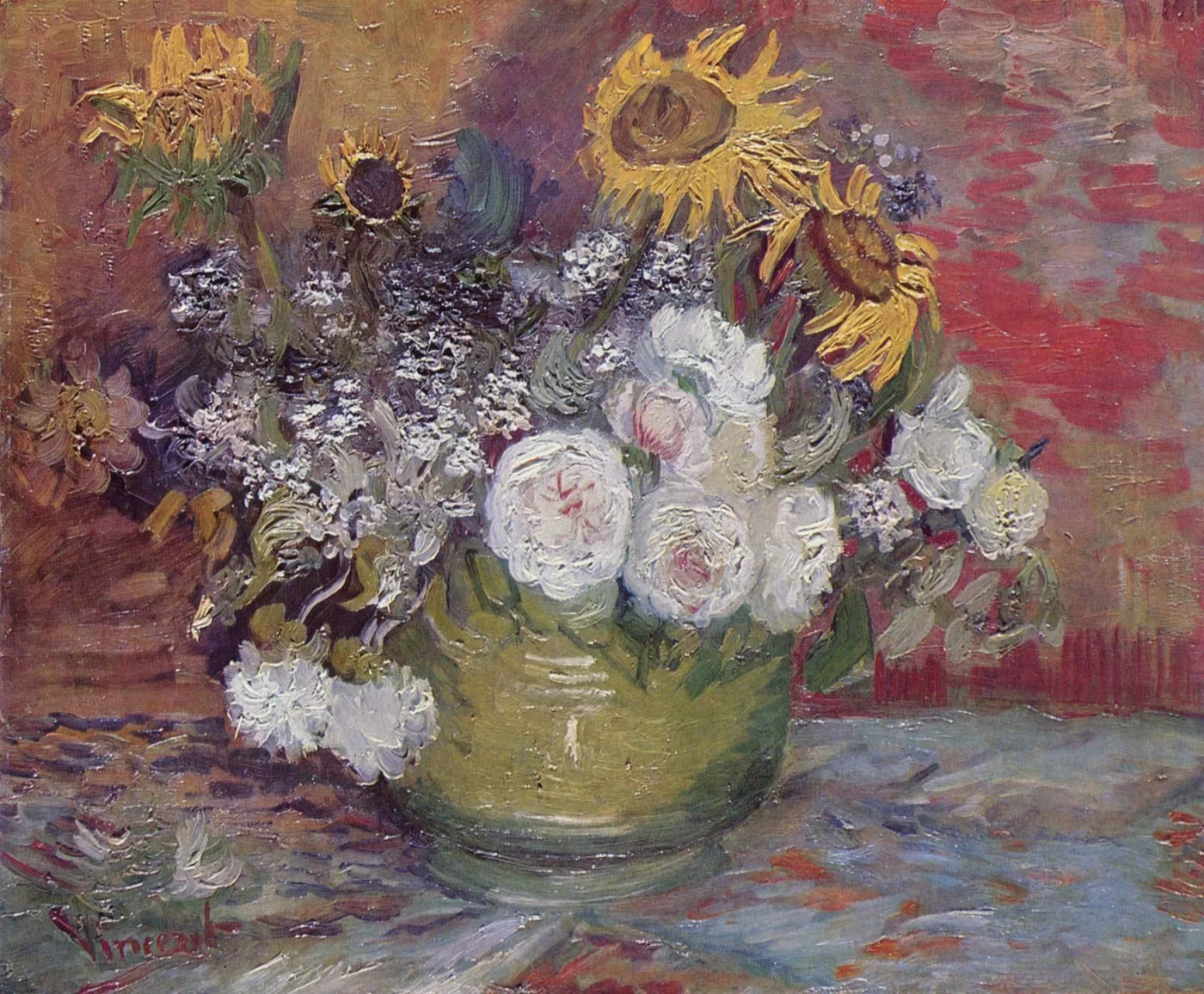
In the early months of 1886, Vincent van Gogh left the flat browns of Nuenen behind and moved to Paris to live with his brother Theo. He was thirty-two, largely self-taught, and convinced that his painting needed to change. Within weeks of arriving he had seen the canvases of Monet, Pissarro and the younger Impressionists at first hand, and the dark, earthbound palette he had built in the Dutch countryside started to look like a liability rather than a style.
Bowl with Sunflowers, Roses and Other Flowers, painted that same year, is one result of that reckoning. It shows a painter using cut flowers the way a musician uses scales: as a fixed, patient subject on which to rebuild a whole way of seeing colour.
A Studio Exercise That Became a Habit
Flowers were a practical choice for an artist retraining his eye. They were cheap, sold on nearly every Paris street corner, and unlike a hired model they did not need paying by the hour. Van Gogh bought bunches, arranged them himself, and painted quickly before the petals dropped.
Over 1886 he worked through dozens of these still lifes, often several in the same week, treating each one as a controlled experiment in a different combination of hues. This bowl, mixing sunflowers with roses and smaller white and lilac blooms, is among the fullest of that group.
The sunflowers themselves are worth pausing on. Two years before he filled the yellow house in Arles with the vases of sunflowers that made his reputation, they already turn up here, jostled among roses in a Paris still life, as if the flower had already caught his attention before he knew what it would become.
What Sits on the Table
The container is not the tall, slender vase of the later Arles paintings but a low, wide bowl in dull green, more kitchen crock than showpiece. It stands on a flat stone or marble slab whose grey surface is broken by loose strokes of rust and blue.
Out of it comes a dense, almost overfull arrangement. Sunflowers with shaggy, half-opened heads rise at the top and lean off to the right, some already drooping on their stems. Below them sits a thick cluster of roses in white and blush pink, their petals built from short, curling dabs of paint, surrounded by a haze of small white and lavender blossoms that fill in every remaining gap.
The eye lands first on those pale roses at the centre, the brightest and most tightly worked passage in the picture, before it is pulled upward and outward to the heavier yellow heads of the sunflowers. Nothing in the arrangement is tidy. Stems cross, flowers overlap, and the bunch reads as something gathered in armfuls rather than composed with tweezers.
A Canvas Split Down the Middle
The background is where the picture takes its biggest risk. The left half sits in warm ochre and umber brown, close in tone to the earth colours of Van Gogh’s Dutch years. The right half breaks into a streaked, vibrating red, laid on in choppy vertical strokes that read almost like a curtain or a reflective surface catching light.
That division sets brown against red across a single canvas, with the bowl and its green leaves acting as the hinge between them. The green of the bowl and stems sits as a cool, steadying note against both the warm brown and the hot red, stopping either side of the background from overwhelming the flowers in front of it.
It is a blunt, almost experimental piece of colour construction, closer to a study than a resolved backdrop, and that is very much the point: this is a canvas made to test what colours do next to one another, not to describe a room.
The Paint Itself
Van Gogh worked the flowers in thick, loaded strokes, laid down quickly and left largely unblended. Petals are built from single dashes of white, pink or yellow rather than smoothly modelled forms, so that up close the bouquet dissolves into a field of separate marks that only resolve into roses and sunflowers from a short distance back.
The signature, “Vincent”, sits in red at the lower left, the same red he used for his given name throughout his career once he stopped signing with his surname. The dimensions are modest, 61 by 50 centimetres, closer to a study than a showpiece, which suits a picture painted at speed as one of many.
In the Room
The original hangs today in the Kunsthalle Mannheim. On a wall, this is a picture that rewards changing light rather than fighting it. In flatter daylight the ochre and red background read close in weight, and the bowl of flowers sits as a single warm mass.
Under warmer evening light, the red side of the background pulls forward and the white roses seem to lift off the canvas, brightening in a way that the brown side never quite matches. It is a painting built from a young artist’s restless experiments with colour, and it still behaves that way, shifting its balance with whatever light happens to fall on it.
Sizes and materials for Bowl with Sunflowers, Roses and Other Flowers are listed on its product page.
More from this collection
Bring this painting home
Choose a hand-painted oil reproduction for real brushwork, or an archival canvas print for a crisp museum-image edition. Every size preserves the original proportions.
View this work & options
Further reading
Verify the original in the Kunsthalle Mannheim collection record and continue through related works in the catalogue.