
The Sower (Arles, 1888): Story, Meaning & Brushwork
Arles, the Wheat Season of 1888
Vincent van Gogh had arrived in Arles in February 1888, chasing a stronger light and a fresh subject for the modern painting he wanted to make. By early summer he was working outdoors almost daily, keeping pace with the harvest around him and with his own restless need to get paint down fast while the light held.
Among the subjects he returned to that year, none held him longer than the sower. He had studied Jean-Francois Millet’s treatment of the same figure for years, and in Arles he set himself the task of finding his own version of it, not in Millet’s greys but in strong, opposed colour.
In his letters to his brother Theo he wrote that the idea of the sower continued to haunt him. It was, for him, a figure standing for something beyond the particular field or the particular man: the recurring cycle of planting and harvest, and the sense of the eternal he was chasing in his work that summer.
The Man Crossing the Furrows
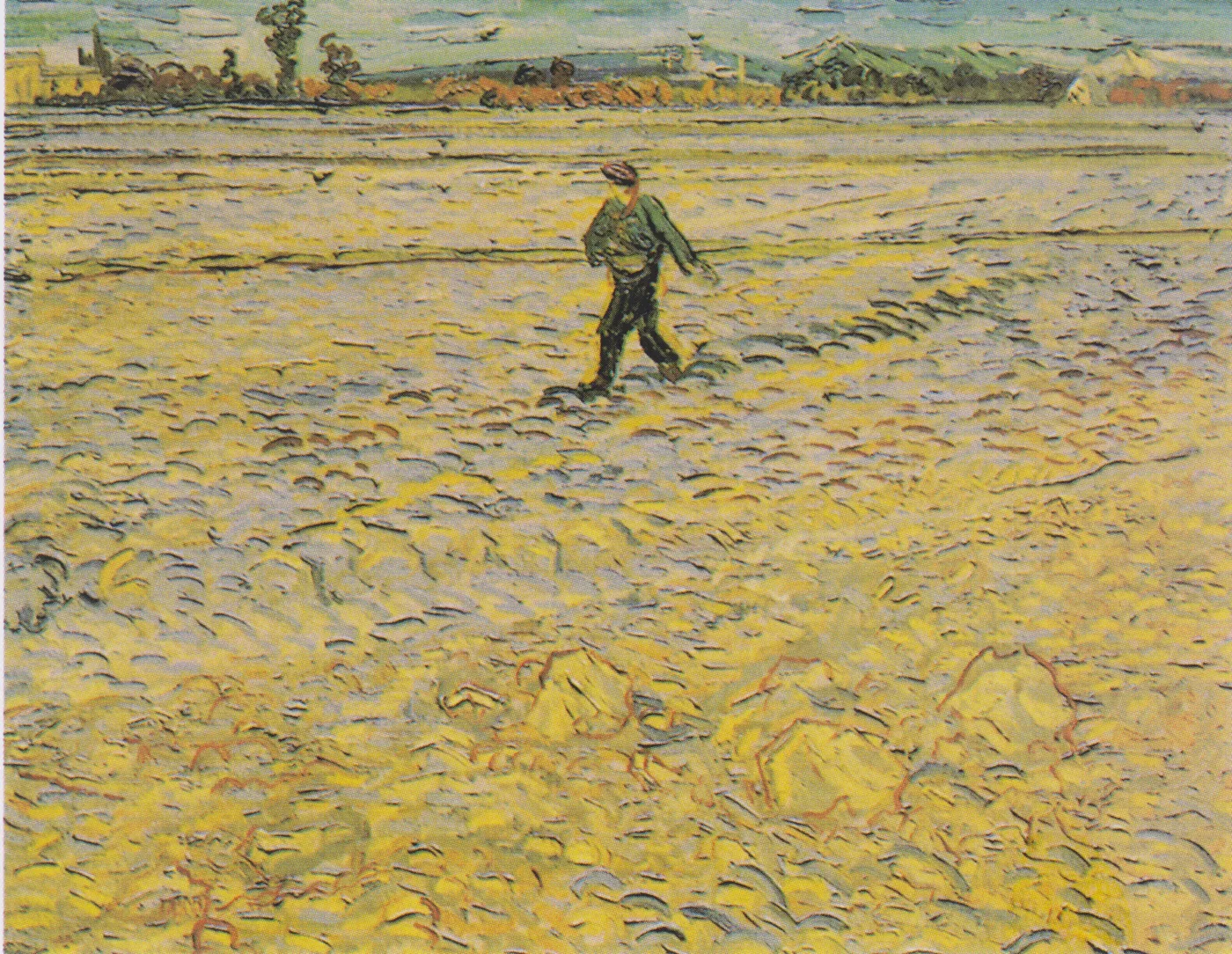
This canvas, painted in 1888 and recorded under its original title The Sower II, keeps close to its subject. The sower stands roughly at the centre of the picture, a compact silhouette in a dark green jacket, black trousers and a small red cap, caught mid stride as he crosses the field.
He moves toward the right, one arm swinging forward in the motion of scattering seed, his feet already sunk into the freshly turned earth ahead of him. Van Gogh gives him almost no facial detail; the figure reads through gesture and posture rather than portraiture, a single dark, moving mark holding the whole restless field steady.
Behind him the land rises gently to a low horizon, where a line of houses, rooftops and trees runs the width of the canvas in muted orange, green and blue. Above that band the sky sits pale and quiet, painted in thin, calm strokes that contrast with the agitation of the field below.
Yellow Earth, Violet Shadow
The field takes up most of the canvas, and it is where Van Gogh does his most demanding work. Short, thick strokes of chrome yellow, ochre and pale gold cover the ground in overlapping directions, each one carrying enough paint to stand slightly proud of the surface.
Running through that yellow are strokes of grey blue and lavender, the complementary shadow colour that keeps the field from reading as flat gold. The two colours sit hard against each other in short dashes rather than blended passages, so the ground seems to shift as the eye crosses it.
Van Gogh worked the paint quickly, in a rhythmic, near repetitive motion that echoes the sower’s own action, row after row of short marks standing in for clods of turned soil. It is brushwork built for pace and repetition, not for polish, and it is the first thing the eye meets on approaching the canvas.
One Sower Among Several
Van Gogh painted the sower more than once in 1888, testing the same figure and the same field against different arrangements of colour and framing. This canvas, 91.5 by 72 centimetres, is one of those returns to the subject, keeping the man and the ground he is working close within the frame.
The painting is recorded today as The Sower II, dated to 1888, and it is held by Villa Flora. Villa Flora, the Winterthur house built around the Hahnloser family’s collection, brought together major French and Dutch modern paintings in the early twentieth century, and this canvas has remained part of that holding.
On the Wall, By Different Light
Hung in a room, the painting reads first as a field of colour rather than a scene, the yellow ground catching the eye before the small dark figure within it is even noticed. Only after a moment does the sower resolve out of the brushwork, and the picture turns from an abstract weather of colour into a specific man doing specific work.
Morning and evening light draw out the warmth of the chrome yellow and ochre, while flatter daylight lets the grey blue and lavender strokes surface and cool the same field. Seen up close the canvas is a field of separate, directional marks; seen from across a room those marks settle into stubble, clod and furrow, so the painting changes character with both the distance and the hour at which it is seen.
Sizes and materials for The Sower II are listed on its product page.
More from this collection
Bring this painting home
Choose a hand-painted oil reproduction for real brushwork, or an archival canvas print for a crisp museum-image edition. Every size preserves the original proportions.
View this work & options
Further reading
Verify the original in the Villa Flora collection record and continue through related works in the catalogue.