
Self-Portrait with Felt Hat: Story, Meaning & Brushwork
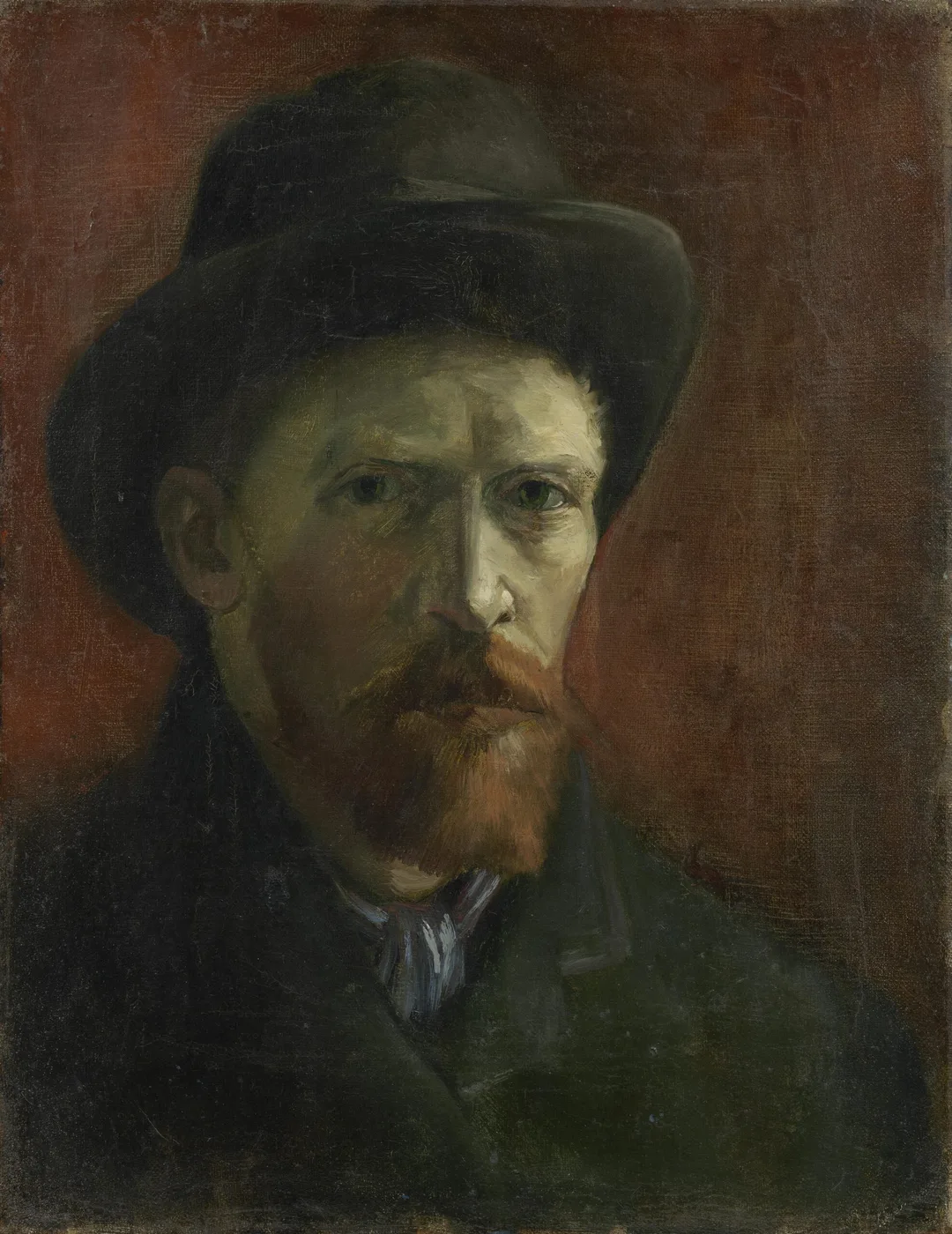
Vincent van Gogh reached Paris in March 1886, turning up at his brother Theo’s door on the Rue Laval without warning, a Dutch painter of dark, earthbound interiors about to be dropped into the middle of French modern art. He had left Antwerp in a hurry, his health poor and his student fees at the academy barely spent. Theo, an art dealer with a front-row view of the new painting coming out of Montmartre studios, took him in and effectively rebuilt his brother’s eye over the following two years.
Money for models was scarce, as it always was for Van Gogh, so he turned the mirror on himself. Self-portraiture became a working method as much as a subject, a way to practise a face under different light and paint without paying a sitter by the hour. This one belongs to that first stretch of Paris months, painted in 1886, when the habit was only beginning.
The picture is modest in scale, 32.5 by 41.5 centimetres, close enough to actual head-and-shoulders size that the encounter feels immediate rather than staged. It is not a grand statement of arrival. It reads more like a private exercise, a man working out what he looked like in this new city and this new light.
A Face Held Between Hat Brim and Collar
The hat dominates the upper half of the canvas, a dark felt shape with a wide, softly rounded brim that dips low over the brow. Its colour sits somewhere between bottle green and near-black, painted with none of the fine finish given to the face beneath it, more a mass than a described object.
Under that brim the face is lit from the front, pale and slightly waxen against the surrounding dark. The forehead carries visible furrows, short worried strokes that cut across the skin, and the deep-set eyes, grey-blue and slightly hooded, meet the viewer straight on without softening.
A close, reddish beard and moustache cover the lower face, the ginger tone the single warm accent against so much brown and green. Below it, a glimpse of a striped scarf, blue against white, breaks the collar line before the dark coat closes back over the shoulders.
Paint Still Carrying Its Dutch Weight
Look at how unevenly the attention falls across the canvas. The face is worked in short, controlled strokes that follow the structure of cheekbone and brow, while the hat, coat and background are laid in with broader, looser passes that barely bother to describe anything beyond mass and shadow.
That imbalance is the picture’s real subject. Van Gogh had spent his Dutch years mixing greys, umbers and bottle greens for peasant interiors, and that palette has not yet loosened here. The background is a scraped, streaky maroon, closer to old furniture varnish than to the Impressionist colour he was about to encounter in Cormon’s studio and in the galleries around him.
What has changed is the handling of the face itself, tighter and more searching than his Nuenen portraits, as though he were now painting to understand rather than simply to record. The coat and hat still belong to Holland. The eyes belong to a man already asking new questions of himself.
A Stare That Does Not Let Go
What strikes a viewer first, before the hat or the coat register at all, is the directness of the gaze. Van Gogh does not turn away from himself and he does not flatter what he sees, the mouth set flat, the eyes slightly wary under that heavy brim.
There is little vanity in it and little performance either. This is closer to a working note than a finished statement, a face checked against a mirror and set down while the paint was still workable, which gives it an unguarded quality that his later, more famous self-portraits sometimes trade away for colour and drama.
On a Wall, in Changing Light
Hung in a room with shifting daylight, a portrait built on this much dark ground behaves differently through the day. In low light the hat and coat sink almost to black and the pale face seems to hang forward on its own, caught mid-thought. Under stronger light the maroon background opens up and the brushwork in the coat becomes legible again, all that scraped, restless paint suddenly visible.
It rewards being looked at from across a room and then up close, the two views showing almost different pictures, one a silhouette against dark red, the other a study in short, deliberate strokes around a pair of watchful eyes.
The original hangs at the Van Gogh Museum in Amsterdam, one entry among the many self-portraits Van Gogh made in these Paris years, but an early and comparatively sober one, painted before the colour and the brushwork both broke loose.
Sizes and materials for Self-Portrait with Felt Hat are listed on its product page.
More from this collection
Bring this painting home
Choose a hand-painted oil reproduction for real brushwork, or an archival canvas print for a crisp museum-image edition. Every size preserves the original proportions.
View this work & options
Further reading
Verify the original in the Van Gogh Museum collection record and continue through related works in the catalogue.