
Self-Portrait with Japanese Print: Story & Meaning
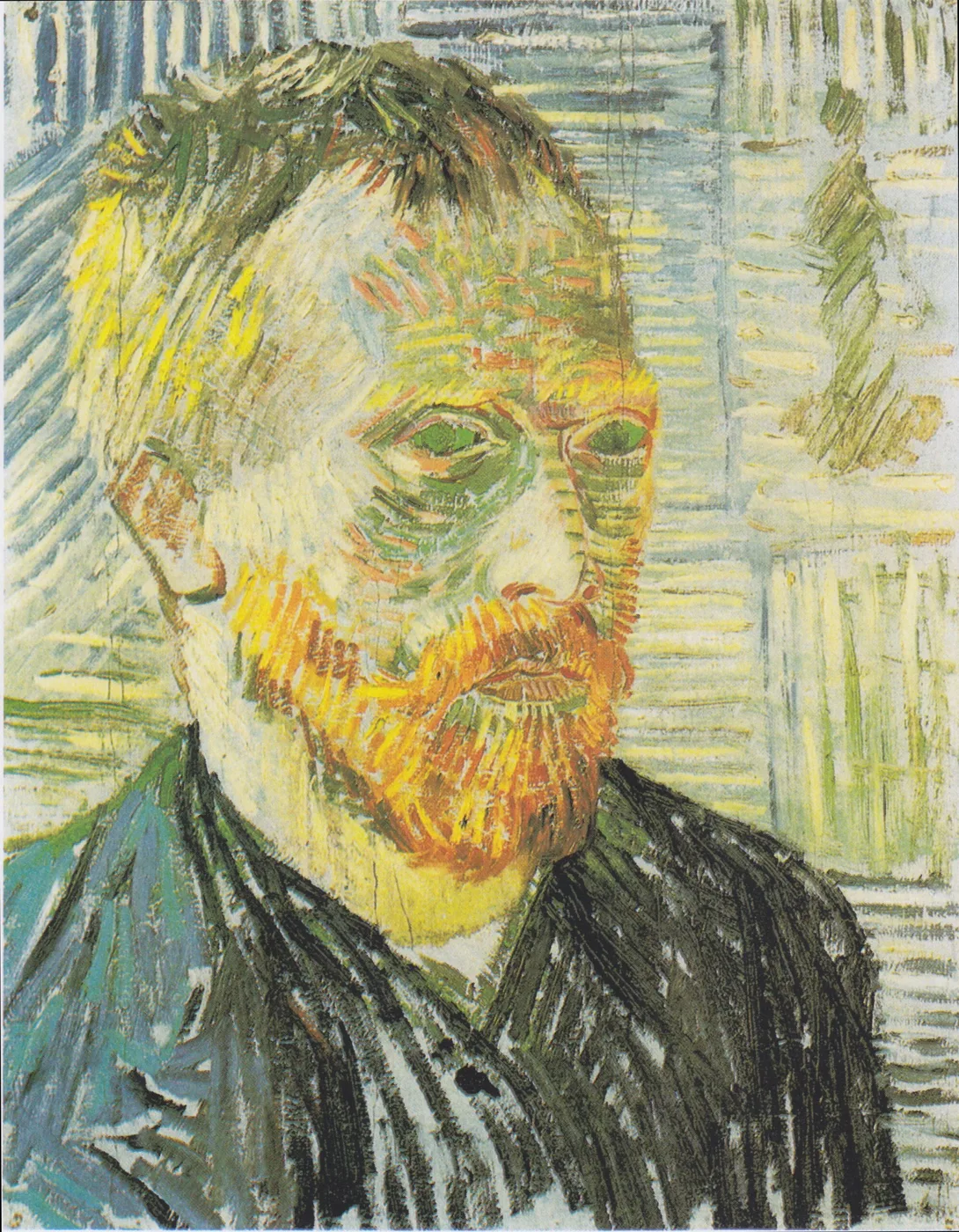
A Painter Rebuilding Himself in Montmartre
By 1887 Vincent van Gogh had been in Paris for the best part of two years, living with his brother Theo in Montmartre and trying to shed the dark, earthbound palette of his Dutch years. He had walked into a city mid-argument about colour, where Impressionists were breaking form into light and a younger generation was pushing further still toward pure, unmixed pigment.
He had also fallen for something further from home. Japanese woodblock prints, sold cheaply in Paris print shops and by dealers such as Siegfried Bing, offered him a completely different logic of picture-making: flat colour, decisive outline, pattern used as structure rather than decoration.
Van Gogh did not admire these prints from a distance. He bought hundreds of them, pinned them to his walls, and in 1887 helped organise a public showing of his collection at a Montmartre cafe. Painting himself with one at his shoulder was a way of declaring where his new work was heading.
A Face Assembled from Small, Deliberate Strokes
The self-portrait shows Van Gogh from the chest up, his head turned very slightly, his eyes meeting the viewer without warmth or performance. He is balding, his close-cropped hair and full beard rendered not as continuous mass but as dozens of short, separate strokes laid side by side.
The skin of his face is built the same way. Instead of blended flesh tones, Van Gogh sets strokes of yellow, pale green and soft orange directly next to one another, letting the eye do the mixing at a distance. Up close the face nearly dissolves into pure pattern; step back and it reassembles into a tired, watchful man.
His beard carries the most saturated colour in the painting, ochre and rust orange combed into shape with quick, radiating touches of the brush. Against it, the eyes are picked out in cool green, small and deep set, giving the face its steadiness even as everything around it seems to vibrate.
The Background as a Second Kind of Portrait
Behind him the wall is not a wall in any traditional sense. Van Gogh covers it with tight bands of directional colour, pale blue-green and warm straw yellow pulled into vertical and diagonal strokes that echo the patterning of the print he owned and pinned near his easel.
There is no attempt at depth here. The background reads as flat, almost woven, closer to textile or screen than to a domestic interior, and that flatness is the point. It borrows the Japanese print’s refusal of illusionistic space and turns Van Gogh’s own studio wall into something closer to a printed surface.
The effect is that the sitter and his setting are painted with the same vocabulary. Nothing in the picture is rendered as solid, continuous form. Face, beard, jacket and wall are all built from the same short, insistent marks, so the whole canvas seems to hum at a single pitch.
A Small Canvas Carrying a Great Deal
Self-Portrait with Japanese Print measures just 35 by 44 centimetres, small enough to have been worked at close range, in the time Van Gogh could snatch for himself between commissions and the demands of Theo’s gallery job. Its modest size is part of how it was made: fast, direct, without the luxury of a large studio composition.
He painted himself often in these Paris years because models cost money he did not have and a mirror cost nothing. Each self-portrait became a place to test an idea, a colour combination or a way of building a head out of marks rather than shading, before carrying the lesson into other work.
This particular canvas, painted in 1887, now belongs to the Emile Dreyfus collection. Its record sits among the documented works of a year in which Van Gogh’s palette lightened dramatically and his brushwork grew visibly more urgent, a shift that would carry him, within months, south to Arles.
What the Painting Does in a Room
Hung where daylight can reach it, this portrait changes character through the day. In flat, even light the small strokes settle into a coherent, slightly severe likeness. Under a lower or more angled light, the ridges of paint catch shadow and the whole surface seems to loosen, the face and background both breaking back into their component marks.
That instability is not a flaw to be corrected by good lighting. It is the painting doing what Van Gogh built it to do: never quite still, never fully resolved into a single reading, a small canvas that keeps asking to be looked at again.
Sizes and materials for Self-Portrait with Japanese Print are listed on its product page.
More from this collection
Bring this painting home
Choose a hand-painted oil reproduction for real brushwork, or an archival canvas print for a crisp museum-image edition. Every size preserves the original proportions.
View this work & options
Further reading
Verify the original in the Emile Dreyfus collection collection record and continue through related works in the catalogue.