
Olive Grove with Picking Figures: Story
By the summer of 1889 Vincent van Gogh had admitted himself to the asylum at Saint-Paul-de-Mausole, on the edge of Saint-Rémy-de-Provence. He was permitted to paint under supervision, and once he was allowed beyond the walls he turned again and again to the olive groves that covered the surrounding hills. Where Arles had given him sunflowers and wheat fields ringed by cypresses, Saint-Rémy gave him these low, twisted trees, and he painted more than a dozen canvases of them within a year.
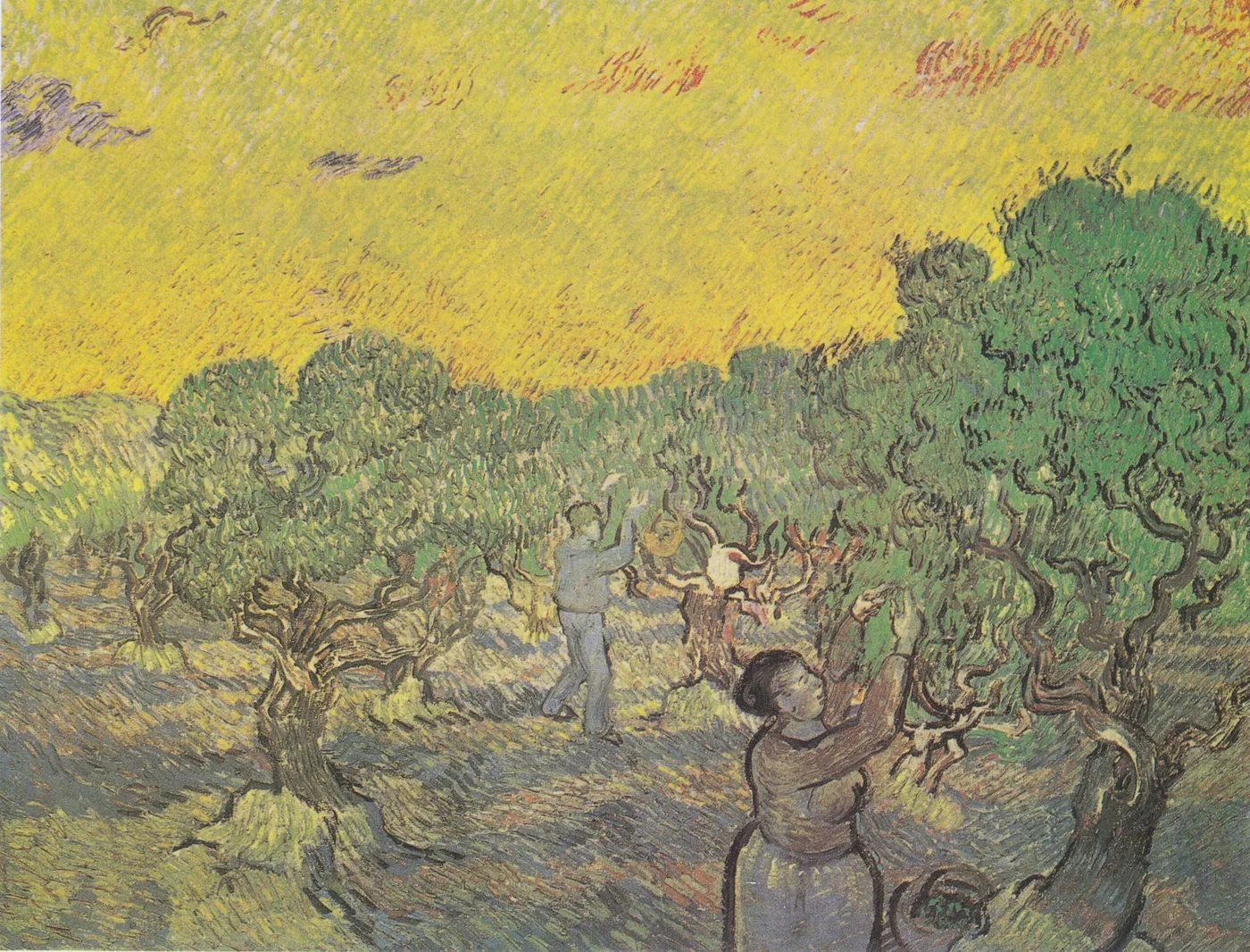
Olive Grove with Picking Figures, finished in 1889, belongs to that sequence. It is not a study of the trees alone but a working orchard, with pickers bent to the branches, and it carries the particular charge of a subject van Gogh returned to because he could not quite finish saying what he wanted to say about it.
A Harvest Caught in Motion
Three figures move through the grove. A woman in the near foreground, dressed in violet-brown, reaches up into a branch with both arms raised, her weight tipped forward into the work. Behind her a second figure in pale bonnet and pink bends among the trunks, and further back a man in blue-grey stands with one arm lifted, caught mid-gesture rather than posed.
None of the three faces the viewer directly. Van Gogh gives them by posture and colour rather than by feature, which keeps the eye moving from figure to figure and then out into the trees themselves, so that the people read as part of the grove’s motion rather than as its subject.
The ground beneath them is built from short, criss-crossed strokes of blue, ochre and green, laid down as if the earth itself were catching some of the same wind that stirs the branches. There is no still patch of canvas anywhere in the lower half of the picture.
A Sky That Overrides the Trees
What strikes a viewer first is not the grove but the sky above it, a wide band of yellow streaked with orange and touched with violet cloud, filling nearly half the canvas. It has the pitch of late afternoon turning towards storm or dusk, though van Gogh leaves the exact hour unresolved.
Against that heat the trees read as cool and dark, their trunks black-green and knotted, their canopies a silvery, blue-tinged green built from short diagonal dashes. The contrast between the burning sky and the shadowed grove does most of the picture’s emotional work.
Colour here is not describing daylight so much as a mood laid over it. Van Gogh had written to his brother about wanting the olive trees to carry feeling the way the sunflowers and cypresses had, and the sky in this canvas is where that ambition is most visible.
The Handling of the Paint
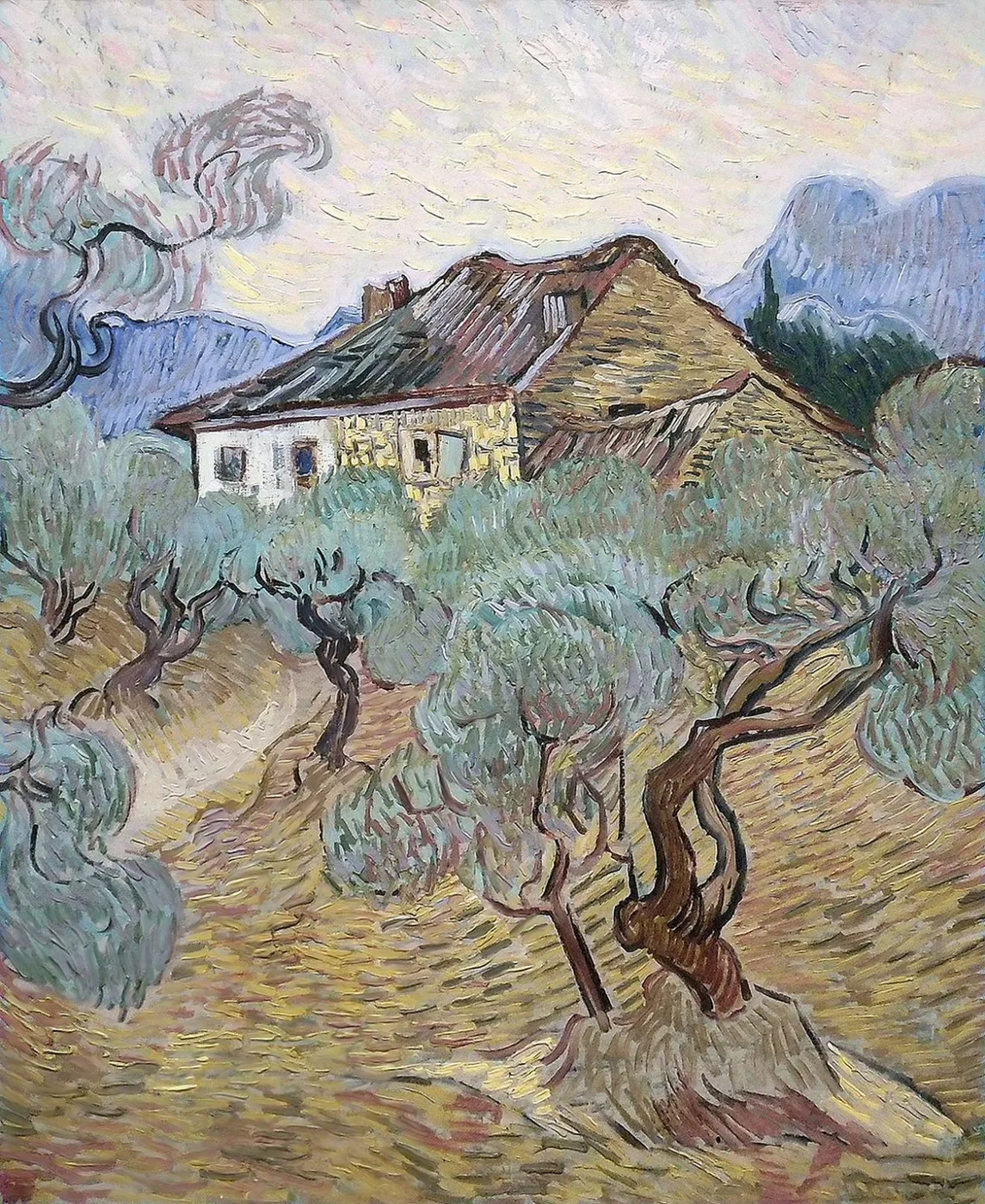
Every surface in the picture, sky, foliage, earth and figures alike, is built from the same short, directional stroke, applied thickly enough that the paint itself has a raised, ridged texture. Van Gogh varied only the direction and colour of the mark, not its character, so trunk, cloud and shoulder are all made of the same restless material.
The trunks are drawn with a darker, more continuous line that twists and knots against the busier strokes around them, giving the trees a gnarled, almost animal presence. It is this line, more than the figures, that carries the sense of age and labour the grove is meant to hold.
Nothing in the canvas is blended or softened. The paint sits on the surface in visible ridges, and from a normal viewing distance the strokes resolve into leaf, cloud and shadow only because the eye does the joining that the brush refused to do.
In a Room, Through the Day
Hung where daylight reaches it directly, the yellow sky in this composition changes character through the day, sharper and more acid under strong morning light, warmer and closer to gold as the light softens towards evening. Under a lamp at night the greens of the grove come forward and the sky settles into something quieter.
It is a picture that rewards being looked at from across a room as well as up close. From a distance the scene reads clearly, three figures at work among silvered trees under a burning sky. Close in, the same canvas breaks into ridges and streaks of paint that show nothing but the movement of the brush.
The original, at 92 by 73 centimetres, is held by the Kröller-Müller Museum, one of the largest holders of van Gogh’s work anywhere. A reproduction at the same scale carries the same weight in a room, the same insistence that a working grove and a troubled sky can occupy the same square of canvas without resolving into calm.
Sizes and materials for Olive Grove with Picking Figures are listed on its product page.
More from this collection
Bring this painting home
Choose a hand-painted oil reproduction for real brushwork, or an archival canvas print for a crisp museum-image edition. Every size preserves the original proportions.
View this work & options
Further reading
Verify the original in the Kröller-Müller Museum collection record and continue through related works in the catalogue.