
Plain near Auvers: Story, Meaning & Brushwork
Auvers, the Summer of 1890
Vincent van Gogh arrived in Auvers-sur-Oise at the end of May 1890, having left the asylum at Saint-Remy and travelled north with his brother Theo’s support, to be near Dr Paul Gachet. He took a room above the Ravoux inn and, in the roughly seventy days that remained to him, worked at a pace that still surprises historians who study his output.
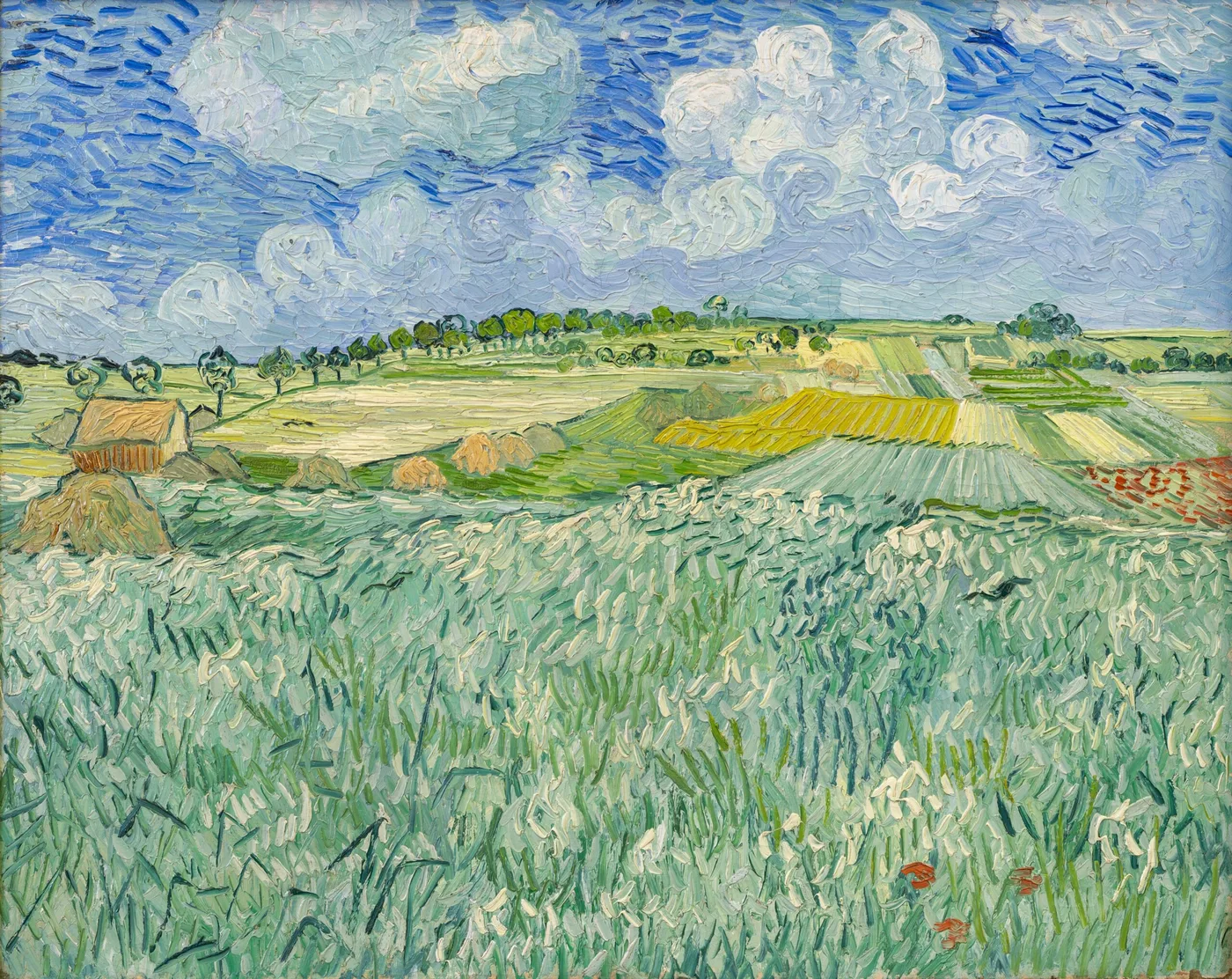
He was drawn immediately to the farmland on the plateau above the village, a stretch of open country where wheat, oats and grass ran unbroken to the horizon. Plain near Auvers, painted in 1890, is one of several canvases in which he set up his easel on that high ground and looked outward rather than into the streets or gardens below.
The painting measures 92 by 73.5 centimetres, tall enough that the sky and the land each claim roughly half the surface. That near-even split is not incidental. It lets both the ground he had walked and the weather moving over it carry equal weight.
Grass, Weeds and a Low Bird
The lower half of the canvas is given over to a field of tall grass and cereal shoots, rendered in short, upright strokes of green, sea-green and near-white. Nothing here is a single flat colour. Van Gogh built the grass out of dozens of separate touches, each one a blade or a cluster of blades, laid close enough together that they read as a moving surface rather than a lawn.
Scattered through this foreground are pale flower heads, likely wild daisies caught by the wind, and a small cluster of red poppies low in the right corner. The red is deliberately sparse. A handful of dabs against so much green is enough to pull the eye down and hold it there before it travels further into the picture.
A single dark bird cuts low across the grass near the centre of the canvas, wings spread flat. It is barely more than three or four strokes of near-black paint, but it does what a bird in a still landscape rarely does: it fixes a moment, a specific instant of flight, inside a scene that is otherwise about slow growth and settled weather.
Fields, Haystacks and a Line of Trees
Beyond the near grass, the land drops into a patchwork of cultivated strips: ochre stubble, pale gold wheat already cut, and bands of green running at slightly different angles, the way real field boundaries do on rolling ground. A thatched barn or cottage with a low roof sits among a group of haystacks on the left, painted in warm browns that stand out against the surrounding greens.
Van Gogh handled this middle ground with shorter, more varied strokes than the foreground grass, dragging the brush sideways to suggest ploughed furrows and stooked hay. The paint here sits noticeably thick in places, ridges of colour that catch real light and shift the tone of the fields depending on where a viewer stands.
A thin line of trees runs across the far edge of the fields, marking the limit of the plain before it meets the sky. The trees are small and loosely brushed, more a suggestion of a boundary than a description of individual trunks, which keeps the eye moving past them rather than resting there.
Clouds That Will Not Settle
The sky takes up the upper half of the canvas and does most of the emotional work. Heavy white and grey-blue clouds roll across a deep blue ground, painted in long curved strokes that coil and double back on themselves rather than sitting flat.
There is a restlessness to this sky that the fields below do not share. Where the grass and crops are built from short, repeated marks, the clouds move in wide sweeps, as if Van Gogh had loaded the brush once and let it travel the full width of a cloud in a single, unbroken gesture.
The blue between the clouds is not uniform either. It darkens toward the top edge of the canvas and lightens near the horizon, a gradation that gives the whole sky a sense of depth and pressure, of weather actually moving rather than painted weather standing still.
On a Wall, Through the Day
Hung in a room that gets daylight, this painting changes more than most. In flat morning light the greens of the foreground read as cool and even. As the light warms toward evening, the ochre strips of stubble and the haystacks pick up more heat, and the small reds of the poppies become the first thing the eye finds.
It suits a room where people spend time rather than pass through quickly, a living room or a study, somewhere a viewer can stand back far enough to take in the whole sweep of sky and field, then step closer to watch the brushwork break the grass into hundreds of individual strokes.
The original is held by the Bavarian State Painting Collections in Munich, in the Neue Pinakothek. It remains one of the clearest records of how Van Gogh looked at open land in the last weeks of his life, not as a backdrop but as something with its own weather and its own motion.
Sizes and materials for Plain near Auvers are listed on its product page.
More from this collection
Bring this painting home
Choose a hand-painted oil reproduction for real brushwork, or an archival canvas print for a crisp museum-image edition. Every size preserves the original proportions.
View this work & options
Further reading
Verify the original in the Bavarian State Painting Collections collection record and continue through related works in the catalogue.