
Ravine at Saint-Remy: Story, Meaning & Brushwork
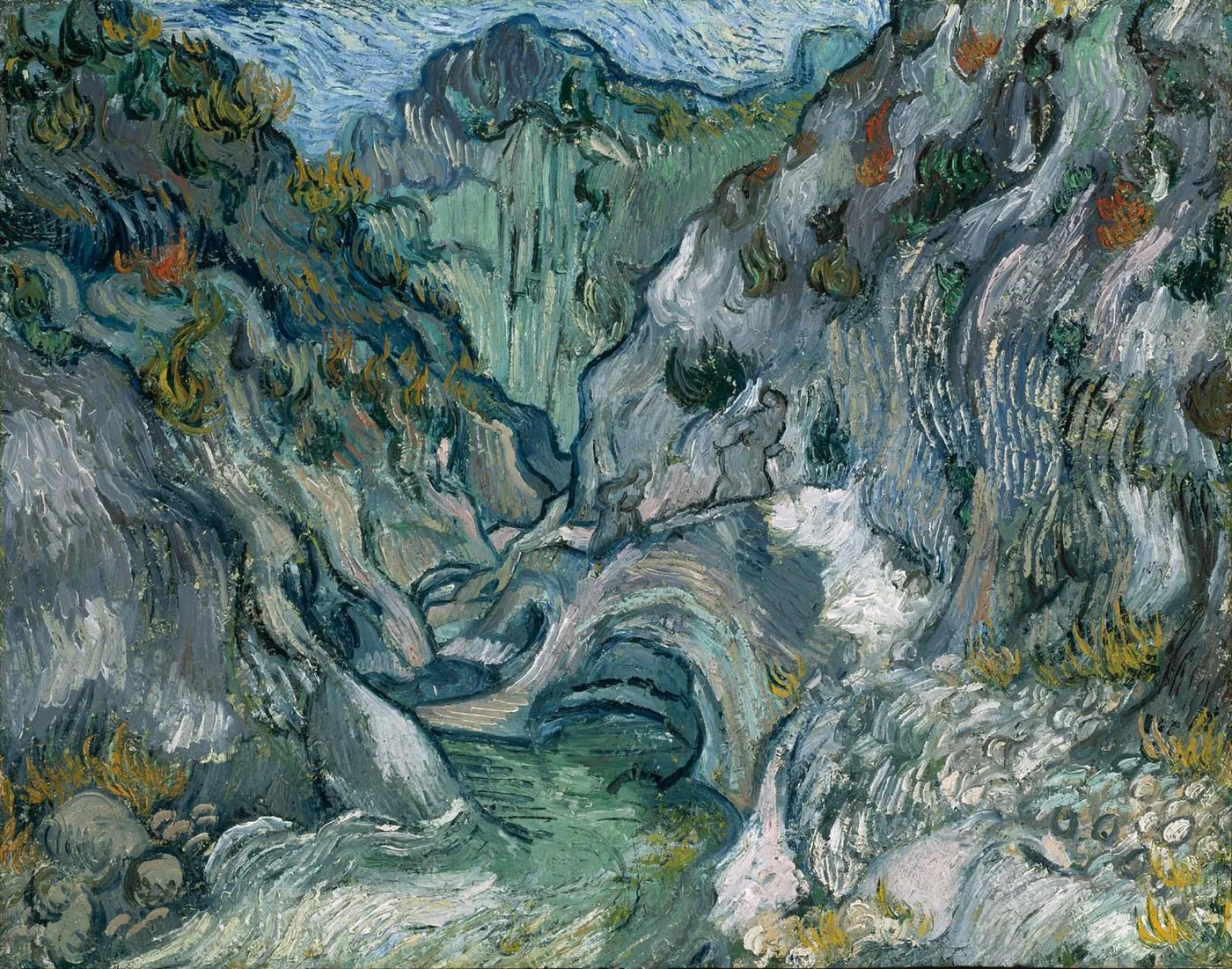
Into the Peyroulets Ravine
In May 1889, Vincent van Gogh admitted himself to the asylum of Saint-Paul-de-Mausole, just outside Saint-Rémy-de-Provence, after the crisis that had ended his time in Arles. He was a voluntary patient there, and under the escort of an orderly he was gradually allowed outings beyond the asylum grounds.
One of those excursions took him into a narrow limestone gorge in the hills nearby, a place known locally as the Peyroulets ravine. He set up his easel among the rocks and worked directly from the motif, carrying canvas and paints into ground that offered him nothing flat or easy to compose.
The painting he brought back from that outing he titled, plainly, Ravine. It is dated 1889 and measures 91.7 by 73 centimetres, one of a small group of rocky-gorge subjects from that autumn in which he pushed his landscape painting toward something rougher and more physical than the orchards and wheatfields of the spring before.
What the Canvas Holds
The gorge opens toward the viewer and closes again in the distance, where a pale green, almost triangular peak rises between the two rock walls. Above it, a narrow wedge of blue and white sky is nearly all that remains of open space in the picture.
Two small figures cross a rough footbridge over the stream at the centre of the composition. They are little more than a few dark strokes against the pale ground, dwarfed by the scale of the rock on either side of them, and easy to miss on a first look.
Below them the stream itself twists down through the gorge in tones of turquoise and green, breaking into white where it runs over stone. Van Gogh built the foam and the pale rock in thick ridges of paint, so that the lightest passages sit slightly proud of the canvas.
The rock faces that climb on both sides are worked in grey, violet and blue-green, streaked through with the ochre and rust of dry vegetation clinging to the ledges. Small bursts of orange, likely gorse or late-season flowers, break the cooler palette at intervals up both walls.
The Handling of Paint
Every surface in the ravine is built from short, curling strokes that follow the lie of the rock beneath them, so that the paint itself seems to describe the geology rather than simply cover it. There is barely a passage in the canvas left plain or unworked.
This is a denser, more agitated brush than the one Van Gogh had used earlier in Arles. The ridges of pigment on the white water and on the pale stone catch real light across their surface, adding a physical relief that a flat photograph cannot fully convey.
The effect is of a painter working fast, trying to keep pace with a subject that offered no calm, level ground to rest on. Rock, water, sky and foliage are all handled with the same restless energy, which is part of what makes this one of the most elemental of his late Saint-Rémy landscapes.
Where the Painting Lives Now
Ravine has been held by the Museum of Fine Arts, Boston, where it remains part of the museum’s collection of nineteenth-century European painting.
In reproduction, the painting rewards a wall with changing light. Under strong daylight the greens and greys separate out clearly and the white impasto of the water catches a real sheen; in the softer light of evening or lamplight, the violets in the rock deepen and the whole gorge reads as a single, closer mass of colour.
Seen across a room rather than up close, the composition still pulls the eye down through the gorge toward the two tiny figures on the bridge, the one detail in the picture built at human scale against everything else that dwarfs it.
Sizes and materials for Ravine at Saint-Remy are listed on its product page.
More from this collection
Bring this painting home
Choose a hand-painted oil reproduction for real brushwork, or an archival canvas print for a crisp museum-image edition. Every size preserves the original proportions.
View this work & options
Further reading
Verify the original in the Museum of Fine Arts Boston collection record and continue through related works in the catalogue.