
Baby Marcelle Roulin: Story, Meaning & Brushwork
A Postman’s Family in Arles
By the second half of 1888 Vincent van Gogh had been living in Arles for months, working at a pace that alarmed even him. Among the handful of local people willing to sit for him was Joseph Roulin, a postal employee whose family became some of the few steady companions of that difficult year.
Van Gogh painted Roulin himself several times, then turned to the rest of the household: his wife Augustine, their two sons, and finally the youngest child, a baby girl named Marcelle. She had been born only months earlier, and by the time Van Gogh set her portrait down on canvas she was still small enough to be swaddled and capped.
Painting an entire family, infant included, was not a casual choice. It reflects how far Van Gogh had come to depend on the Roulins for company and warmth during a period when his circle in Arles was thin and his letters to his brother Theo increasingly anxious.
A Face That Fills the Small Canvas
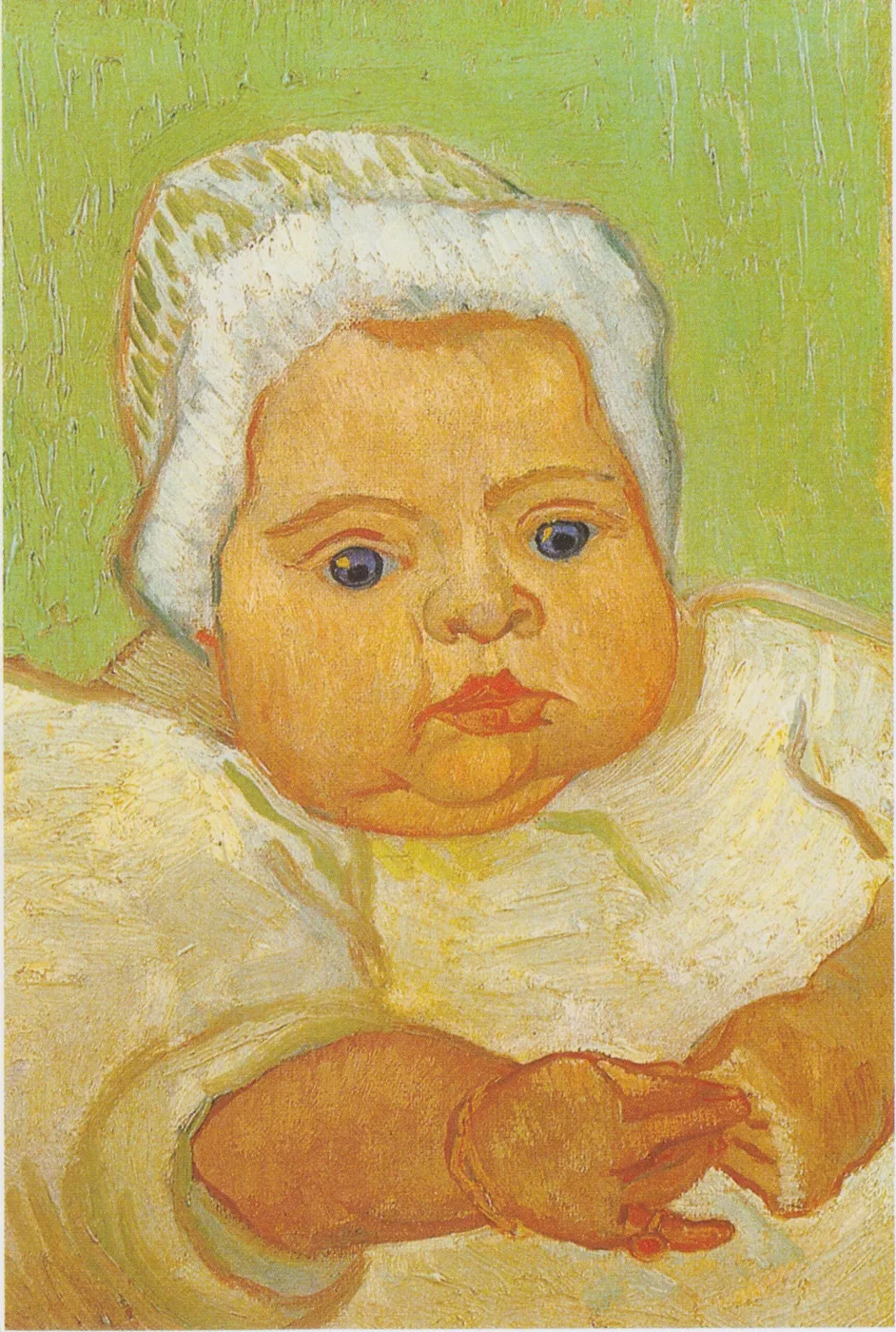
The picture is built almost entirely around the baby’s face. Painted on a canvas only 24.6 by 35.2 centimetres, the composition leaves little room for anything but the child herself, propped up so that her head and folded arms occupy nearly the whole surface.
Her eyes are the first thing the viewer meets: dark, round and fixed somewhere just past the painter, giving the face a gravity unusual in a portrait of an infant. The cheeks are full and ruddy, the small mouth set in the slightly pursed, uncertain line babies often wear when they are concentrating rather than smiling.
A soft white bonnet frames the head, its folds picked out in grey-blue shadow against the warm orange-gold of the skin. Below, her arms cross loosely over a pale gown, the hands rendered as quick, blunt strokes rather than carefully modelled fingers.
Green Ground, Warm Child
Behind her, Van Gogh laid in a flat field of yellow-green, applied in short, dragged strokes that leave the canvas weave visible in places. It is not a room or a setting of any kind, simply a field of colour chosen to work against the flesh tones in front of it.
Orange and green sit near opposite ends of the colour wheel, and Van Gogh knew exactly what that pairing would do: the green pushes the child’s face forward and warms it further, while the face in turn keeps the background from reading as merely decorative. It is the same logic he used in his portraits of adults that year, scaled down to a single small head.
The paint on the child’s skin is built up more densely than the ground behind her, ridges of pigment catching light across the forehead and the bridge of the nose. Up close the face resolves into individual strokes of ochre, pink and white; at a normal viewing distance they knit into soft, convincing flesh.
The Baby From La Berceuse
This is the same infant whose cradle Augustine Roulin rocks by a cord in Van Gogh’s better known La Berceuse, one of several portraits he made of the mother that year. Seen together, the two pictures fill out a single household: the mother at her post beside the cradle, the child herself studied close up and alone.
Van Gogh made more than one version of the baby’s portrait, returning to her face as he had returned to her parents’ and brothers’. Whatever difficulty a squirming infant subject presented, he treated her with the same seriousness he gave the adults, matching her portrait in scale and handling to the rest of the family group.
What the Portrait Does in a Room
Hung at eye level, the painting reads first as a pair of eyes before anything else in it registers. The scale is intimate by design, closer to a page in a family album than a formal portrait, and it asks to be looked at from near rather than across a room.
Morning light draws out the yellows in the bonnet and gown; by lamplight the green ground deepens and the orange of the skin comes forward even further, warming the whole picture. It is a small canvas that holds its own on a wall because so little in it is wasted: one face, one field of colour, and the paint doing all the work.
Today the original is held by the Van Gogh Museum in Amsterdam, part of the wider record of the Roulin family that Van Gogh built across his time in Arles in 1888.
Sizes and materials for Baby Marcelle Roulin are listed on its product page.
More from this collection
Bring this painting home
Choose a hand-painted oil reproduction for real brushwork, or an archival canvas print for a crisp museum-image edition. Every size preserves the original proportions.
View this work & options
Further reading
Verify the original in the Van Gogh Museum collection record and continue through related works in the catalogue.