
Evening, End of the Day (after Millet, version): Story
A Room at Saint-Paul-de-Mausole
By the autumn of 1889 Vincent van Gogh had been a voluntary patient at the asylum of Saint-Paul-de-Mausole, near Saint-Rémy-de-Provence, for several months. Allowed a bare cell to work in and, later, use of a second room as a studio, he was cut off from the models and open-air motifs that had sustained him at Arles. He turned instead to reproductions of works he admired, chief among them the black-and-white prints after Jean-François Millet that his brother Theo sent him from Paris.
Millet had died in 1875, revered across Europe as the painter of peasant labour. Van Gogh had copied his figures as a young student and returned to them now with a different purpose. He was not tracing Millet so much as translating him, the way a musician might set another composer’s melody for a different instrument.
Working from Black and White
Van Gogh described this practice in letters to Theo as a kind of collaboration across time, treating a print as a black-and-white record of a scene he was free to colour as he pleased. He kept Millet’s drawing, the pose of the figure and the arrangement of tools, and supplied everything else: the hour of day, the temperature of the light, the weight of the paint.
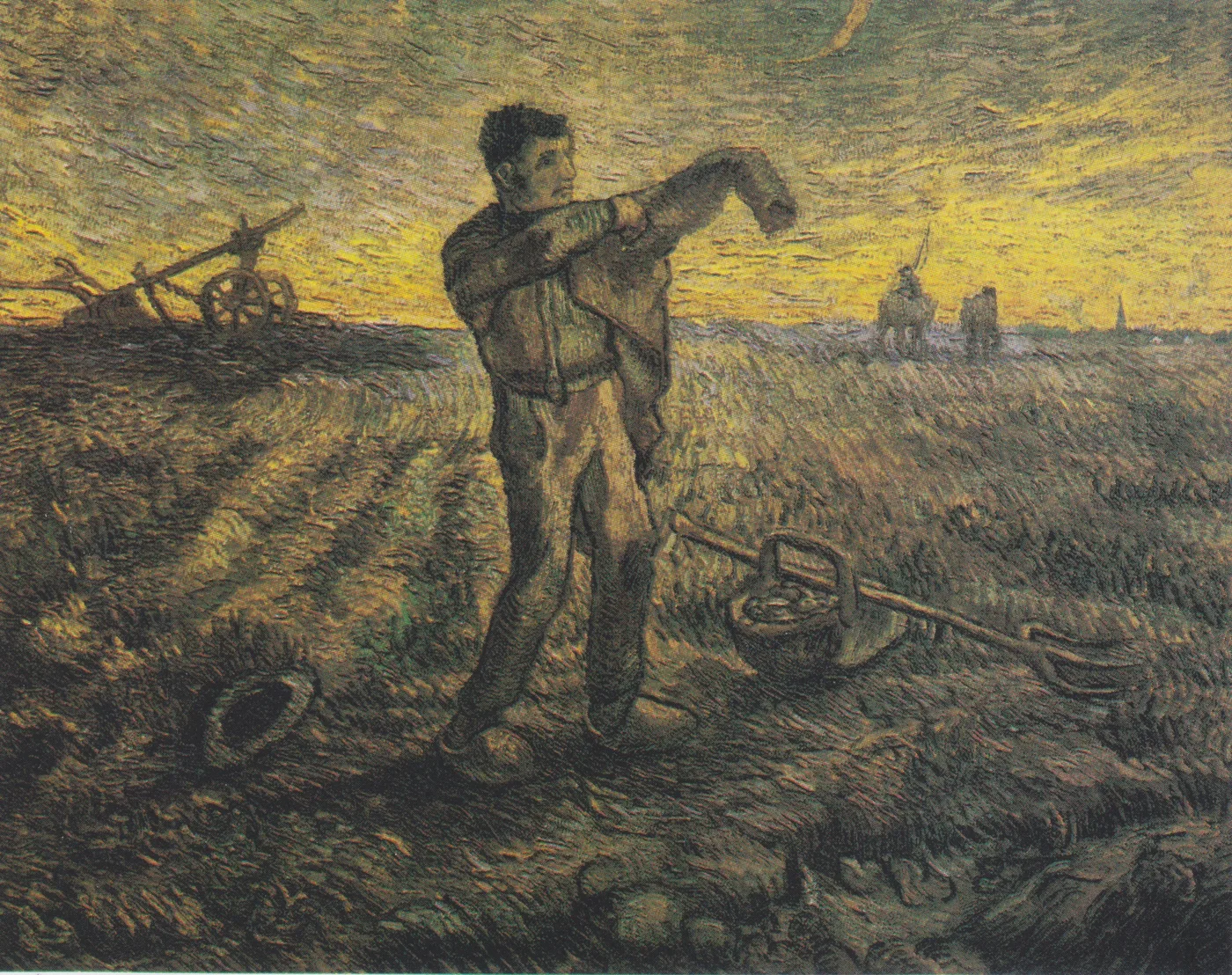
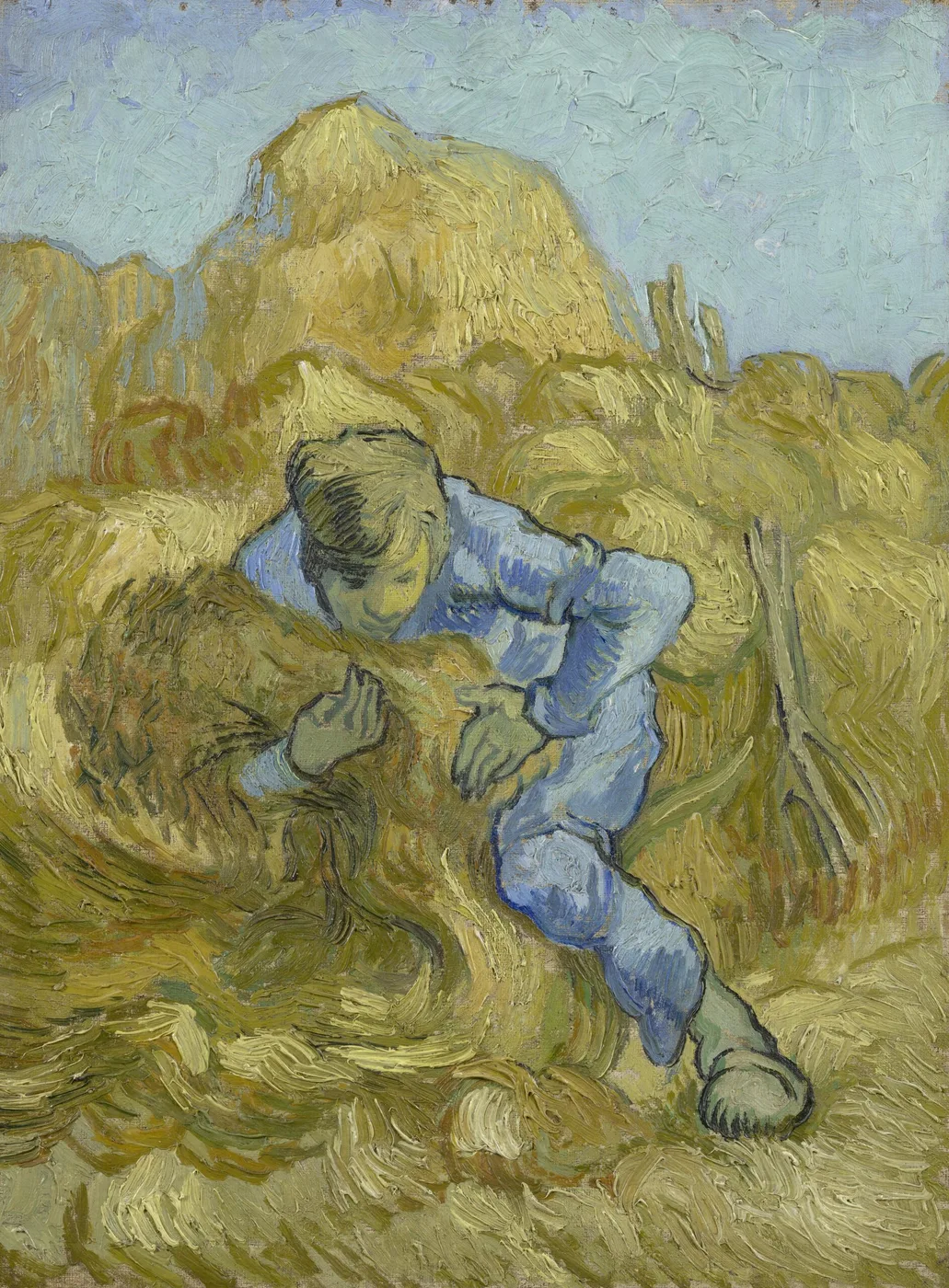
Evening: The End of the Day, painted in 1889 and now in the Menard Art Museum, belongs to this group of coloured translations. It follows an engraving after Millet’s original composition, but nothing in its colour owes anything to Millet. The palette is van Gogh’s own, built from the violets, blues and sulphurous yellows he had been using since Arles.
A Man Stretching at Dusk
At the centre of the canvas a peasant stands in a half-ploughed field, arms crossed and raised above his head in the unmistakable stretch of a body that has been bent to work since dawn. His head tilts back and his shoulders roll open, and for a moment the labour of the day is set aside.
He has left his tools nearby. A pitchfork leans across the foreground with a wicker basket hooked over its prongs, and a broad hat lies discarded on the turned earth at his feet. To the left, a plough stands abandoned at the edge of the furrows, its wheel catching the last light.
Further back, little more than a few strokes, a horse and a mounted figure cross the field towards the horizon, where a thin spire marks a distant village. These small incidents keep the eye moving without ever competing with the man at the centre.
The Sky Doing the Work
Above the field the sky takes up almost half the canvas, and it is where van Gogh spends his effort. Thick curling strokes of yellow and ochre push outward from a low sun, cooling into green and grey-violet as they rise, with a sliver of crescent moon already visible near the top edge.
The ploughed earth below answers in the same rhythm, furrows raked in short diagonal touches of green, brown and violet that catch the sky’s last warmth. Van Gogh lets the two zones, land and sky, share a single restless energy, so that the field seems to breathe with the same rhythm as the clouds above it.
The figure, by contrast, is built more solidly, its outline held in a darker contour so it reads clearly against the glow behind it. That contrast, a still silhouette against a turning sky, is what carries the painting’s mood: exhaustion met by a moment of release.
On a Wall at the End of the Day
Hung where evening light reaches it, a reproduction of this scene shifts with the room the way the original’s colour shifts across the canvas. In direct light the yellows of the sky read almost hot; as the light fades, the violets and greens in the shadowed earth come forward and the whole field seems to cool.
It rewards the kind of looking that has time to spare, the eye moving from the man’s raised arms out to the pitchfork, the hat, the distant horse, and back again. At 94 by 72 centimetres, the canvas holds a single figure comfortably at something close to human scale, so the stretch at its centre keeps its immediacy from across a room.
What stays with a viewer is not the plough or the darkening field but the gesture itself, a working man permitting himself one unguarded moment before the tools are picked up again tomorrow.
Sizes and materials for Evening: The End of the Day (after Millet) are listed on its product page.
More from this collection
Bring this painting home
Choose a hand-painted oil reproduction for real brushwork, or an archival canvas print for a crisp museum-image edition. Every size preserves the original proportions.
View this work & options
Further reading
Verify the original in the Menard Art Museum collection record and continue through related works in the catalogue.