
Olive Grove: Story, Meaning & Brushwork
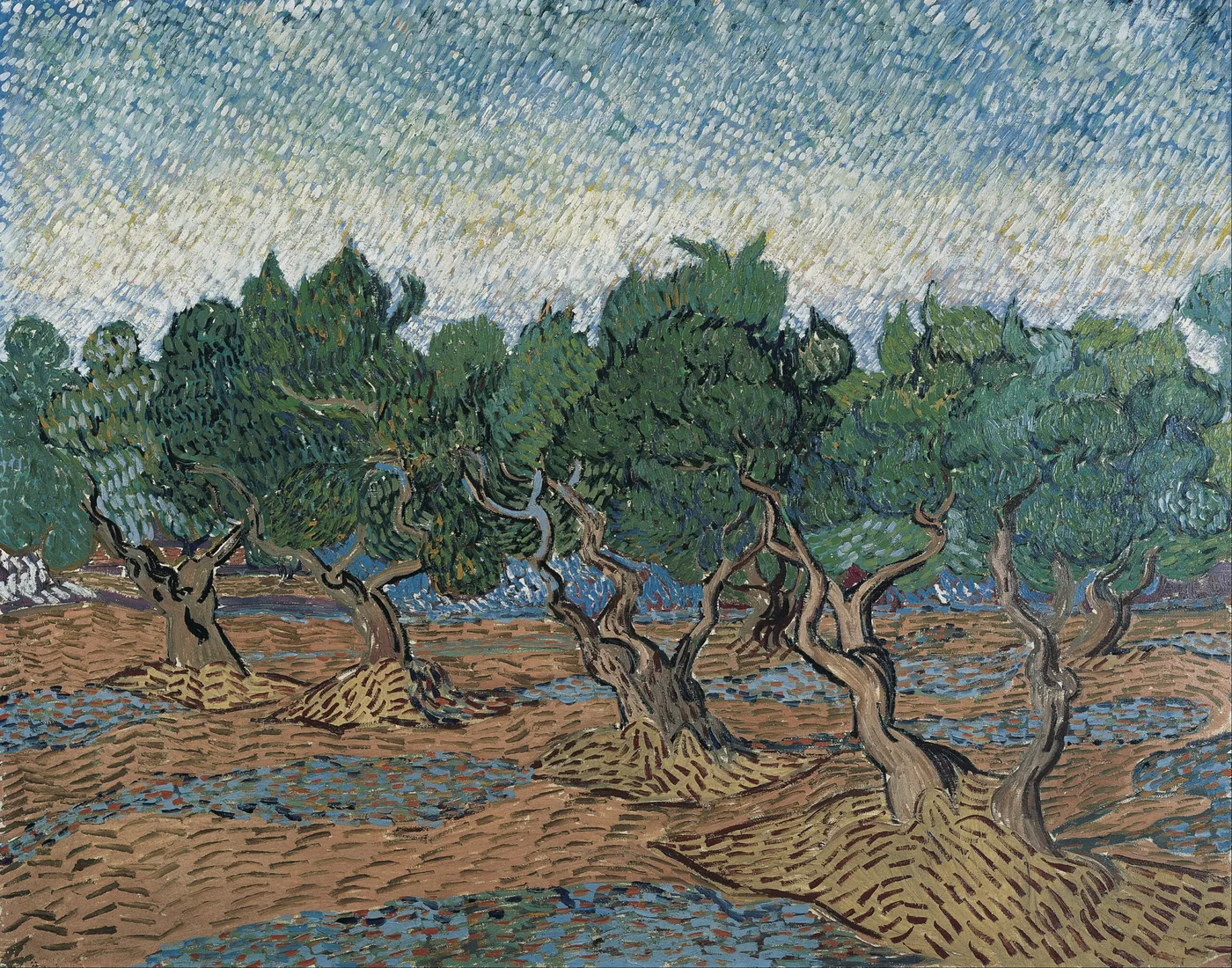
By the spring of 1889 Vincent van Gogh had committed himself to the asylum of Saint-Paul-de-Mausole, just outside Saint-Rémy-de-Provence. He was allowed to paint under supervision, and once the worst of his attacks had passed he was permitted short excursions beyond the walls, into the fields and groves that ringed the old monastery. Among cypresses and wheat, it was the olive trees that held him longest.
He had written to his brother Theo that the olive tree meant as much to him as the cypress, a tree he felt no one before him had painted the way it deserved. Over the following months he returned to the groves again and again, at different hours and in different weather, trying to catch something in the silver-green foliage that kept slipping away from him. Olive Grove, painted in 1889, belongs to that sustained effort.
A grove with no horizon to spare
The canvas, 92 by 73 centimetres, gives almost its entire height to trees and earth. There is no distant view, no village roofline breaking the middle ground, nothing to soften the sense of being inside the grove rather than looking at it from a comfortable distance.
Eight or nine trunks rise and cross through the lower half of the picture, their bark rendered in ropes of ochre, grey and dull violet. Van Gogh has let them bend and twist against each other, some leaning left, some right, so that the grove reads less like a planted orchard and more like a gathering of individual, almost animate figures.
Above the trunks the canopies close ranks into a single dense band of green, broken only by narrow slots of sky. The foliage is built from short, curling strokes rather than distinct leaves, so that from a normal viewing distance the trees seem to be in motion, caught mid-shiver.
Where the light actually falls
There is no sun in this painting, no cast shadow pointing to a time of day. Instead the light is diffused evenly across the whole surface, coming from a pale, high sky rather than from any single direction.
That sky takes up roughly the top third of the canvas and is worked in short diagonal strokes of blue, white and a faint sulphurous yellow, laid close together like rain seen sideways. It has weight and movement of its own, closer to a current of air than to empty space above the trees.
The ground answers it in kind. The earth is a warm ochre and tan, scored with the same short, directional strokes used in the sky, and threaded through with flecks of blue and a little red that keep it from ever settling into flat brown.
Between these two active zones, the green of the olive leaves sits as the picture’s still centre, though even that green shifts constantly, from near-grey in shadow to a brighter, almost acid tone where the light catches the upper leaves.
The habit of a painter who could not stop looking
Van Gogh painted olive groves obsessively during his time at Saint-Rémy, returning to the same stand of trees under sun, wind and moonlight as though one version could never be enough. He described the grove to Theo as a subject that changed its character completely from hour to hour, and his letters make clear he saw the series as a single sustained study rather than a set of separate pictures.
What sets this canvas apart within that series is its density. Rather than isolating one or two trees against open ground, as he did elsewhere, he has packed this grove edge to edge, so the eye has almost nowhere to rest that is not tree, trunk or turned earth.
The gnarled, knotted trunks were themselves part of the attraction. Olive trees of real age twist and split as they grow, and Van Gogh exaggerated that twisting further, giving each trunk a distinct silhouette so that even in a crowded grove no two trees repeat.
How the paint itself was laid down
Every part of the canvas, sky, foliage and earth alike, is built from the same short, repeated stroke, applied in a slightly different direction and colour in each zone. It is this consistency of touch, more than any single motif, that unifies the picture and gives it its restless surface texture.
The paint sits thickly in places, particularly along the trunks, where ridges of pigment catch real light and add a physical dimension to the bark that no flat reproduction can fully flatten out. Up close the picture dissolves into pure gesture; only at a step or two back does it resolve into trees again.
This is a picture that rewards both distances. Standing close, the viewer sees the working of Van Gogh’s hand, stroke by stroke. Stepping back, those strokes lock into a grove that feels, despite its evident agitation, entirely at rest in itself.
On a wall, through the day
Hung in a room that gets real daylight, Olive Grove keeps changing. Morning light tends to pull the blue out of the shadows and the ground; by evening, under lamplight, the ochres and warm greens come forward and the picture reads noticeably softer.
It suits a room where green is already doing some of the work, a bedroom or a quiet reading corner rather than a hallway passed through at speed, since its detail asks for a few minutes of unhurried looking rather than a glance. The density of the composition means it holds attention at close range as well as from across a room, which is unusual for a landscape of this size.
The original is held by the Van Gogh Museum, where it is catalogued alongside the artist’s other work from the Saint-Rémy period. Seen there or in reproduction, it remains one of the clearest records of how doggedly Van Gogh worked a single subject until the paint itself seemed to move.
Sizes and materials for Olive Grove are listed on its product page.
More from this collection
Bring this painting home
Choose a hand-painted oil reproduction for real brushwork, or an archival canvas print for a crisp museum-image edition. Every size preserves the original proportions.
View this work & options
Further reading
Verify the original in the Van Gogh Museum collection record and continue through related works in the catalogue.