
Portrait of a Peasant (Patience Escalier): Story
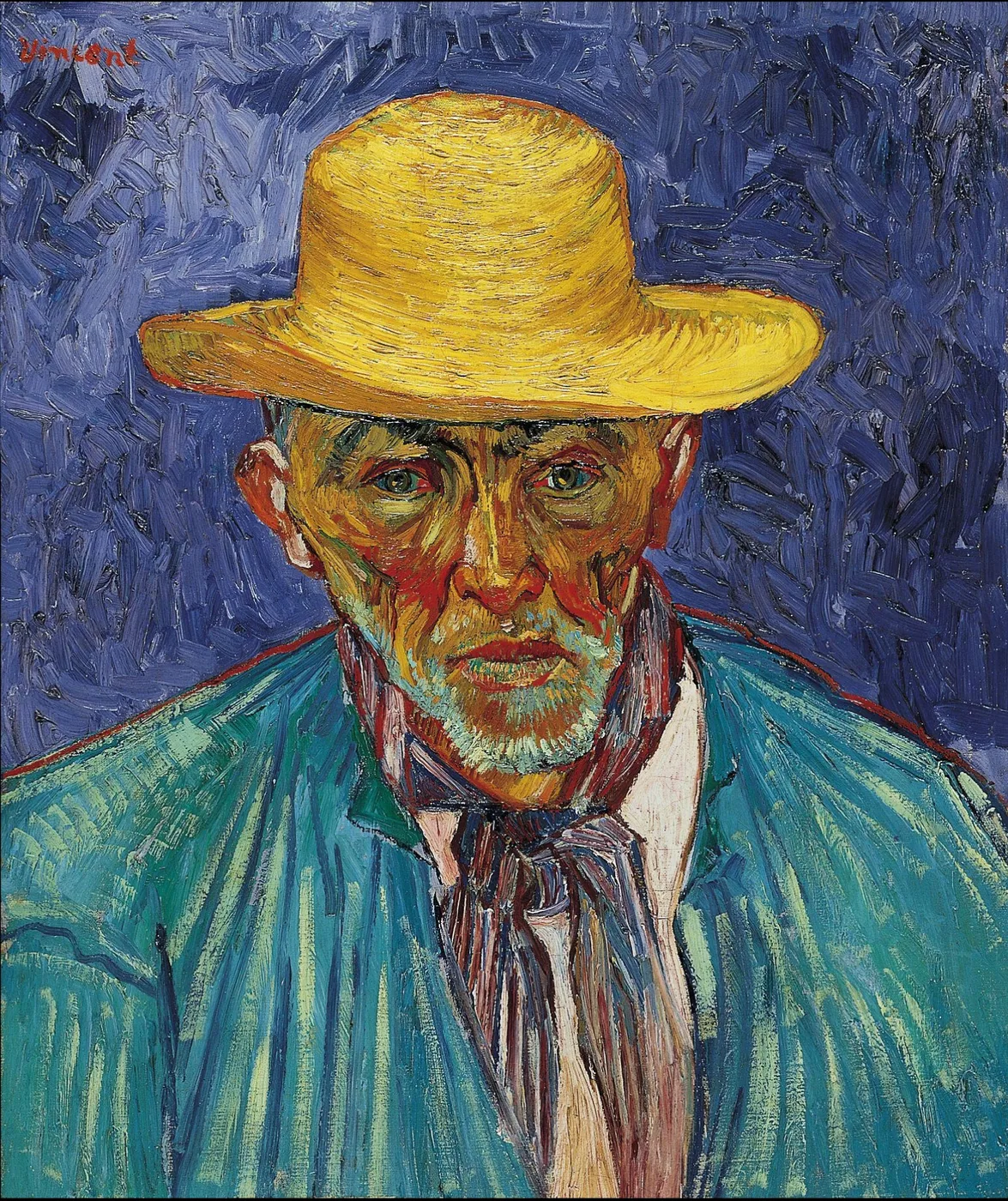
By the summer of 1888, Vincent van Gogh had been in Arles for several months, chasing a light he had never found in Paris and a subject he had not yet found anywhere. He wrote to his brother Theo about wanting to paint ordinary working people the way earlier painters had once painted saints, not idealised but raised up by colour and by the directness of the artist’s attention. Patience Escalier, an old man from the country near Arles, sat for him that summer, and Van Gogh painted him twice.
This is the second of the two, the version now in the Norton Simon Museum, and it is the bolder of the pair. Where the first stays close to the ochres and reds of the Provençal soil, this one pushes the picture toward violet and blue, so that the whole canvas reads as a single deliberate contrast: a burnt, ruddy face set against a cool, restless ground.
A face the artist chose to find
Van Gogh did not simply record Escalier’s features. He was after a type, the peasant as a figure of endurance, a man whose face had been made by decades outdoors rather than by a single sitting in a studio. That ambition shapes every choice in the painting, from the pose to the palette.
The sitter fills the canvas close to the picture plane, shoulders wide, head slightly lowered, eyes meeting the viewer without softening. There is no landscape, no tool, no clue to a trade beyond the man’s own weathered face. Van Gogh strips away narrative detail so that character carries the whole picture.
The straw hat is the first thing the eye meets, its brim curving down in broad, sunlit strokes of yellow and ochre. It sits like a second horizon above a face that is its opposite in every way: deep red at the cheekbones, greenish in the hollows, a grey-white beard catching the little light left over.
Violet ground, orange face
The background is worked in short, choppy strokes of blue and violet, laid on in a crosshatched weave that never settles into a flat colour. It reads at a distance as shadowed dusk, though up close it is built from dozens of separate marks, each visible and none blended away.
Against that cool field, the face and neck carry the heat of the picture: orange, vermilion, streaks of green in the shadows under the eyes. Van Gogh was working with complementary colour here in the most literal sense, setting blue against orange so that each intensifies the other rather than cancelling it out.
The jacket completes the scheme in a third register, a worn turquoise-green scored with lighter and darker strokes that follow the fall of the cloth over the shoulders. A loosely knotted scarf, striped in violet, ochre and white, breaks the line between collar and chin and gives the lower half of the painting somewhere to rest.
Paint laid on like weather
Nothing in this canvas is smoothed over. The brushwork in the hat runs in long parallel strokes that follow the curve of the straw. In the jacket the strokes turn diagonal, almost like rain, giving the fabric a sense of weight and movement that a flatter technique could never manage.
The face is built more slowly, in shorter overlapping touches that let one colour show through another. It is this layering, red under green under ochre, that gives the skin its sunburnt, almost inflamed quality, as though the paint itself had been left too long in the sun.
Van Gogh signed the canvas simply “Vincent” in orange at the upper left, a habit from these Arles months when he was painting at a pace that left little time for anything more formal. The signature sits lightly on the violet ground, almost lost in the brushwork around it.
Living with it
At 54.6 by 64.1 centimetres, this is a picture meant to be met at close range, not viewed across a large room. The scale keeps the face life-sized and near, so the sitter’s gaze stays direct wherever the canvas is hung.
Daylight changes it considerably. Under a soft, indirect light the violet background deepens and the orange of the face seems to lift forward, the two colours pulling against each other exactly as Van Gogh intended. Under a warmer lamp in the evening, the contrast softens and the whole picture reads closer to a single glowing tone.
It rewards a wall where someone will actually stand near it, a hallway, a study, a reading corner, somewhere a face this direct can be met rather than glanced at from across a room. The painting does not soften with familiarity. Escalier’s stare holds the same weight on the hundredth viewing as the first, which is precisely the effect Van Gogh was reaching for when he chose to paint a peasant as though he were a saint.
Sizes and materials for Portrait of a Peasant (Patience Escalier) are listed on its product page.
More from this collection
Bring this painting home
Choose a hand-painted oil reproduction for real brushwork, or an archival canvas print for a crisp museum-image edition. Every size preserves the original proportions.
View this work & options
Further reading
Verify the original in the Norton Simon Museum collection record and continue through related works in the catalogue.