
Postman Joseph Roulin: Story, Meaning & Brushwork
By the summer of 1888, Vincent van Gogh had been in Arles only a few months, and the town had given him almost nothing of the artists’ community he had hoped to build there. Paul Gauguin had not yet arrived, the Yellow House stood half furnished, and van Gogh was largely working alone, painting fast and writing home about the light. Into that isolation walked Joseph Roulin, a postal employee at the Arles station, who became one of the very few local people willing to sit for him, drink with him, and remain a friend once the town turned against him.
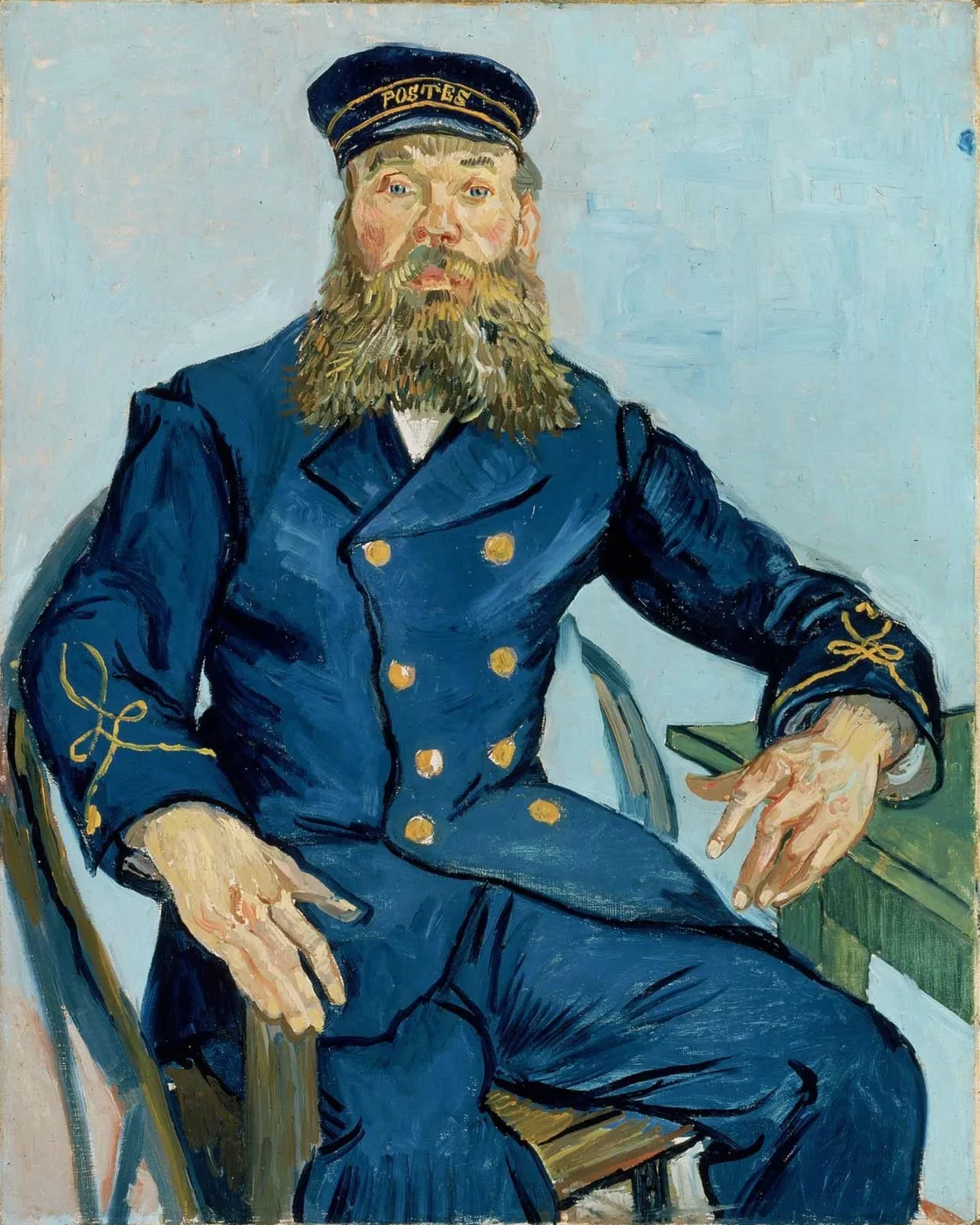
Roulin was in his forties, married with three children, and paid a modest wage that he supplemented, by his own account, with wine and long conversation. Van Gogh painted him repeatedly across 1888, and this canvas, Postman Joseph Roulin, is one of the results of that sustained attention. It is dated to 1888 and measures 65.4 by 81.3 centimetres, a scale close enough to life size that the sitter meets the viewer almost eye to eye.
A Postal Worker Who Would Not Sit Still to Be Flattered
Roulin was not a patron and had no reason to perform for the canvas. Van Gogh painted him in his own trade rather than dressed up for the occasion, and the picture reads less like a commissioned portrait than like an evening spent with someone he trusted.
That trust shows in the directness of the pose. Roulin sits square to the viewer, one hand resting loose on his knee and the other draped over the arm of a green chair, his body angled slightly but his face turned forward, unguarded.
The friendship had a practical weight to it too. Roulin was among the handful of people in Arles who stood by van Gogh through the crisis that would soon overtake him, and the warmth in this portrait is not sentimental invention but the record of a man painting someone who had earned it.
The Postman as van Gogh Actually Saw Him
The uniform announces the man before the face does. Roulin wears a dark navy postal coat with two rows of gilt buttons running down the front, its cuffs trimmed with a looping gold braid, and a stiff-peaked cap lettered POSTES sits square on his head.
His beard is the other dominant fact of the picture, a great forked spread of ochre, grey and rust that fills the lower half of his face and spills down over his collar. Van Gogh gives it as much attention as the uniform, working it in short overlapping strokes so that it seems to move even in stillness.
Behind him the setting is stripped to almost nothing, a flat field of pale blue green broken only by loose vertical strokes, so that no room, no window and no furniture competes with the man himself. Only the green ladder-back chair at his side survives as a solid object, anchoring him in a real space without describing one.
His hands are painted with the same honesty as his face, weathered and slightly reddened, one curled loosely and the other spread flat against the chair arm. They are a working man’s hands, and van Gogh does not soften them.
Blue Against Blue, and a Face Built From Colour
The picture is built on a single audacious decision: to set a deep, almost black navy uniform against a background of nearly the same hue, only paler and greener. Where a more cautious painter would have reached for contrast, van Gogh let the two blues argue quietly with each other, so that the buttons, in hot ochre and gold, become the loudest note in the entire canvas.
Skin tone carries the second half of the colour scheme. Roulin’s face and hands are pushed toward pink, rust and gold, warm enough to read as sunburnt and alive against all that cool blue, and it is this warm and cool pairing, repeated from face to buttons to beard, that holds the composition together.
Up close, the paint is anything but smooth. Van Gogh drew the beard, the coat’s piping and the cap’s lettering in quick, almost calligraphic marks, laid on with visible speed rather than blended or corrected, so that the whole figure seems to have been caught mid-sentence.
The background is handled just as openly, in loose diagonal and vertical strokes that never quite resolve into a described room. It functions more like a held breath than a setting, giving the eye nowhere to rest except on Roulin himself.
What the Portrait Does in a Room, Morning and Evening
Hung where daylight reaches it, the picture changes character through the day. Morning light tends to cool the blues further, making the uniform recede and the gold buttons and warm skin step forward; by evening, under lamplight, the whole canvas warms and the beard and face seem to advance toward the viewer.
What stays constant is the directness of Roulin’s gaze and the plainness of his pose, neither of which asks to be admired from a distance. This is a portrait built for close looking, and it rewards a wall where someone will actually stand near it.
The original hangs today in the Museum of Fine Arts, Boston, part of the public record of a friendship that otherwise left almost no trace beyond the letters and the paintings themselves. What remains on the canvas is not an idealised postman but a specific, tired, generous man, rendered by someone who had very few people left in Arles willing to sit still for him.
Sizes and materials for Postman Joseph Roulin are listed on its product page.
More from this collection
Bring this painting home
Choose a hand-painted oil reproduction for real brushwork, or an archival canvas print for a crisp museum-image edition. Every size preserves the original proportions.
View this work & options
Further reading
Verify the original in the Museum of Fine Arts Boston collection record and continue through related works in the catalogue.