
Seascape near Les Saintes-Maries-de-la-Mer: Sand Worked Into the Paint
From Arles to the Mediterranean, June 1888
Van Gogh painted Seascape near Les Saintes-Maries-de-la-Mer in June 1888, during a short trip from Arles to the fishing village on the Camargue coast. It is oil on canvas, 50.5 by 64.3 centimetres, and now belongs to the Van Gogh Museum.
He had arrived in Arles in February 1888, after leaving Paris for stronger colour and clearer light, and spent the following months painting the orchards in blossom and the flat farmland around the town.
He travelled south to Les Saintes-Maries-de-la-Mer, a small fishing port reached from Arles by the local stagecoach. He stayed about a week.
Grains of sand are worked into the paint itself. The Van Gogh Museum’s catalogue reads the sand as evidence that he painted this view from the beach, in front of the water itself.
He painted boats drawn up on the sand in Fishing Boats on the Beach at Saintes-Maries, and a second view of the open water in Seascape at Saintes-Maries.
Earlier that same year, back in Arles, he had painted the drawbridge and canal on the edge of town, the subject of The Langlois Bridge at Arles. Within a few months he had painted still canal water and open sea on the same stretch of southern France.
The Paint Itself, From Thin Sky to Thick Foam
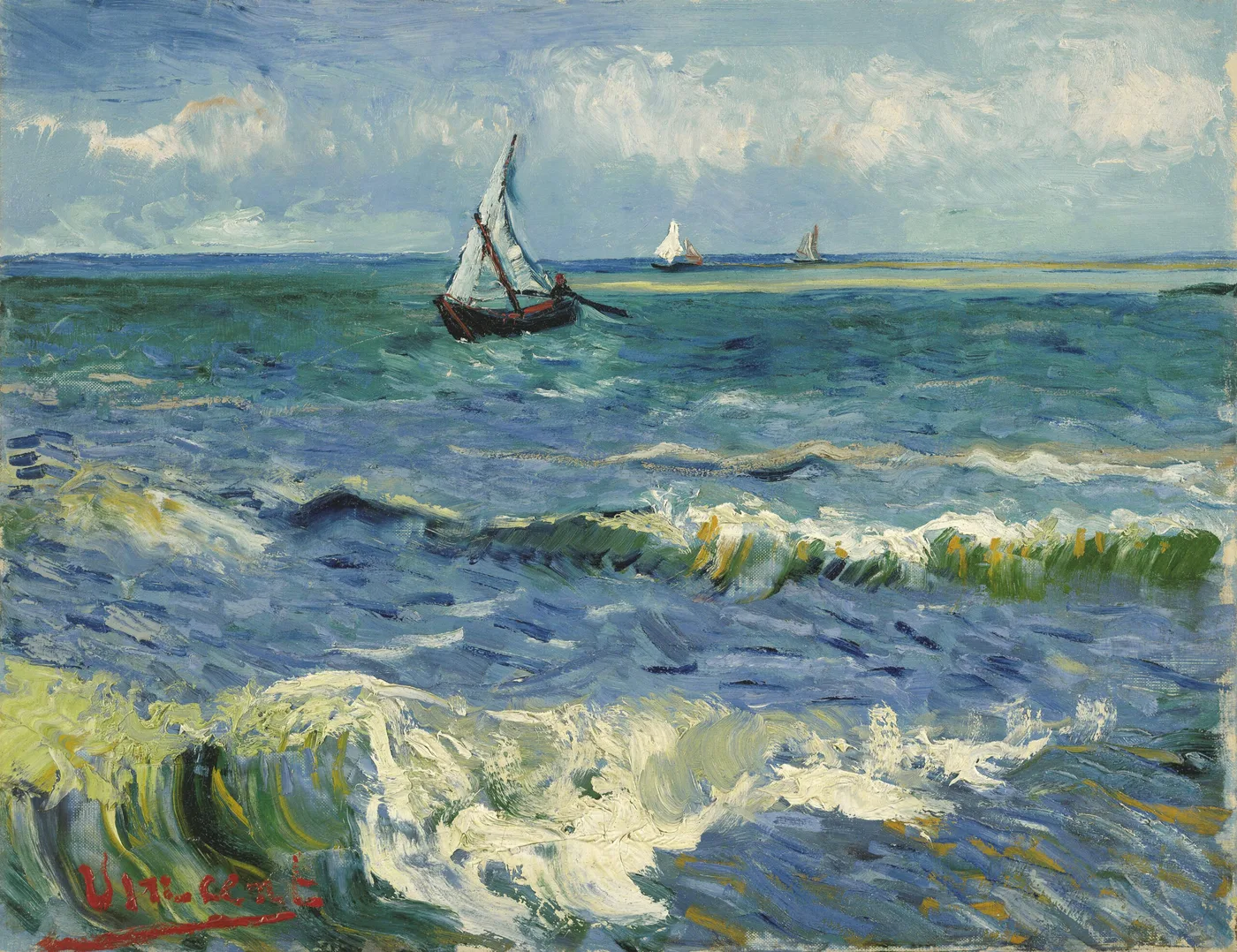
The horizon sits high, about a quarter of the way down the canvas, leaving a wide band of sky above a sea that fills most of the picture. Below that line the water splits into two moods: a calmer middle distance carrying the boats, and a foreground given over to two breaking waves.
A fishing boat sits left of centre, its hull dark, almost black, with touches of red along the mast and the stern. Two sails catch the light, a larger triangular sail in white and cream above a smaller one set lower, and a dark figure stands near the stern.
Further along the horizon two smaller boats carry the eye out to sea, one with a plain white sail, the other with a small sail touched in red brown. Both are reduced to a handful of strokes, barely more than marks against the pale line of the horizon.
The water changes colour as it comes forward. Across the middle distance it runs teal and viridian green, with a band of ochre yellow along the horizon. In the foreground that green gives way to a deep cobalt and ultramarine blue.
The blue and white that make up most of the sea are laid on in bold strokes of the brush. In the breaking wave, green and yellow are worked in with a palette knife instead, built up in ridges that stand clear of the canvas and catch real light the way the water itself would.
The sky above is handled far more thinly, grey white cloud swept on in loose passes that leave the weave of the canvas showing through in places. Van Gogh’s red signature, simply Vincent, sits low in the left corner, prominent against the nearest wave.
Reading the Distance Between the Boat and the Wave
The subject is ordinary work at sea near Les Saintes-Maries-de-la-Mer: a fishing boat under sail, two more boats further out, and the water itself, calm in the distance and breaking close to the viewer.
The two halves of the canvas can be read as two different distances from the same scene. The boats ride a working sea, evenly lit and untroubled. The foreground wave puts the viewer at the edge of that same water, where it is loud and close rather than calm and distant.
There is no beach or shoreline in view, so nothing in the picture holds the viewer back from the water. You stand in it, close enough to the near crest to feel its spray.
The ochre worked into the foam is the warmest note in the water, the one place where the light reaches through the surface.
Seeing the Original at the Van Gogh Museum
The original Seascape near Les Saintes-Maries-de-la-Mer is held by the Van Gogh Museum, credited to the Vincent van Gogh Foundation. It is one of the seascapes that came out of his first visit to the Mediterranean.
At 50.5 by 64.3 centimetres, the canvas is modest in scale, close enough to study the ridges of paint in the foreground wave and the thinner strokes of the sky from a normal viewing distance, without needing to step back.
Opening hours and the exact arrangement of galleries change, so check with the Van Gogh Museum directly before a visit.
Choosing a Reproduction of This Seascape
Every reproduction in this catalogue starts from the Van Gogh Museum’s own photograph of the original painting. The source, the image, its rights status and its resolution are recorded for each work, and the product page for Seascape near Les Saintes-Maries-de-la-Mer links to the museum’s own record, so the original can be checked directly.
The shop offers two mediums. The hand-painted oil reproduction is painted from scratch on canvas by an artist working from the museum image, with its own brushwork and texture, so no two copies are identical. The archival canvas print is a high-resolution giclée in pigment inks, photographically consistent, with its finish detailed on the product page.
Every size keeps the proportions of the original. The size ladder is listed on the product page, alongside the Original size option. Given the composition’s wide, horizontal spread and high horizon, a size at or just above the Original keeps the balance between the calm distance and the near wave, and suits a wall with room to read the picture from a few steps back, such as above a sofa or a sideboard.
Framing runs from a rolled canvas to a piece stretched and framed ready to hang, and nothing ships until it has been checked against the museum’s photograph for colour and proportion. Painting the oil by hand takes 2 to 4 weeks. Printing takes 2 to 4 business days. Delivery then takes 5 to 7 business days.
Questions About This Seascape and Its Reproduction
What does Seascape near Les Saintes-Maries-de-la-Mer show?
A dark-hulled fishing boat with a large white and cream sail rides calm, teal-green water in the middle distance, while the foreground is a breaking wave in deep blue, white foam and streaks of yellow and green.
Where is the original painting kept?
The Van Gogh Museum holds it. Gallery arrangements change over time, so check with the museum directly before a visit.
What is the difference between the hand-painted oil and the print?
The oil reproduction is painted by hand on canvas with real brushwork and texture, while the giclée print is a consistent, high-resolution reproduction on canvas, with its finish detailed on the product page.
Can I order it at the same size as the original?
Yes. The product page lists an Original size using the museum’s own 50.5 by 64.3 centimetre dimensions, alongside the standard size ladder.
How long does it take to receive?
Painting the oil by hand takes 2 to 4 weeks. Printing takes 2 to 4 business days. Delivery then takes 5 to 7 business days.
More from this collection
Bring this painting home
Choose a hand-painted oil reproduction for real brushwork, or an archival canvas print for a crisp museum-image edition. Every size preserves the original proportions.
View this work & options
Further reading
Verify the original in the Van Gogh Museum collection record and continue through related works in the catalogue.