
Sunflowers Gone to Seed: Story, Meaning & Brushwork
By 1887 Vincent van Gogh had been in Paris for the better part of a year, sharing a flat in Montmartre with his brother Theo and working his way through the city’s competing ideas about colour. He had met Signac, seen Seurat’s dotted canvases, and pored over the Japanese prints Theo’s gallery kept in stock. None of this showed up yet as a settled style. Instead it showed up as a string of small, deliberately narrow exercises, still lifes of cut flowers set on a table and studied hard, close up, for what their colour could teach him.
A study set for himself
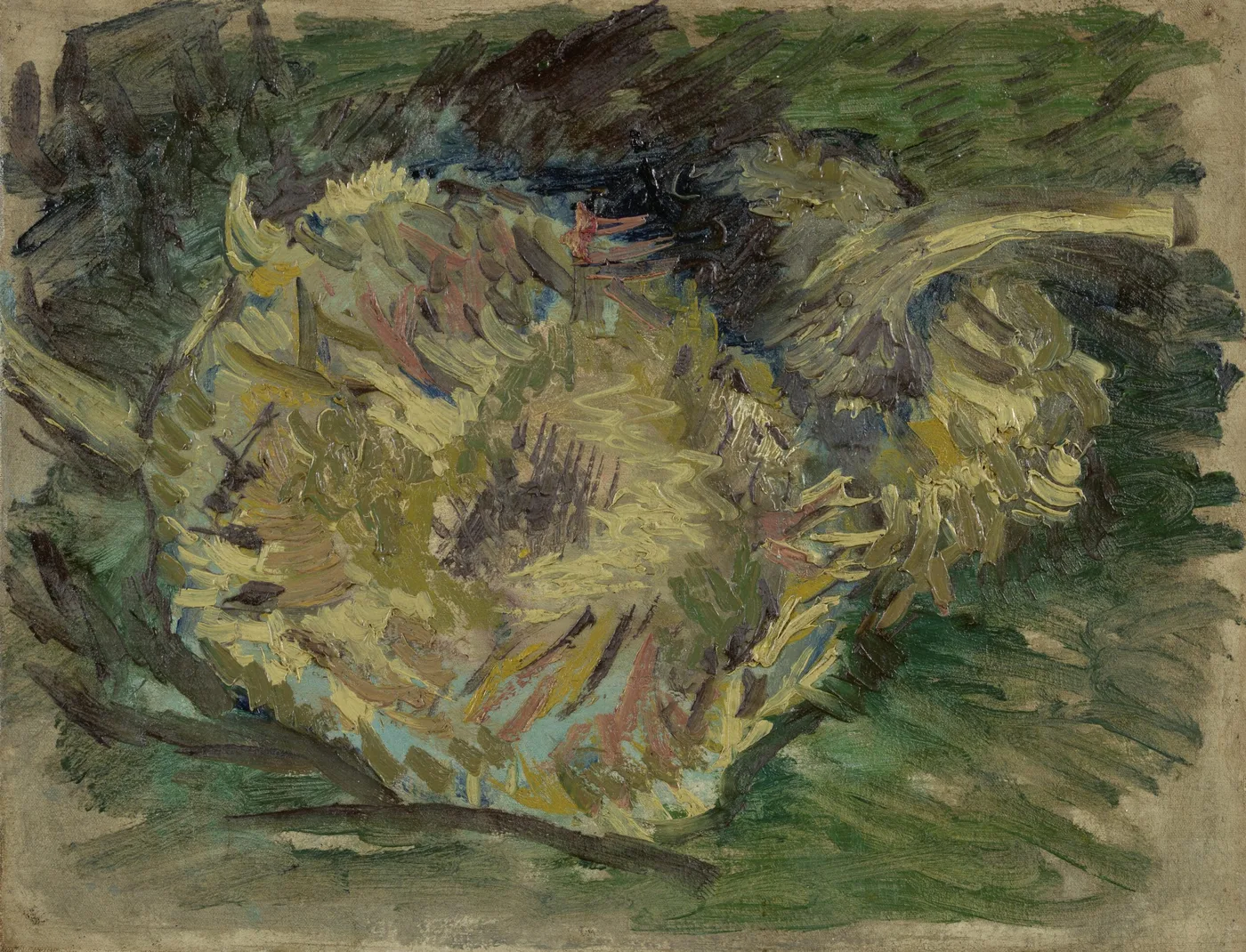
Sunflowers Gone to Seed, painted in 1887, belongs to that run of exercises. It is a modest panel, only 27 by 21 centimetres, and nothing about its subject asks to be admired. The flowers are not fresh. Their petals have curled and dried, their heads have gone to seed, and Van Gogh set himself the harder problem of finding colour in a plant past its moment rather than at it.
This was not sentimental subject matter. It was material, chosen because a spent flower head gives an eye trained on colour theory more to work with than a fresh one: browns instead of pure yellow, the seed disc’s texture instead of a clean petal edge, greens shading toward black instead of the flat green of a stem.
He would return to sunflowers a year later in Arles, in the vases that made the subject his own. This small, unglamorous study is part of how he got there.
Two heads, seen close
The canvas is filled almost edge to edge by two sunflower heads. One turns fully toward the viewer, its dried petals splayed out in a rough circle. A second, paler head is visible just behind it and to the right, caught at an angle, its curling petals reading as a lighter, more olive mass against the dark ground.
There is no vase, no table, no room. A dark, brushy tangle fills the upper part of the panel, more shadow than described space, and a horizontal line of brown paint crosses the lower edge like a stem or branch left in. The flowers seem to sit in their own patch of gloom rather than in any identifiable setting.
At the centre of the main head, the seed disc is built from short, dense strokes, rust, dusty pink and pale blue-green set close together, with darker marks radiating out where the florets have dried and fallen. It is the densest, most worked passage on the panel, and the first place the eye lands.
Colour worked in dashes
Van Gogh’s petals are not blended. They are laid as separate strokes of straw yellow, olive and khaki, each one following the curl of a real petal, so the paint itself seems to bend and dry the way the flower has. Touches of dusty rose and pale turquoise sit inside this yellow-green range, small enough to read as texture before they read as colour.
The background is handled just as directly but with a narrower, darker range: near-black greens and browns, brushed in long diagonal strokes that give the impression of foliage or shadow without describing either precisely. Against that dark field the yellows of the flower heads carry most of the light in the painting.
Paint is laid on thickly, especially in the seed disc and along the petal edges, so the ridges left by the brush catch real light and cast their own small shadows across the surface. Van Gogh was not smoothing colour into place here. He was building it, stroke on stroke, the way a flower’s structure builds itself.
What it does on a wall
In strong daylight the straw yellows and olives come forward and the impasto reads clearly, every ridge of paint catching light and throwing a thin line of shadow beside it. The painting looks busy, almost restless, the way the flower heads themselves look caught mid-collapse.
In dimmer light, evening light or a lamp-lit room, the dark greens and near-blacks of the background take over and the two flower heads read as a single dense, tangled shape rather than two distinct forms. The painting quiets down considerably, closer to a study of decay than a celebration of bloom.
Because the original is so small and so closely observed, a reproduction of it rewards a room where it can be approached rather than glanced at across a distance, a reading corner or a bedroom wall rather than an entrance hall. The original is held today by the Van Gogh Museum, and it remains one of the clearest records of the close, patient looking that eventually produced the sunflowers Van Gogh became known for.
Sizes and materials for Sunflowers Gone to Seed are listed on its product page.
More from this collection
Bring this painting home
Choose a hand-painted oil reproduction for real brushwork, or an archival canvas print for a crisp museum-image edition. Every size preserves the original proportions.
View this work & options
Further reading
Verify the original in the Van Gogh Museum collection record and continue through related works in the catalogue.