
The Sower (Study, 1883): Story, Meaning & Brushwork
A Peasant Subject Taking Root in Drenthe
In September 1883 Vincent van Gogh left The Hague for Drenthe, a remote province of peat bogs and scattered farms in the north-eastern Netherlands. He went there partly to save money and partly because he wanted subjects that had not already been worked over by other painters: diggers, weavers, women bent over potato fields, men walking behind ploughs. It was cheap lodging and hard weather, and he did not stay long.
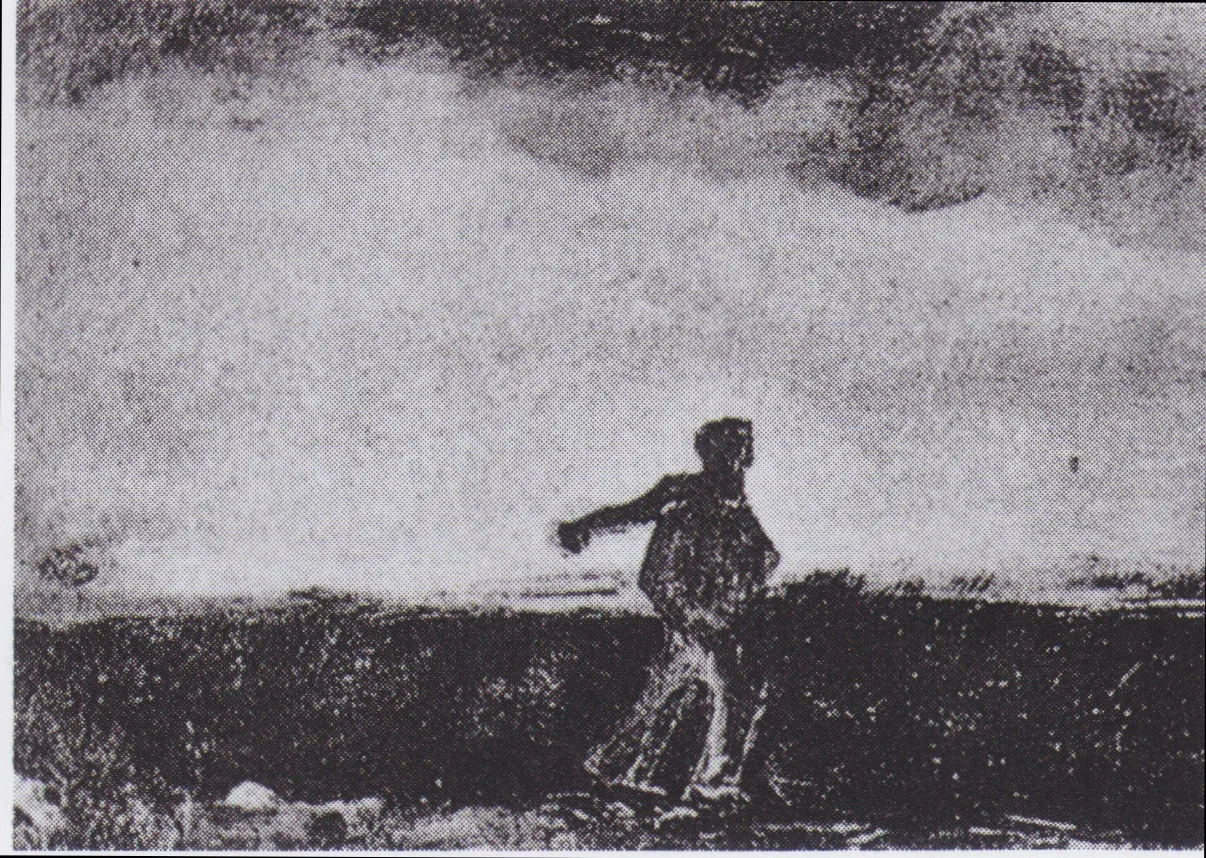
By December he had moved again, this time to Nuenen, where his father held the parsonage and where Vincent would live and work for the next two years. The Sower (study) belongs to this restless stretch of 1883, painted small and fast, at 27.5 by 19 centimetres, the kind of size a man could carry in a satchel across a field.
He was not yet the painter of Arles. The colour he reached for in these years was the colour of the Dutch soil itself: bistre, umber, a grey that never quite becomes green. What he was after was not brightness but conviction, the sense that a peasant at work was as fit a subject for serious painting as any portrait or history scene.
Millet’s Long Shadow
The sower had a specific ancestor. Jean-François Millet had painted a man striding through a ploughed field, arm swinging in the act of casting seed, and the image had become something close to scripture for Van Gogh. He owned prints after Millet, copied them repeatedly, and spoke of the older painter as a kind of moral teacher rather than merely a stylistic model.
For Van Gogh the sower was never only a figure of study. It carried an idea of labour as a form of faith, seed thrown onto ground that would not answer for months, an act performed without proof that it would work. He had trained for the ministry before he trained as a painter, and something of that unproven, forward-leaning conviction stayed with him when he turned to paint instead of preach.
This 1883 study is an early attempt at a subject he would return to for the rest of his working life. Five years later, in Arles, the same gesture would reappear under a huge yellow sun, the field turned violet, the sower himself nearly haloed. None of that colour is present yet here. What is present is the pose, already fixed, already his own.
A Figure Built from Almost Nothing
The composition is spare to the point of severity. A single man walks across the lower third of the panel, body turned in profile, one arm flung out mid-throw, the other drawn back for balance. Behind him the ground darkens into a band of broken, granular paint that reads less as furrows than as raw weight, earth pressing up against the bottom edge of the picture.
Above that band the sky takes up most of the surface, pale and unsettled, streaked with cloud that has been worked wet into wet rather than drawn. The horizon sits low, which was already Van Gogh’s habit in these Dutch studies: let the land shrink and let the sky do the work of scale, so that a single man on foot looks smaller than the weather around him.
There is almost no incident beyond the figure and the line where field meets air. No second worker, no farmhouse, no tree to anchor the middle distance. The eye has one thing to land on, the sower’s dark silhouette, and everything else in the study exists to set him against that emptiness.
The Weight of a Study
Van Gogh treated the figure with a kind of blunt economy. The head, the shoulders, the swing of the coat are laid in as solid dark shapes rather than built up through modelling, so that the man reads first as a silhouette and only afterwards as a body in motion. It is the method of someone working fast, outdoors or from memory of the fields around him, more concerned with getting the rhythm of the stride right than with finishing any one passage.
That bluntness is not carelessness. Van Gogh was, at this point, drilling himself in figure construction through repetition, drawing and painting the same peasant poses again and again until the proportions came without hesitation. A study like this one was practice in the plainest sense, a rehearsal for pictures he had not yet earned the skill to paint.
The palette stays close to the ground it depicts. Browns, greens gone nearly black, and a sky mixed down to a chalky grey-white are as far as the colour travels. Nothing here anticipates the saturated yellows and blues of his later work, and that restraint is part of what the study shows: a painter still teaching his hand what a working man’s body does in a field, before he let himself think about colour at all.
Living With a Dark Sky
Hung on a wall, a study this size does not announce itself from across a room. It asks to be approached, the way the original would have asked something similar of Van Gogh himself, bent over a small panel with the light of a low Dutch sky behind him.
In daylight the sky dominates, that pale, worked-over expanse pulling the eye up and away from the figure. Under warmer evening light the dark foreground and the sower’s silhouette come forward instead, and the picture reads less as landscape and more as portrait, one man alone with a task that will not show its results for months.
What stays constant is the gesture, that outflung arm, held mid-throw for as long as anyone looks at it. Van Gogh painted that motion for the whole of his career, and this small, sober 1883 study is where he first set it down.
Sizes and materials for The Sower (study) are listed on its product page.
More from this collection
Bring this painting home
Choose a hand-painted oil reproduction for real brushwork, or an archival canvas print for a crisp museum-image edition. Every size preserves the original proportions.
View this work & options
Further reading
Verify the original in the collection record and continue through related works in the catalogue.