
The Town Hall at Auvers: Story, Meaning & Brushwork
A Holiday in the Final Weeks
By July 1890 Vincent van Gogh had been in Auvers-sur-Oise for about ten weeks, lodging above a café, working under the loose watch of Dr Paul Gachet and writing to his brother Theo almost daily. He was painting at a furious rate, sometimes finishing a canvas a day, pushing through fields, farmhouses, portraits and the small civic buildings of the village as if trying to set down everything around him before the summer ended.
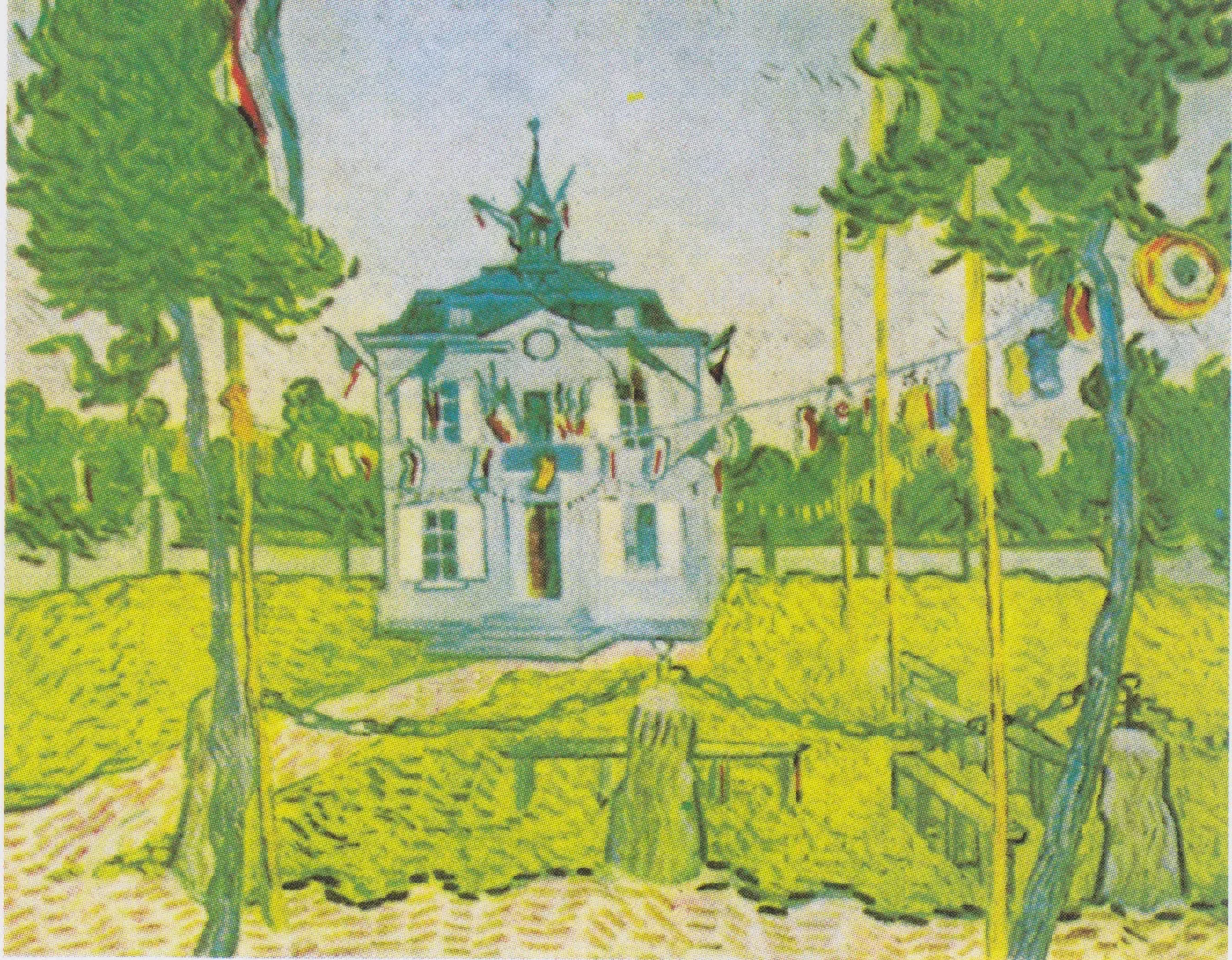
Bastille Day fell on the fourteenth of that month, and the town hall of Auvers, the mairie, was strung with tricolour bunting and flags for the occasion. Van Gogh set up in front of it and painted the building as he found it, decorated and ordinary at once, a small provincial hall dressed up for a national holiday rather than any grand civic monument.
The Mairie Behind the Bunting
The town hall sits at the exact centre of the canvas, a compact white building with a steep blue-grey roof and a slim spire rising from its ridge. Shuttered windows in cool grey-blue punctuate the pale façade, and a round window sits beneath the gable like a single closed eye above the doorway.
Garlands of small flags are strung on lines that cross the picture from side to side, looping between poles and the corners of the roof. Larger flags stand upright at the roofline and along the front of the building, their red, white and blue picked out in short, decisive touches rather than smooth passages of colour.
A circular wreath of bunting hangs at the upper right, rendered as a ring of dabbed colour rather than a clearly drawn object, so that it reads first as a note of pattern and only afterwards as decoration. Van Gogh painted 1890 into the work as the year of a specific, dateable event rather than a generic village scene.
Trees Set Like a Frame
Two tall trees rise at the left and right edges of the canvas, their crowns painted in the same chrome yellow-green that dominates the whole picture. They lean inward slightly, closing off the sky at the corners and turning the town hall into something seen through a gap, almost as if the viewer were standing just behind the crowd gathered for the holiday.
Between the trees and the building, the ground is given over almost entirely to grass, laid down in dense, short strokes of yellow-green with darker flecks worked through it. A pale ochre path curves in at the lower left, one of the few passages in the picture where the paint thins out and the canvas weave shows through.
The sky above the roofline is a soft, chalky blue-lilac, applied more calmly than anything below it. Against that quieter passage, the agitation of the grass and the trees reads even more clearly, and the building itself, painted in flatter, cooler tones, holds still at the centre of all that movement.
How the Paint Sits on the Canvas
At 93 by 72 centimetres, the canvas is large enough for Van Gogh to work in short, repeated strokes without the picture losing its overall shape from a normal viewing distance. Up close, almost nothing in the painting is a flat area of colour; the grass, the roof and even the pale walls of the town hall carry visible, separate touches of the brush.
The palette is narrow and forceful: chrome yellow and green for the ground and trees, blue-grey for the roof and shutters, white and pale ochre for the walls and path, with the red, white and blue of the flags supplying the only sharp accents. Van Gogh was not matching the actual colours of an Auvers July so much as building a picture where those few colours could carry the whole scene.
There is little softening or blending anywhere in the work. Outlines are drawn as much with the brush as with any preparatory line, so that the edge of a roof or the curve of a garland is a stroke of paint doing two jobs at once, marking a boundary and adding texture in the same movement.
Living With a Painted Holiday
On a wall, this is not a quiet picture. The yellow-green ground and the crossing lines of bunting keep the eye moving, from the trees at the edges toward the building at the centre and back out along the flags, so the painting rewards being looked at for longer than a single glance.
Morning light picks out the pale walls of the town hall and the white ground beneath the darker greens, giving the whole scene a fresher, cooler cast. In the warmer light of late afternoon, the yellows in the grass and foliage deepen and start to dominate, and the picture shifts toward something closer to the heat of a real July afternoon in the days before Van Gogh’s death that same summer.
Sizes and materials for The Town Hall at Auvers are listed on its product page.
More from this collection
Bring this painting home
Choose a hand-painted oil reproduction for real brushwork, or an archival canvas print for a crisp museum-image edition. Every size preserves the original proportions.
View this work & options
Further reading
Verify the original in the collection record and continue through related works in the catalogue.