
The White Cottage Among the Olive Trees: Story
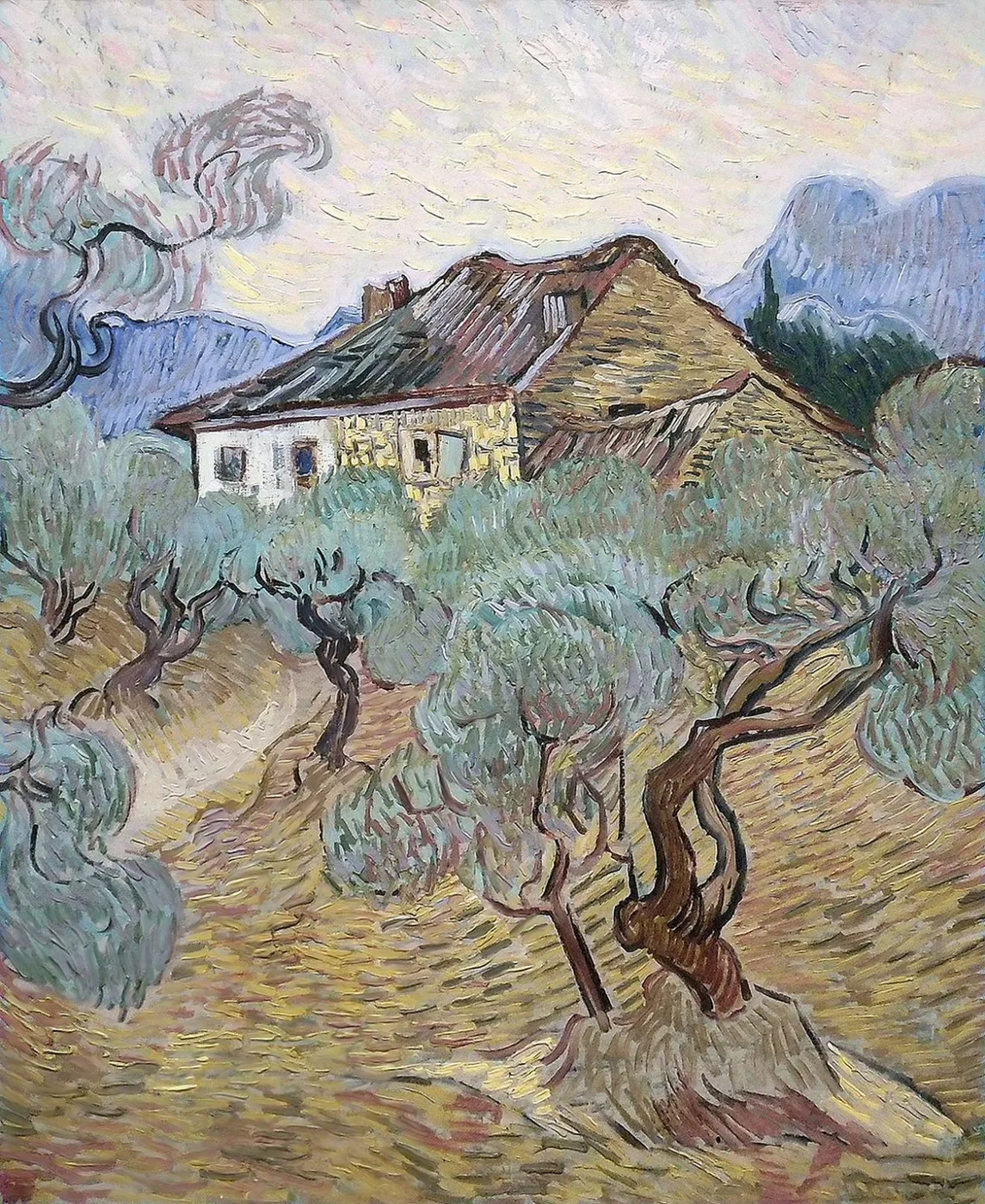
Vincent van Gogh painted The white cottage among the olive trees in 1889, the year he committed himself to the asylum of Saint-Paul-de-Mausole at Saint-Rémy-de-Provence. He had left Arles after the breakdown that ended his time with Gauguin, and at Saint-Rémy he was, for stretches, allowed out under supervision to paint the wheat fields, cypresses and olive groves beyond the asylum walls. The olives became one of his fixed subjects that year, a series he returned to again and again, trying to catch trees he found harder to paint than he expected.
A House Seen Between the Branches
He wrote of the olive trees as difficult, their colour changing with every hour and every cloud, silver one moment and almost blue the next. Here he set that shifting foliage against something fixed: a low whitewashed cottage with a dark, heavy roof, glimpsed through the grove rather than placed in open ground.
The house sits just off centre, its gable and chimney breaking the line of hills behind it. A path of pale ochre earth curves in from the left, giving the eye a way into the picture before the trees close back around it.
Only two small windows and a doorway are legible in the whitewashed wall, dashed in with a few strokes of blue-grey and yellow. The roof is built from short diagonal marks of brown, mauve and dull red, laid so densely that the tiles seem to have weight and slope of their own.
Smoke Against a Restless Sky
A single plume of smoke rises from the chimney and curls back on itself in the upper left corner, a spiral of pink, grey and cream that dwarfs the house it comes from. It is the most agitated passage in the whole canvas, drawn with the same unbroken, looping line Van Gogh used for the cypresses of that same year.
Behind the cottage, blue-violet mountains rise in soft, rolling ridges, their edges dissolved rather than drawn. The sky above them is worked in short horizontal and diagonal strokes of white, pale pink and lilac, closer to woven cloth than to open air.
Nothing in the sky is still. The same restlessness that pulls at the smoke runs through the clouds, so that the calm, square house below reads almost as a held breath in the middle of it.
The Grove in the Foreground
The olive trees dominate the lower two thirds of the canvas, their trunks twisting and forking in thick, dark outlines of brown and black. Van Gogh gives each trunk a physical struggle, bending and knotting as if the wood itself were under strain.
Their leaves are built from short, curling dabs of sage green, silver-grey and touches of white, applied so thickly in places that individual strokes stand proud of the surface. Between the trunks, the ground is laid in warm ochre, gold and rose, broken by the same restless rhythm of marks that fills the sky.
Nothing in the grove is flat. Trunk, leaf and earth all carry the same nervous, curling handwriting, so that a tree in the foreground and a tree half a field away are made of the same visible motion, only smaller.
Colour, Paint and the Painter’s Hand
The picture works from a narrow range pushed hard: ochre and gold in the earth, sage and silver in the leaves, violet-blue in the hills, and the white of the cottage set against all of it like a single struck note. Van Gogh laid the paint on in short, directional strokes throughout, never blending where a visible mark would do the work instead.
At 60 by 70 centimetres, the canvas is small enough that this handling reads as intimate rather than monumental, a close study of one grove rather than a panorama of the valley. The brushwork carries the same urgency across the whole surface, from the tightly wound smoke to the loosely gathered clouds, so that looking at the painting feels less like observing a static scene and more like watching one still in motion.
Living With It
Hung in a room with changing daylight, the painting shifts with the hours much as its subject once did for the man who painted it. Morning light draws out the cool sage and silver in the olive leaves; evening light warms the ochre ground and the rose in the sky until the whole grove seems to glow from within.
What stays constant is the house, small and steady among trees that never quite settle, a fixed point the eye returns to after following the curling smoke, the bending trunks and the restless sky back down again.
Sizes and materials for The white cottage among the olive trees are listed on its product page.
More from this collection
Bring this painting home
Choose a hand-painted oil reproduction for real brushwork, or an archival canvas print for a crisp museum-image edition. Every size preserves the original proportions.
View this work & options
Further reading
Verify the original in the collection record and continue through related works in the catalogue.