
Two Cut Sunflowers: Story, Meaning & Brushwork
By the summer of 1887 Vincent van Gogh had been in Paris for over a year, sharing a flat with his brother Theo on the Rue Lepic and working his way through the city’s competing ideas about colour. He had met Signac, argued theory with Bernard, and watched Seurat build pictures out of small, disciplined touches of paint. Rather than take on a grand Parisian subject, he turned to something he could set on a table and study for days: cut flowers left to dry.
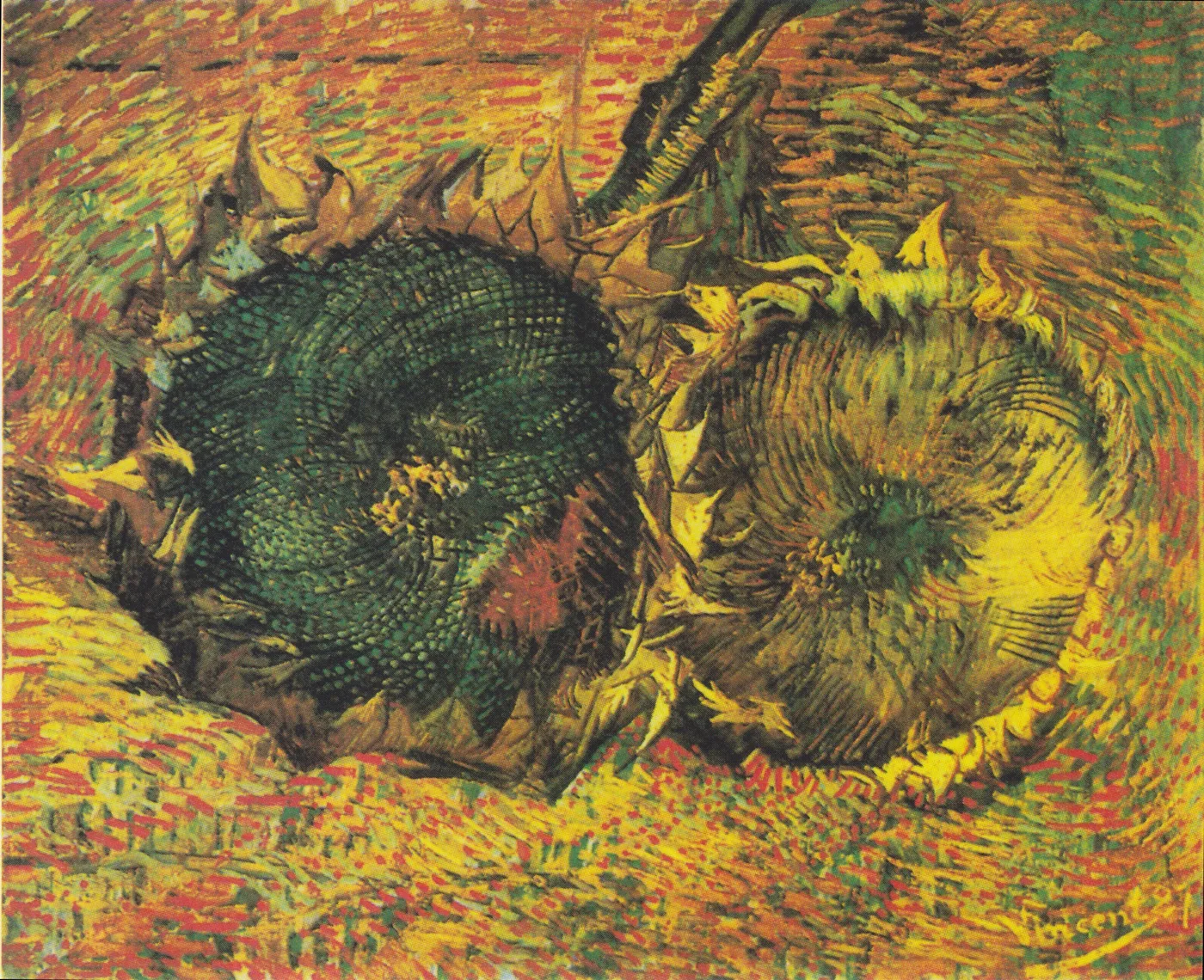
Two Cut Sunflowers, painted that year and measuring 60 by 50 centimetres, belongs to this run of studies. It is not a bouquet in a vase, the form he would make famous a year later in Arles. It is two flower heads laid flat, already past bloom, their petals curling and browning at the edges.
A quiet table, not a garden
The two heads sit close together, almost touching, filling most of the canvas. There is no vase, no stem in water, no suggestion of a garden beyond the frame. Van Gogh has brought the flowers indoors and put them under scrutiny, the way another painter might study a skull or a pair of boots.
The heads face the viewer directly, seed discs turned outward rather than in profile. The left flower is the darker of the two, its packed florets rendered in deep blue-green with a single warm patch of red-orange breaking across the lower right of the disc. The right flower is lighter, an olive and ochre weave with a smaller, greener centre, its ring of dried petals a brighter, more sun-bleached yellow.
Around both heads the dry petals splay outward like spent flames, brown at the base and gold at the tip, some curling back on themselves as they lose their moisture. There is nothing decorative in this arrangement. It reads as observation first, composition second.
A ground that will not sit still
What surrounds the flowers is not a wall or a tabletop in any conventional sense. Van Gogh has covered the whole background, and the surface beneath the flowers too, in short dashes of orange, red, yellow and green, laid in overlapping directions so that no patch of canvas reads as flat or empty.
The effect is closer to a woven mat or a length of rough fabric than to a room. Colour here does not describe a surface so much as generate one, built stroke by stroke rather than blended.
This all-over handling pulls the eye away from any single focal point at first glance, before the two dark discs reassert themselves as the picture’s anchors. It is a tension Van Gogh seems to have wanted: a restless field holding two still, heavy forms.
Colour set against colour
The picture leans hard on contrast. Blue-green sits against orange-red, the classic complementary pairing that Van Gogh had been reading about and testing through 1887, learned in part from the younger painters he was meeting in Paris and from his own study of colour theory.
The brushwork is drawn as much as painted, short marks laid in rhythm rather than smoothed into gradients. Around the seed discs the strokes curve to follow the spiral pattern of the florets; in the background they fall into looser, more agitated diagonals.
Nothing in the paint surface is thin or hesitant. Van Gogh has worked the whole canvas at the same pitch of intensity, so that dried petal and painted background press against each other with equal weight, equal insistence on being looked at.
A picture Edgar Degas chose to keep
Two Cut Sunflowers was held in the Degas Collection, meaning it once hung among the pictures Edgar Degas gathered for himself rather than for sale. Degas bought selectively and for his own eye, and a painting entering his rooms says something about how it was seen by at least one exacting contemporary.
It is a small but telling thread in the story of how Van Gogh’s Paris work, unglamorous subjects painted with real conviction, found its first serious audience among the very painters he had come to the city to learn from.
On a wall, as the light turns
Hung where daylight reaches it, this canvas changes hour by hour. Morning light draws out the reds and oranges of the woven ground until they seem to vibrate against the dark green discs; by evening, under lamplight, the greens and blues in the flower heads pull forward and the picture settles into something quieter and more sombre.
At 60 by 50 centimetres it asks to be met at close range, in a room where someone actually stops in front of it rather than passing by. It rewards that kind of looking precisely because so little of it is picturesque: two spent flowers, studied hard, in the year before Van Gogh made the sunflower entirely his own.
Sizes and materials for Two Cut Sunflowers are listed on its product page.
More from this collection
Bring this painting home
Choose a hand-painted oil reproduction for real brushwork, or an archival canvas print for a crisp museum-image edition. Every size preserves the original proportions.
View this work & options
Further reading
Verify the original in the Degas Collection collection record and continue through related works in the catalogue.