
Self-Portrait Dedicated to Gauguin: Story & Meaning
A Gift Before the Yellow House
By September 1888 Vincent van Gogh had been in Arles for six months, working towards his idea of a Studio of the South, a community of painters sharing a house and a way of seeing. He had rented the Yellow House on the Place Lamartine and was waiting for Paul Gauguin, then still in Brittany, to agree to come and share it with him.
Before Gauguin’s arrival the two men agreed to exchange painted self-portraits, a custom they had heard was practised among Japanese artist friends. Van Gogh painted his half of the exchange quickly and sent it north as a kind of pledge, a picture of himself standing in for the letters he had already sent.
He inscribed a dedication to Gauguin along the top edge of the green ground and gave the picture its full title, Self-portrait, dedicated to Paul Gauguin. Gauguin did not reach Arles for another month, and the two men would live and work together there for barely nine weeks.
A Shaved Head Against Malachite Green
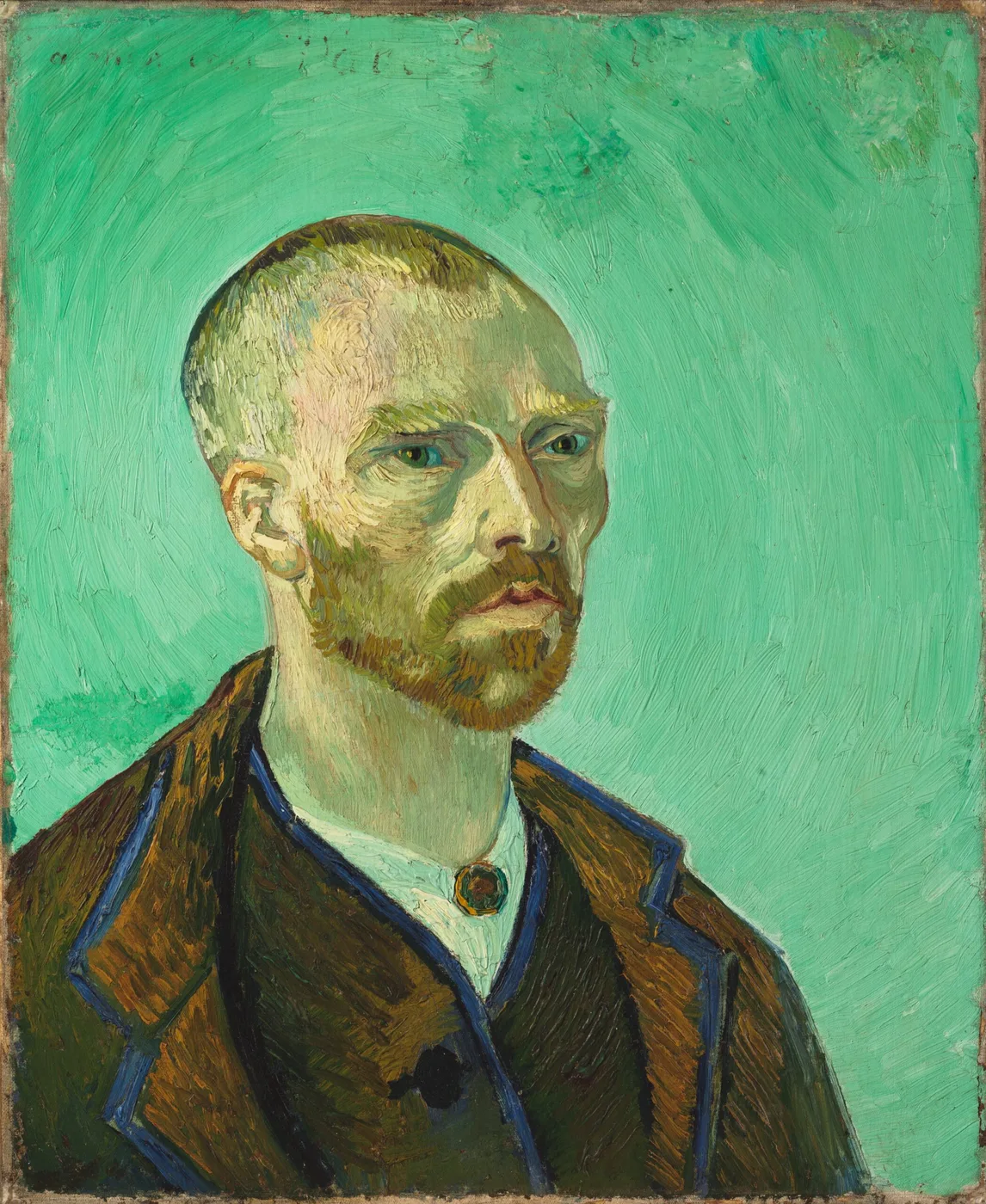
The canvas is small and close, just 50.3 by 61.5 centimetres, and Van Gogh fills nearly all of it with his own head and shoulders. There is no room, no window, no object beside him; the paint runs almost to all four edges of the panel.
He shows himself with his hair cropped close to the skull, his eyebrows and beard the same warm reddish colour, his eyes narrowed and pulled upward at their outer corners. He does not look straight out at the viewer; his gaze slides slightly to one side, watchful rather than open.
He wears a plain dark jacket edged with a line of blue at the lapel, buttoned over a white shirt fastened at the throat with a small round clasp. Behind him the ground is an even field of pale malachite green, broken only by that inscription at the top.
The Portrait of a Bonze
Van Gogh explained the picture himself, in a letter written to accompany it south. He had conceived it, he said, as the portrait of a bonze, a simple worshipper of the eternal Buddha, and he asked Gauguin to read the shaved head and slanted eyes in that light, as a chosen role rather than a plain likeness.
The idea leaned on both men’s admiration for Japanese woodblock prints, an enthusiasm Van Gogh had carried since his years in Paris and had written about at length from Arles. Gauguin’s own dedicated self-portrait, painted for the same exchange, struck a very different note.
Van Gogh’s version reads less as a record of his features than as a statement of intent. He painted it at the exact moment he was staking his savings, his brother’s patience and his own health on the hope that Gauguin’s arrival would make the Studio of the South real.
Colour Laid Bare
The face is built from warm, direct colour: pink across the cheekbone, sallow yellow at the temple, set straight against the cool green behind it with almost no soft transition between the two. That collision of warm and cool does the work that shadow and half-tone would do in a more conventional portrait.
The jacket is laid in loose, diagonal strokes that catch the light differently depending on where a viewer stands in front of it. The face is handled more finely, the marks following the structure of cheek, brow and jaw rather than blending into an even surface.
Nothing here is smoothed away. Even the green ground, which reads from across a room as a flat, decorative field, breaks up close to into distinct, visible strokes of paint laid one against another.
From Confiscation to Cambridge
The painting’s later history carries its own weight. It passed through the “degenerate art” collection, works pulled from German public display in the 1930s under the Nazi campaign against modern and Expressionist painting, before eventually crossing the Atlantic.
It is held today by the Harvard Art Museums, in the Fogg Museum, Cambridge, Massachusetts. It survived a decade in which paintings very like it were seized and sold off elsewhere simply for being modern.
On a wall, that malachite ground shifts through the day. Under warm evening light it leans towards turquoise; under cooler daylight it settles closer to jade, and the reddish beard and pale, watchful face read differently against it each time.
Van Gogh painted this at conversational distance, close enough to see every stroke. It still asks to be met that way, at arm’s length, in a room, rather than across a gallery hall.
Sizes and materials for Self-portrait, dedicated to Paul Gauguin are listed on its product page.
More from this collection
Bring this painting home
Choose a hand-painted oil reproduction for real brushwork, or an archival canvas print for a crisp museum-image edition. Every size preserves the original proportions.
View this work & options
Further reading
Verify the original in the collection record and continue through related works in the catalogue.