
Vase with Five Sunflowers: Story, Meaning & Brushwork
Arles, August 1888
By the late summer of 1888 Vincent van Gogh had been settled in Arles for six months, renting the four rooms of the Yellow House and waiting for Paul Gauguin to arrive from Brittany. He wanted the walls of Gauguin’s bedroom to hold something unmistakably his own, a decoration no other painter would think to attempt. Sunflowers, coarse and ordinary garden flowers, became his answer.
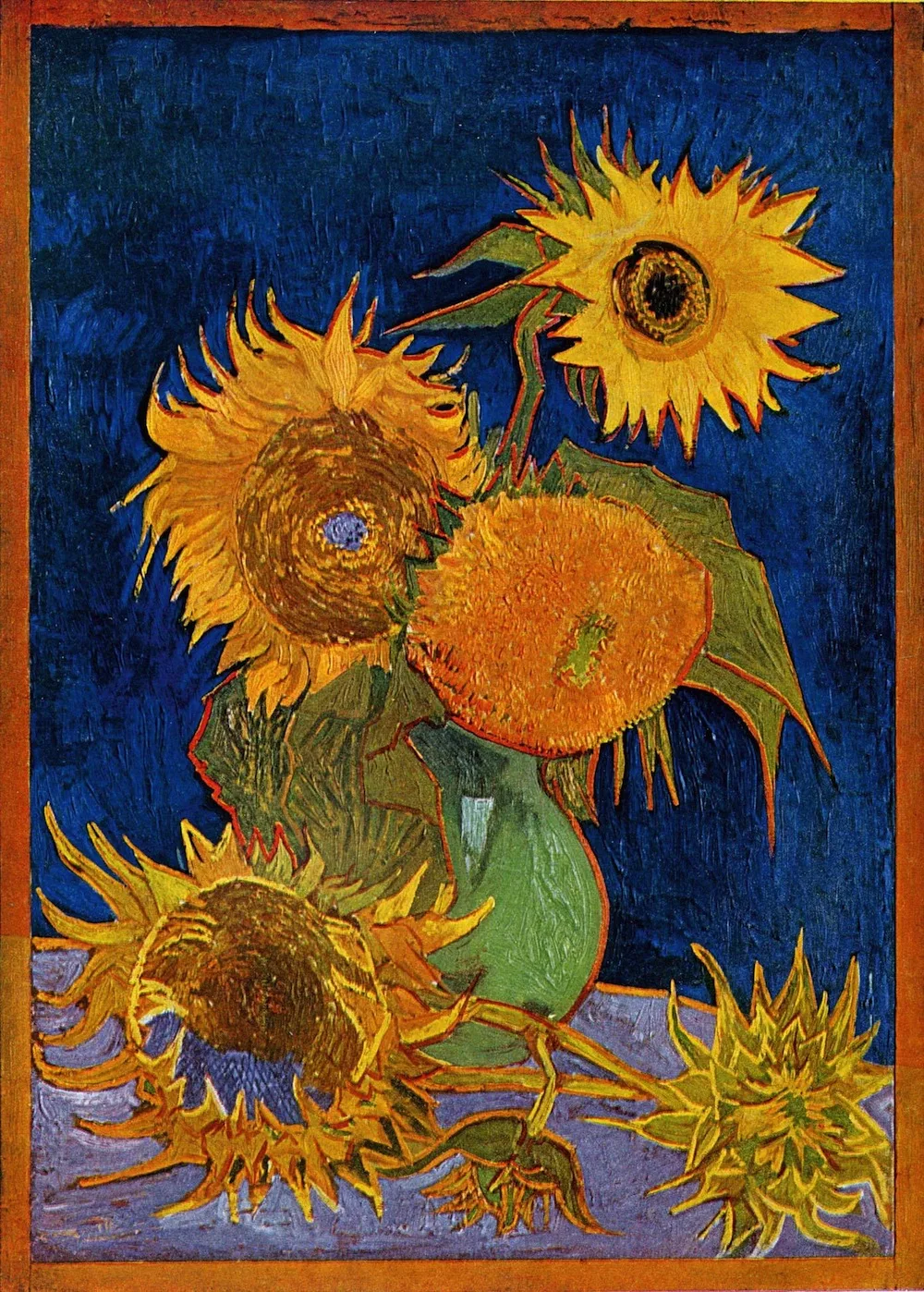
He worked quickly, painting head after head while the blooms were still fresh enough to hold their shape on the table in front of him. Several canvases came out of that stretch of work, each a variation on the same idea: a plain vase, a spray of sunflowers, and a flat field of colour behind them. This picture, originally titled Still Life: Vase with Five Sunflowers, belongs to that group, painted in Arles in 1888.
Five Heads Against Deep Blue
Where several of the Arles sunflower pictures set their bouquets against a wall of yellow, this one is different: the flowers stand against a deep, almost nocturnal blue. Two heads reach upward and outward near the top of the canvas, petals splayed like fireworks, one turned to catch the light full on, the other angled away so that only a ring of petals and a hint of a dark centre show.
Below them, a broad orange-brown head faces the viewer nearly flat on, its disc built from dabs of ochre, rust and green set down in a loose spiral. Two more heads slump at the base of the arrangement, spent and seed-heavy, their petals thinned and curling. Between all five, a squat green vase holds the stems, standing on a bare table rendered in cool violet-grey.
At 98 by 69 centimetres, the canvas is large enough for the flowers to sit close to life size, so a viewer standing in front of it meets the blooms at something near their true scale. The eye lands first on the bright, forward-facing orange disc at the centre, then works outward to the paler heads above and the drooping pair below.
How the Paint Sits on the Canvas
Van Gogh built the petals from thick, short strokes, each laid separately so the ridges of paint catch real light and throw small shadows across the surface. He outlined the flower heads and leaves in a dark red-brown line, a habit picked up from the cloisonnist painting he had seen in Paris, which lets each bloom hold its shape even from a distance.
The seed heads are the densest passages in the picture, built up in overlapping circles of pigment that read almost as relief. The blue ground, by contrast, is worked more thinly and evenly, brushed in long vertical strokes that keep it from competing with the flowers for attention.
Green appears sparingly, in the leaves curling behind the blooms and in the vase itself, painted with the same loaded brush as the petals rather than smoothed into a neutral object. Nothing in the picture is left flat or inert; even the tabletop carries visible strokes of violet and grey-blue.
Bloom and Decay, and What Remains
What makes the five heads compelling as a group is that they are not uniform. Two are in full, open flower, petals still crisp and radiating outward. Two more have passed their peak, heavy-headed and browning at the centre, closer to seed than to bloom.
Van Gogh painted sunflowers at every stage he could find them, and this canvas keeps that range in a single vase rather than smoothing it away. The effect is a still life that reads less as a fixed arrangement and more as a moment caught partway through a longer process, flowers opening while others are already turning to seed.
This particular canvas no longer exists to be seen directly. It was destroyed by fire in Japan in 1945, and what is known today about its colour and handling comes from photographs and from painted copies made before its loss, this reproduction among them.
A reproduction of a lost painting carries a different weight from a copy of a picture still hanging somewhere. It is as close as most people will now come to these particular five heads, the deep blue ground, the thick orange disc at the centre of the vase.
On the Wall
Hung in a room that gets real daylight, the blue ground shifts through the day, deepening toward black in low evening light and opening up again under a bright morning window. The orange and yellow of the flowers hold their heat regardless, working as the one warm note in a room that otherwise leans cool.
Because the flower heads sit close to their original size, the painting reads at conversational distance rather than needing to be viewed from across a room. It suits the kind of looking a hallway, kitchen or dining room allows: passed daily, glanced at, occasionally stopped in front of.
Sizes and materials for Still Life: Vase with Five Sunflowers are listed on its product page.
More from this collection
Bring this painting home
Choose a hand-painted oil reproduction for real brushwork, or an archival canvas print for a crisp museum-image edition. Every size preserves the original proportions.
View this work & options
Further reading
Verify the original in the collection record and continue through related works in the catalogue.