
Three Pairs of Shoes: Story, Meaning & Brushwork
Vincent van Gogh reached Paris in early 1886 with almost nothing settled about how he wanted to paint. He moved in with his brother Theo, an art dealer with rooms near Montmartre, and spent the next two years absorbing what the city’s painters were doing with colour and light. The heavy, earth-bound manner he had used in Nuenen, the manner of The Potato Eaters, was still close at hand, but it was starting to loosen.
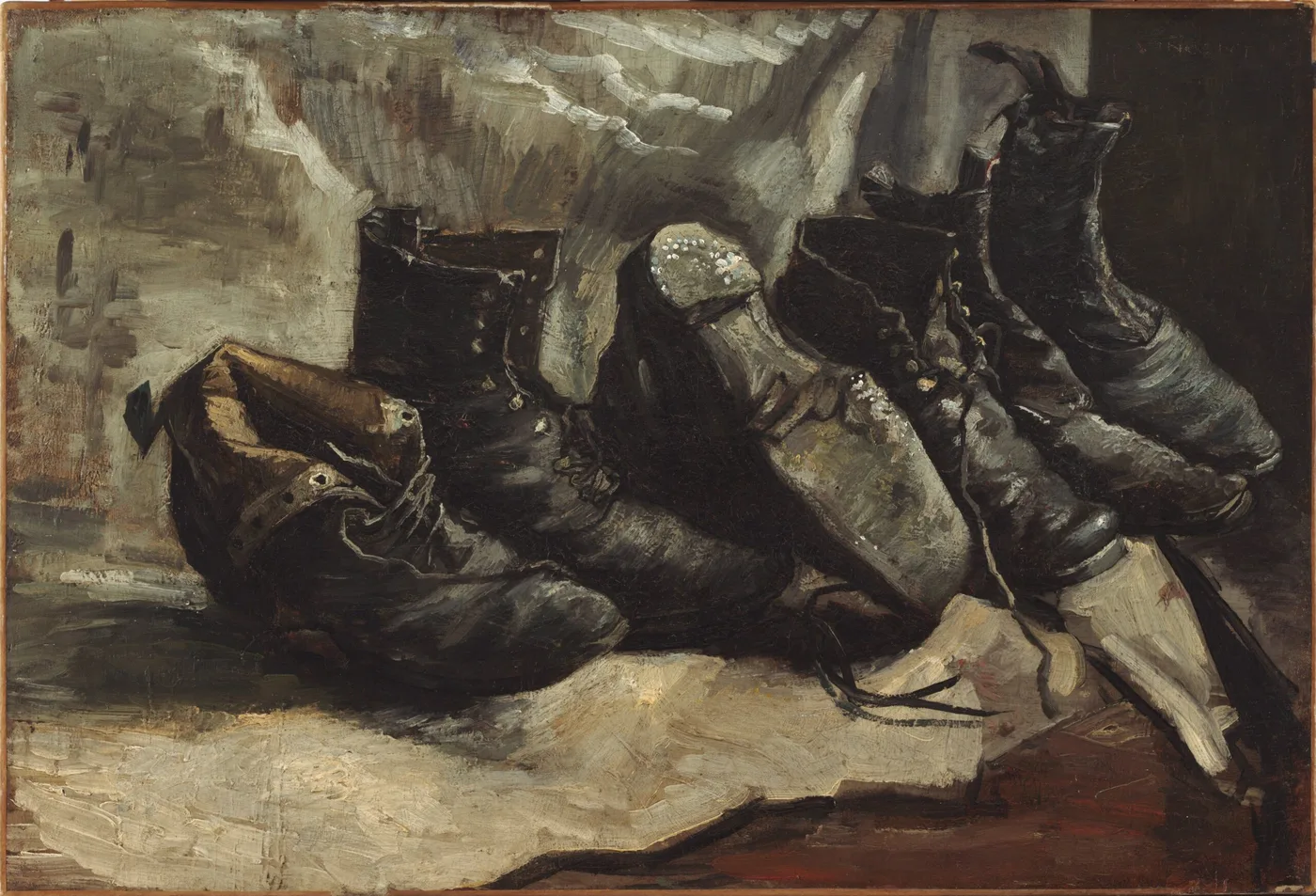
In the middle of that transition he kept returning to a subject that had nothing fashionable about it: old shoes. Several canvases of worn footwear survive from 1886, painted in his Paris studio rather than out of doors, and Three Pairs of Shoes is one of them. It measures 72.5 by 49.8 centimetres and now belongs to the Harvard Art Museums.
Choosing boots as a subject, at a moment when he might have been chasing the boulevards and cafe-concerts that drew other painters, says something about where his attention actually was. He was not yet ready to let go of the labouring world he had painted in the Dutch countryside. Old leather gave him a way to keep faith with that world while trying out a freer hand.
Six boots, one cloth, one floor
The painting holds three pairs of shoes, six boots in all, set down together on a pale cloth thrown across a wooden floor. They are not arranged with any formality. They look as though someone has just stepped out of them, or lined them up to dry.
In the foreground a low brown shoe lies tipped on its side, its lace undone and trailing loose across the cloth. Its worn tongue and scuffed toe catch the most direct light in the whole picture, which is why the eye tends to land there first.
Behind it stands a lighter pair, their leather gone grey and chalky at the toe where the finish has rubbed away entirely. That pale patch of worn-through leather is one of the most closely observed passages in the picture, built from small dabs rather than a single stroke.
To the right, a taller pair of lace-up boots rises higher up the canvas than the others, their leather almost black, one boot leaning back against its partner. Their height and their darkness anchor the composition and stop the row of shoes from reading as a flat line.
Behind all six, the wall is a rough field of grey, brown and streaked white, brushed on with the same loaded strokes as the floor cloth. There is no window, no doorway, no other object. Nothing in the room is allowed to compete with the boots for attention.
The weight of the paint
Van Gogh worked from a narrow palette here: umber and black for the leather, ochre and grey for the wall, a chalky off-white for the cloth beneath everything. It is a deliberately restricted range, closer to the tonal painting he had grown up on than to the brighter colour he was starting to see around him in Paris.
What has already changed is the handling. The leather is built with short, loaded strokes that follow the actual creases and folds of the material rather than smoothing them away, and in places the paint sits proud enough of the canvas to catch real shadow across its surface.
Light comes from the upper left and falls unevenly across the row, picking out the worn toe of the middle boot and the loose lace in the foreground while leaving the boots at the right in near-darkness. That uneven fall of light is what gives the row its sense of depth, since the six boots are otherwise close in tone and size.
What old shoes are asked to hold
Van Gogh returned to worn boots often enough across 1886 that the subject clearly meant something beyond convenience. Old leather carries the shape of a foot and the record of years of walking in a way few other everyday objects do, and he painted that record with the same seriousness he had once given to the faces of the peasants in Nuenen.
No figure appears in the painting, yet the boots are unmistakably marked by use. Each pair has its own wear, its own way of sitting on the cloth, so that the absence of a wearer becomes part of what the picture is about rather than an empty gap in it.
On a wall, in changing light
Hung in a room with shifting daylight, this is a painting that keeps revealing more of its surface. In flat light the boots read mostly as dark, close-toned shapes; when light rakes across the canvas at an angle, the impasto in the leather and the streaked wall behind it stand up in relief, and the brushwork becomes as much the subject as the shoes themselves.
It rewards the kind of looking that a fast-moving gallery visit rarely allows: standing close enough to see how the worn toe of one boot was built stroke by stroke, then stepping back to watch six ordinary objects settle again into a single, quiet still life.
Sizes and materials for Three Pairs of Shoes are listed on its product page.
More from this collection
Bring this painting home
Choose a hand-painted oil reproduction for real brushwork, or an archival canvas print for a crisp museum-image edition. Every size preserves the original proportions.
View this work & options
Further reading
Verify the original in the Harvard Art Museums collection record and continue through related works in the catalogue.