
Almond Blossom: A Branch Painted for Theo’s Newborn Son
Painted at Saint-Rémy in 1890 for Theo’s newborn son
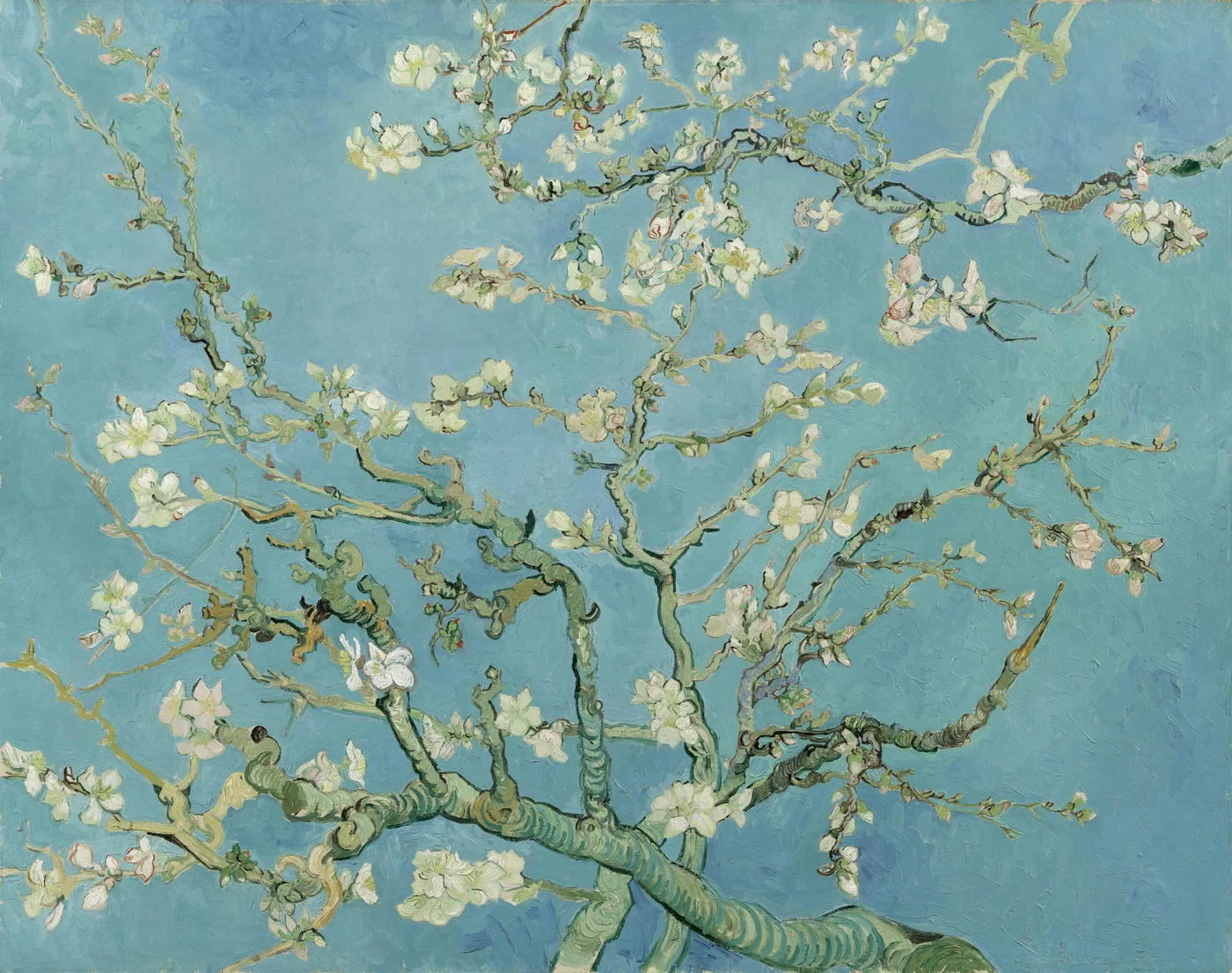
Almond Blossom is a canvas of 92.4 x 73.5 cm that Van Gogh painted in 1890 at Saint-Rémy, in the south of France, for the baby son of his brother Theo. The Van Gogh Museum holds it today.
Saint-Rémy is a small town in Provence. Van Gogh lived there as a patient of the asylum of Saint-Paul-de-Mausole, on the edge of town, and he kept painting through his stay, in the fields around it and in the asylum garden, where he had set down the irises of Irises: A Bouquet Painted Against Time.
At the end of January, news came from Paris. Theo, the art dealer who sent his brother money and supplies, and his wife Jo had a son. They named the boy Vincent Willem, after his uncle.
Van Gogh answered with a canvas. He chose almond branches in flower against a blue sky and made it as a present for the child.
Van Gogh found the tree in season. Almond trees flower in Provence in late winter, ahead of the other fruit trees, so a painter walking out in February could find them in bloom while the orchards around them were still bare.
Blossom was familiar ground for him. In Arles, the town where he had lived before Saint-Rémy, he had painted whole orchards in flower with the town in the distance, as in Orchards in Blossom, View of Arles. Almond Blossom drops the orchard, the town and the ground, and keeps a single branch.
The canvas belongs to the last months of his life. He left Saint-Rémy that spring for Auvers-sur-Oise, north of Paris, and died there in the summer of 1890.
Turquoise sky, grey-green limbs and cream blossom, cropped to the edges
The branch has no ground to stand on. A thick limb comes in at the lower right corner and sweeps left along the bottom edge, where it splits into several shoots that climb in curves. Thinner twigs fan out from those towards the top and both sides until the spread touches every edge of the canvas. The format is landscape, and there is no horizon, no base of the trunk and no second tree.
Behind the branches the sky is a pale turquoise, close to aqua, laid in short strokes that run in different directions. Deeper blue gathers in patches along the bottom edge and near the right side. No sun shows and no twig casts a shadow, so the light is even across the whole canvas.
With no light source to follow, value does the work. The cream of the petals is the lightest tone in the picture, and the sky sits at the middle. In the lower left, about two thirds of the way down, one flower is painted in a heavier, whiter paint than any other, and it is the brightest point on the canvas.
The petals are small thick touches of cream white, some warmed with pale pink, others cooled with yellow-green near the centre. Closed buds are green, a few edged with thin red lines. The flowers crowd across the upper middle and upper right, then spread into smaller clusters down the left side.
Branches are grey-green and olive, outlined in dark green wherever a limb crosses the sky. Knotted stubs at left of centre pick up ochre and brown, and at right one pointed shoot ends in yellow ochre. On the thick limbs at the bottom, pale green and dark green strokes wrap around the form like rings, which makes the wood read as ridged and gnarled.
Sky and wood sit close in value, both mid-tones leaning towards green-blue, so the branches do not jump forward. The cream blossom carries the contrast, and the red lines, the ochre stubs and the pink on some petals are the only warm notes in a picture built of blues, greens and whites. The tight crop against an unbroken field of blue echoes the Japanese woodblock prints Van Gogh collected in Paris.
This is oil on canvas, and the paint is thickest where the form is nearest: ridges on the lower limbs, small raised dabs for the petals, thinner strokes for the sky and the outer twigs. Many of the twigs are a single dark green line. A hand-painted oil version builds that relief in paint, which a flat image cannot give.
A birth present from a patient: how to read the branch
The subject is a present for a newborn. A branch in flower, painted for a newborn, reads as a welcome.
Look at the lower limbs and then at the twigs above them. The limbs are thick, knotted and ringed like old wood, while the flowers on the thin shoots are fresh. A viewer can take the old wood for the uncle and the blossom for the boy who carries his name.
The viewpoint is from below, with sky behind every twig. The picture has no depth to walk into, so the eye stays on the branch and the person looking seems to stand under the tree.
Almond Blossom shows no figure, no building and no sign of the asylum, only sky and a branch. Van Gogh, a patient there, painted it for someone else.
Twigs, buds and flowers cover most of the surface, with only a few patches of open sky, and the branches run off all four edges. That fullness gives a sense of growth continuing beyond the frame, a reading that suits a picture made at a birth.
Seeing the original at the Van Gogh Museum
The Van Gogh Museum in Amsterdam holds the canvas. Check the museum’s site before you travel to confirm Almond Blossom is on display.
The original measures 92.4 x 73.5 cm, a landscape format. In a gallery you read the whole branch from a few steps back, and the blossom, the buds and the crossing twigs all come into focus from there. A step closer, individual strokes separate out.
In front of the canvas you see the ridges on the lower limbs and the raised cream dabs of the petals, which a screen flattens. Screens also shift the sky anywhere between blue and green.
Choosing a size and frame for an Almond Blossom reproduction
Every reproduction here starts from the museum’s own open-access photograph of the original. The shop records the source of that image, its rights status and its resolution, and the product page links to the museum’s record so you can check the original yourself.
Two mediums are offered, and both appear on the same page. The oil reproduction is painted from scratch on canvas by an artist working from the museum image; it has real brushwork and texture, and no two are strictly identical. The canvas print is a giclée in pigment inks, photographically consistent.
The proportions of the original never change, so every size keeps this landscape shape. Standard sizes keep those proportions, and an Original size option uses the museum’s exact dimensions; both are listed in centimetres and inches in the sizes on the product page. This composition carries detail from edge to edge, with small blossoms, buds and twigs spread over most of the canvas, so a size well above the smallest keeps each flower legible. The Original size, 92.4 x 73.5 cm, suits the wall above a chest of drawers or a desk.
The turquoise already fills the canvas, so the frame can stay slim. A narrow frame in pale wood or white keeps the sky in charge, while a wide gilt frame competes with the blossom, and you can compare the finishes among the rolled and framed options. Warm white, pale grey or cream walls let the blue stand out, and the picture sits naturally in a bedroom. Choose rolled canvas if you plan to frame locally.
Everything is made to order, and nothing ships until it has been checked against the museum source image for colour, proportion and detail. A reproduction is never presented as an original and never recoloured, so the sky keeps the tone of the museum photograph. Painting the oil by hand takes 2 to 4 weeks. Delivery then takes 5 to 7 business days.
Questions about Almond Blossom, answered
Why did Van Gogh paint Almond Blossom?
He painted it as a present for Vincent Willem, the son born to his brother Theo and Theo’s wife Jo at the end of January. The boy was named after his uncle.
Where is the original painting?
The Van Gogh Museum holds it. Confirm with the museum that it is on display before a visit.
Is the oil version identical to the museum canvas?
No. An artist paints it from scratch following the museum image, so it has real brushwork and no two oils are strictly identical. It is a reproduction and is never presented as the original.
Can I order it at the size of the original?
Yes. Each work has an Original size option that uses the museum’s exact dimensions, marked as such on the product page next to the standard sizes.
More from this collection
Bring this painting home
Choose a hand-painted oil reproduction for real brushwork, or an archival canvas print for a crisp museum-image edition. Every size preserves the original proportions.
View this work & options
Further reading
Verify the original in the Van Gogh Museum collection record and continue through related works in the catalogue.