
Blossoming Chestnut Branches: Story, Meaning & Brushwork
A last spring at Auvers
Vincent van Gogh reached Auvers-sur-Oise in May 1890, worn down by the year at Saint-Rémy and hoping that a village within reach of Paris, and of his brother Theo, might steady him. Chestnut trees were coming into flower along the roads and gardens there, heavy white and pink candles against fresh leaf. He painted several close studies of blossoming branches that spring, working fast, the way he had worked all that final year.
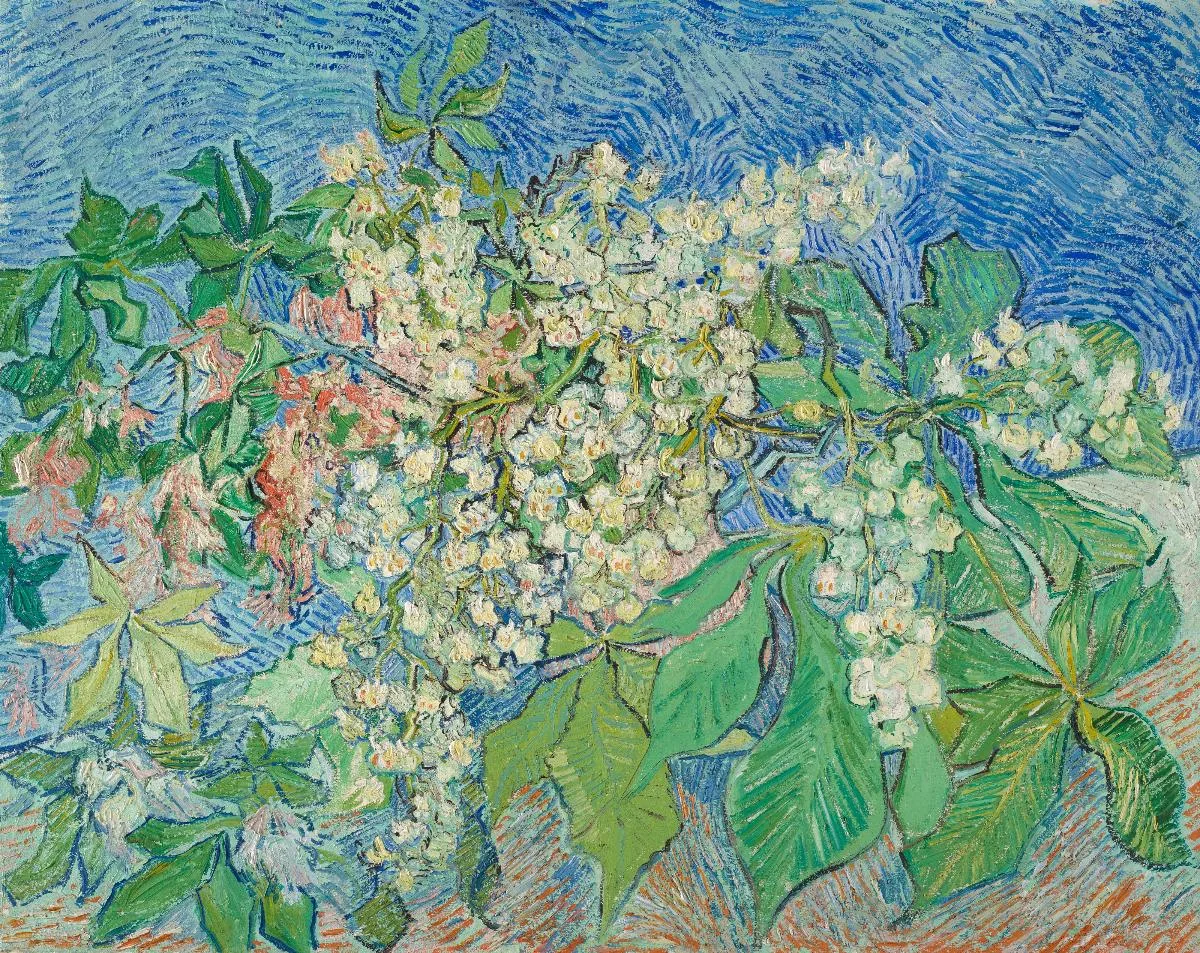
Blossoming Chestnut Branches belongs to that burst of work. It is dated 1890, the same year Van Gogh died at Auvers in July, and it carries none of the caution of an artist pacing himself. The canvas measures 91 by 72 centimetres, tall enough that the branch it holds reads at something close to life size.
There is no sky-line, no garden wall, no sense of where the tree stands in the world. Van Gogh has cut straight into the subject, the way he had learned to from the Japanese woodblock prints he collected and pinned to his studio walls in Paris and Arles. A branch fills the frame edge to edge, and the viewer is given no distance from which to stand back and take it in as a whole tree.
What fills the canvas
Two heavy sprays of white chestnut blossom dominate the centre and right of the picture, their florets built from short, loaded touches of white, cream and pale yellow. To the left a second cluster leans in from off-canvas, its flowers gone a deeper pink-red, as though caught slightly further along in bloom.
Around and beneath the flowers, the broad palmate leaves of the horse chestnut spread in every direction, some still a hard young green, others softening towards yellow at the edges. A few, lower in the picture, have been left almost bare of blossom, giving the eye somewhere to rest before it is pulled back up into the white.
The branch itself is barely visible. Van Gogh lets the leaves and flowers carry the whole weight of the composition, so that structure is implied rather than drawn, the way a full-grown chestnut in flower actually looks from underneath, all canopy and no trunk.
Colour, light and the working of the brush
Behind the branch, the sky is a dense, restless blue, built from short curved strokes that turn and eddy like moving air rather than sitting flat. It is not a calm blue. It has the same nervous energy Van Gogh gave the sky over the wheat fields he painted in these same weeks at Auvers.
Along the lower edge, that blue gives way without warning to a warm ground of orange and red hatching, laid in with the same short, driven strokes. The two colours, blue above and orange-red below, sit at opposite ends of the colour wheel, and Van Gogh lets them argue with each other rather than blend.
Green does the work of holding the picture together. It runs from a cool, almost grey-blue green in the shadowed leaves through to a hot yellow-green where light catches a leaf edge, and every leaf is built from several such greens laid side by side rather than one colour shaded into another.
The white of the blossom is never flat white. Van Gogh threads pale blue, yellow and pink through it, so that the flowers seem to hold light rather than simply reflect it. Up close the paint sits thick and separate, ridge after ridge left by the brush or the loaded tip of a painting knife; the picture only resolves into flowers and leaves at a short distance back.
What the eye meets first is that mass of white blossom at the centre, before it travels out along the diagonal pull of the branch to the smaller cluster of flowers at top right and back again to the pink-toned spray on the left. Nothing in the canvas asks to be read as background. Every part of it, sky included, is worked with the same urgency.
In Zürich, and on a wall at home
The original painting is held today by the Kunsthaus Zürich, part of a collection that has kept it on record and, at times, on view for well over a century. It is a picture that rewards standing close, where the separate strokes of colour keep their edges, and stepping back, where they resolve into branch and leaf and flower.
Hung where morning or afternoon light reaches it directly, the whites of the blossom pick up whatever warmth or coolness the room is giving off that hour, brightening at midday and settling into something quieter towards evening. It is a picture that keeps a room feeling like spring without asking to be looked at all the time, which is closer to how a real branch of chestnut blossom behaves on a table or through a window than most flower paintings manage.
Sizes and materials for Blossoming Chestnut Branches are listed on its product page.
More from this collection
Bring this painting home
Choose a hand-painted oil reproduction for real brushwork, or an archival canvas print for a crisp museum-image edition. Every size preserves the original proportions.
View this work & options
Further reading
Verify the original in the Kunsthaus Zürich collection record and continue through related works in the catalogue.