
Evening, The End of the Day (after Millet): Story
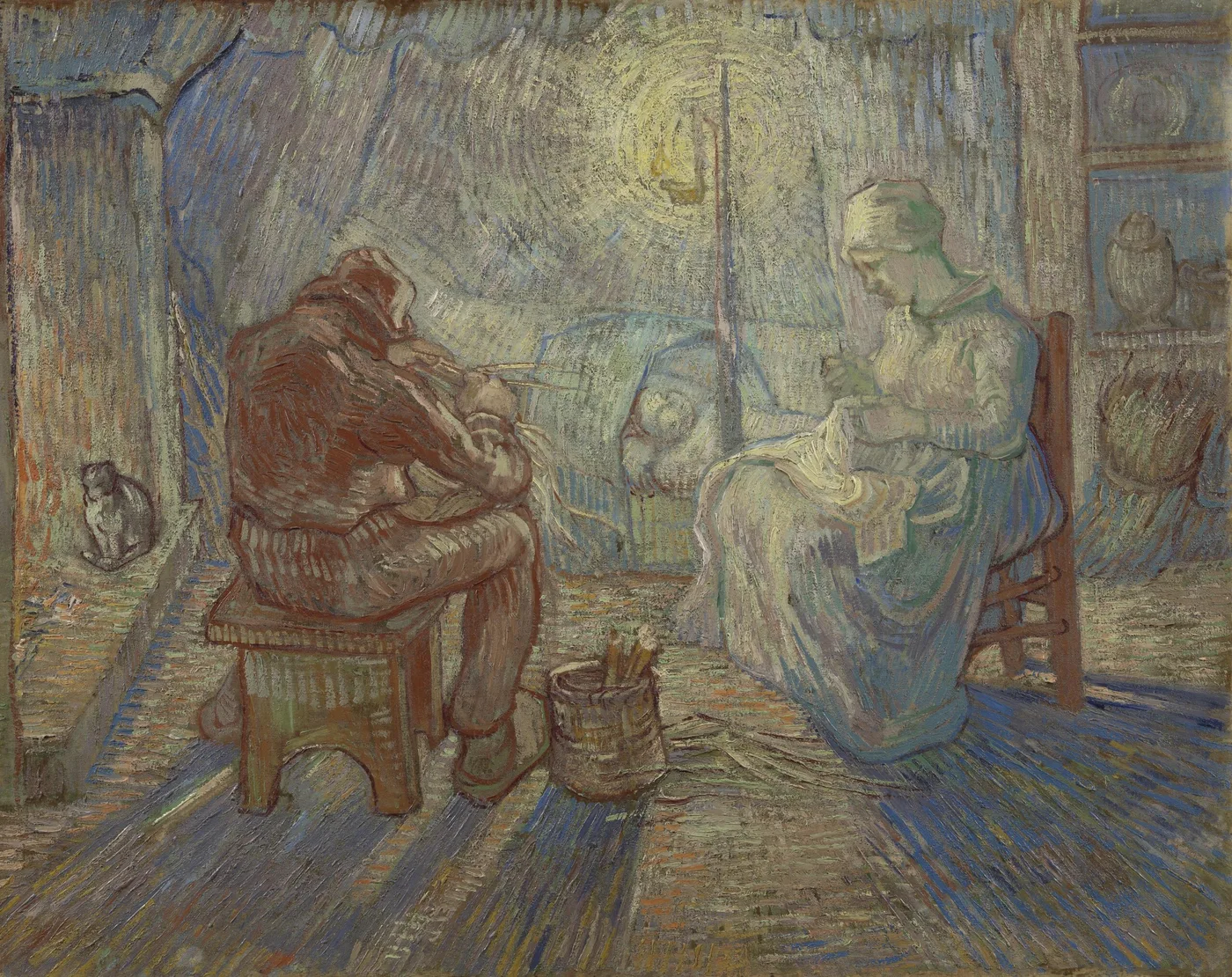
By May 1889 Vincent van Gogh had admitted himself to the asylum of Saint-Paul-de-Mausole, just outside Saint-Rémy-de-Provence. He was permitted to paint, but not always to leave the grounds, and for weeks at a stretch the fields and orchards he loved were out of reach. What he still had, kept among his belongings, were black and white prints after Jean-François Millet, the painter of French peasant life he had admired since his earliest years as an artist.
Van Gogh did not think of working from these prints as copying. He compared it, in letters written that year, to the way a musician interprets a score left by another composer: the structure is given, but the voice is not. Colour was his instrument, and it is what he added to Millet’s design in the picture now known as Evening (after Millet), painted in 1889.
A Score Borrowed from Millet
Millet had drawn this subject as a quiet study of rural rest, a labourer’s household closing out the day. Van Gogh’s version keeps the composition intact but works it entirely in his own hand, so that a scene he had never witnessed becomes, somehow, unmistakably his.
He made a number of these translations that year, after Millet, after Rembrandt, after Delacroix, working through images he could hold in front of him when the world beyond the asylum garden was closed to him. Evening belongs to that body of work, painted at Saint-Rémy at 93.5 by 74.5 centimetres, and now in the collection of the Van Gogh Museum.
Inside the Cottage at Dusk
The scene is a single low room, lit by a lamp that hangs from the ceiling and throws a ring of yellow light across the upper half of the canvas. An elderly man sits in the foreground on a low stool, his back half turned to us, wrapped in a heavy brown coat, a long pipe held to his mouth.
Opposite him, on a wooden chair to the right, a woman in a pale blue-grey dress bends over needlework gathered in her lap, her head covered with a light cap. Between the two figures, close to the floor, a draped bundle rests in the dimness, the kind of covered cradle that would have stood by a hearth in a labourer’s cottage.
A cat crouches low in the far left corner, barely more than a few dark strokes against the wall. To the right, a shelf holds jugs and pottery, and a basket sits near the woman’s feet, the ordinary furniture of a working household settling in for the night.
Colour Standing in for Line
Millet’s original was tonal, built from grey and black. Van Gogh replaced that greyscale with violet walls, blue shadow and a lamp rendered in thick, radiating strokes of gold and ochre, so that the light itself becomes the most active passage of paint on the canvas.
The floor is laid down in long diagonal strokes of blue and ochre that catch the lamplight the way worn floorboards would, dragging the eye from the foreground stool back toward the seated woman. The walls behind the figures are built from close, parallel hatching, almost woven in texture, a device Van Gogh used again and again that year to keep a flat surface in constant, quiet motion.
Neither figure is painted with a modelled, individual face. Van Gogh was after weight and posture, the tilt of the man’s shoulders toward his pipe, the bend of the woman’s neck over her sewing, rather than likeness.
An Evening That Keeps Happening
The eye meets the lamp first, then follows its light down into the two seated figures, and only afterwards notices the cat, the cradle, the shelf of jars. Nothing in the room is idle; everything is doing the quiet work of ending a day.
Hung in a room where the light changes through the afternoon, that lamp glow shifts with it. In daylight the violets and blues read cool and settled; as a room dims toward evening, the painted lamp seems to brighten in sympathy, and the whole cottage interior draws closer to the mood it was painted to hold.
It is a picture of rest borrowed from another painter and remade in a hospital garden at Saint-Rémy, and it still performs that small act of translation every time the light around it changes.
Sizes and materials for Evening (after Millet) are listed on its product page.
More from this collection
Bring this painting home
Choose a hand-painted oil reproduction for real brushwork, or an archival canvas print for a crisp museum-image edition. Every size preserves the original proportions.
View this work & options
Further reading
Verify the original in the Van Gogh Museum collection record and continue through related works in the catalogue.