
Green Wheat Field with a Cypress: Story, Meaning & Brushwork
A Summer at Saint-Paul-de-Mausole
By June 1889 Vincent van Gogh had admitted himself to the asylum of Saint-Paul-de-Mausole, just outside Saint-Rémy-de-Provence, after the breakdown that ended his time in Arles. He was given a second room to use as a studio, and once his condition allowed it he was let out, under supervision, to paint in the fields and olive groves around the walls.
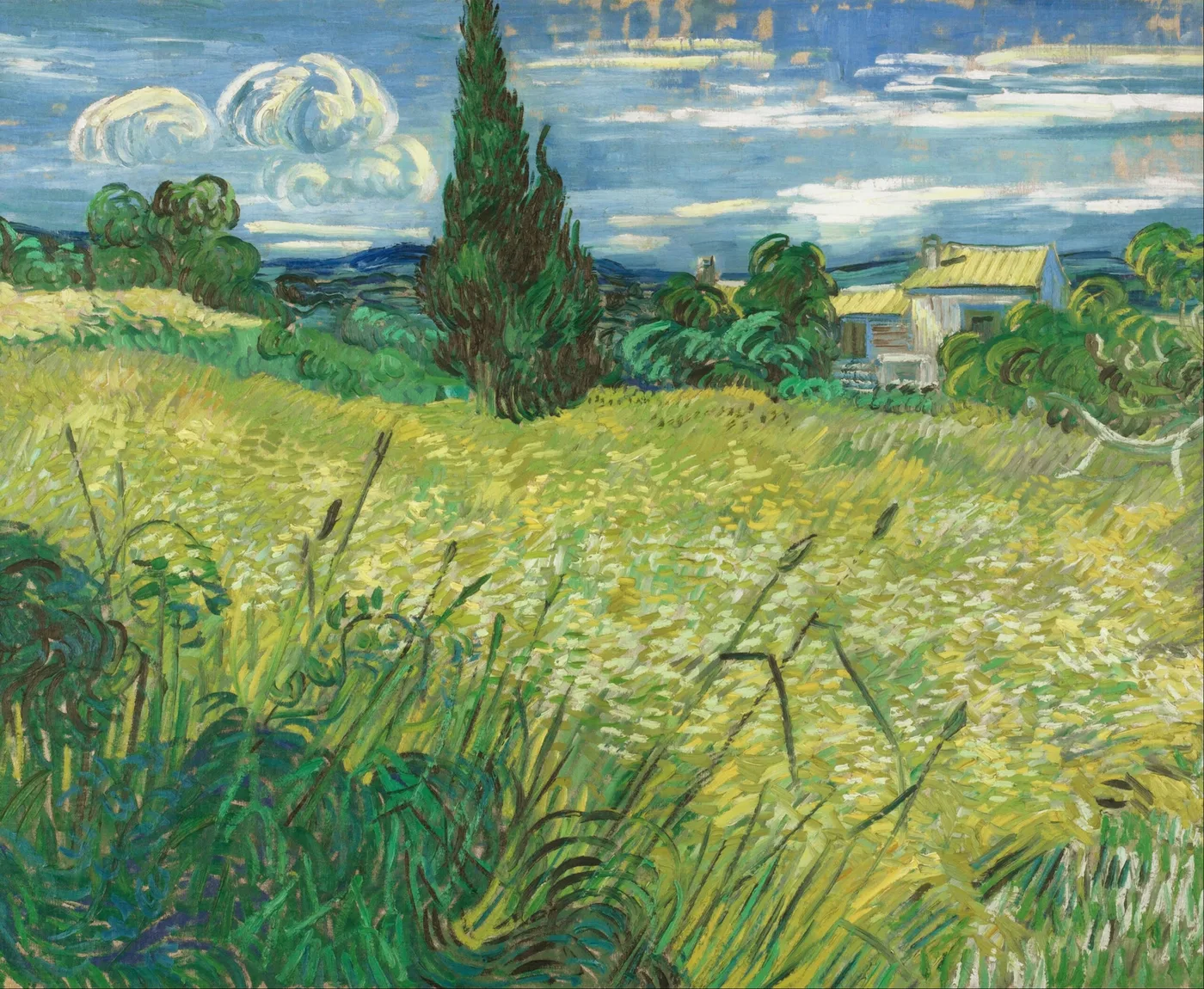
Green Wheat Field with Cypress, painted in 1889 and now known by that original title, belongs to this stretch of closely watched but intensely productive months. Van Gogh worked fast in the open air that summer, returning again and again to the same slope of wheat below the asylum, the same line of hills, the same dark cypress standing over the crop.
He was, by his own account in letters to his brother Theo, painting to hold himself together as much as to make pictures. The wheat field, cut into and regrown, becomes in these canvases a kind of clock for his own recovery, measured in the colour of the crop rather than in months.
Wheat, a Farmhouse Roof and a Rolling Sky
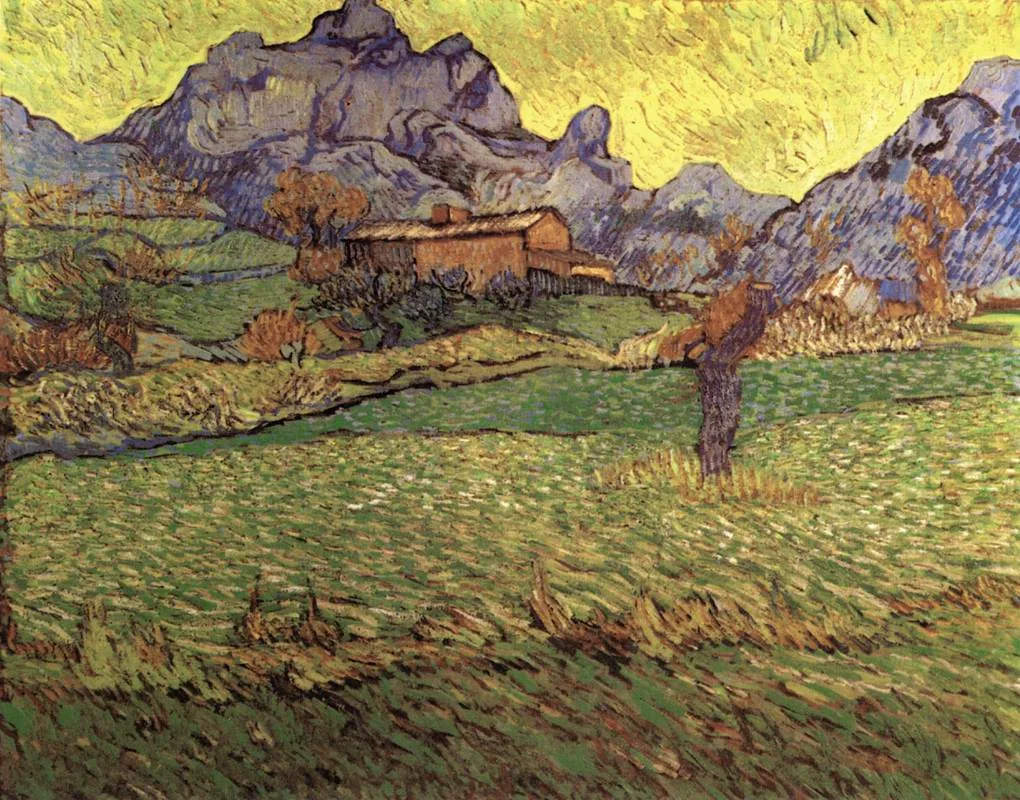
The canvas, 92.5 by 73.5 centimetres, is built in three bands. A wide field of young wheat fills the lower two thirds, still green rather than gold, its stalks and grass blades picked out one by one in short, upright strokes that thicken into dark, weed-like leaves at the bottom left corner.
Behind the field a low farmhouse sits just off centre to the right, its roof a pale yellow-green, a chimney breaking the roofline, half hidden by a cluster of rounder, softer trees. Further trees and a low ridge of hills run along the horizon in blues and violets, closing the middle distance without ever flattening it.
To the left of the farmhouse the cypress rises through the whole height of the canvas, dark and irregular against a sky that is doing most of the work of the picture. Large, rolling clouds, white with grey-blue shadow, are set down in broad curling strokes against a mid-blue ground streaked with warmer, ochre-tinted passages.
Nothing in the painting sits still. The eye lands first on the cypress, because it is the one vertical in a canvas built otherwise on horizontals and diagonals, then is pulled sideways along the field and up into the turning sky.
The Tree Van Gogh Wanted to Own
Cypresses had become something close to an obsession for Van Gogh that summer. In a letter to Theo he called the tree as beautiful of line and proportion as an Egyptian obelisk, and set out to do with it what he had already done with the sunflower, to make it a subject nobody before him had painted in quite this way.
He described the cypress elsewhere as a splash of black in a sunlit landscape, and it is that role it plays here, a single dark, upward form set against the palest, brightest elements in the picture, the clouds and the young wheat.
Paired with a field still green rather than ripe, the tree reads less as a note of gloom than as a counterweight, the one fixed, rooted thing in a scene where everything else, crop, cloud and light, is visibly moving.
Brushwork That Never Sits Still
Van Gogh built this landscape almost entirely out of the direction of his strokes. In the wheat they run low and close together, laid down at a slight diagonal so the whole field seems to lean, as if a wind has just passed through it.
In the cypress the same loaded brush turns vertical and slightly spiralling, stroke over stroke, so the tree seems to twist as it climbs rather than simply stand. In the sky the strokes curl and roll, describing the clouds as moving weather rather than fixed white shapes.
The paint itself is thick in places, laid on with visible ridges where the brush has been dragged and reloaded, and this texture catches real light differently depending on where a viewer stands, so the surface itself seems to shift as much as the scene it depicts.
The Painting Today
The original Green Wheat Field with Cypress is held by the National Gallery Prague, where it can be seen as one record of what Van Gogh made of a single view, returned to repeatedly, in a difficult and productive year.
On a wall at home the same qualities that make the canvas restless in the gallery make it responsive to the room around it. Morning light picks out the cool blues of the sky and hills, while warmer evening light draws out the ochre and gold buried in the wheat and in the clouds, so the painting never quite settles into one mood.
Sizes and materials for Green Wheat Field with Cypress are listed on its product page.
More from this collection
Bring this painting home
Choose a hand-painted oil reproduction for real brushwork, or an archival canvas print for a crisp museum-image edition. Every size preserves the original proportions.
View this work & options
Further reading
Verify the original in the National Gallery Prague collection record and continue through related works in the catalogue.